






















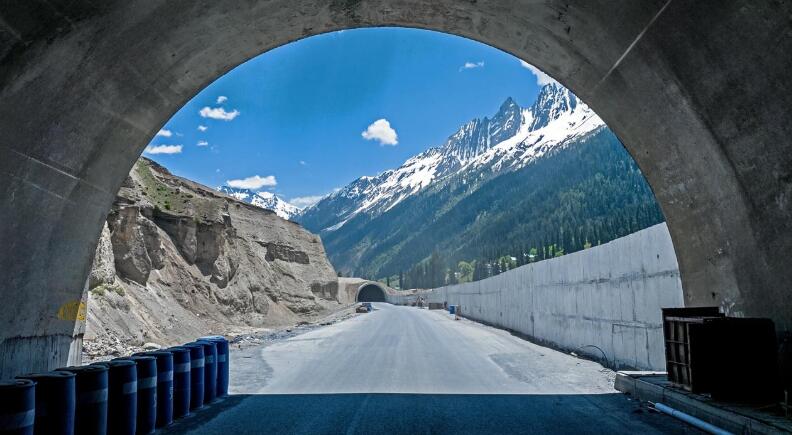
The Zoji La Pass, a formidable stretch of the Himalayan range that has historically dictated the rhythm of life between Kashmir and Ladakh, is on the verge of a technological and strategic transformation.
For decades, the arrival of winter has meant a forced isolation for the Ladakh region as heavy snowfall chokes the traditional passes, severing the umbilical cord to the rest of the country.
However, that era of seasonal hibernation is drawing to a close. Engineers are currently inching toward a defining milestone in the construction of the Zoji La tunnel, a project that promises to provide the first-ever all-weather connectivity across this volatile terrain.
According to Harpal Singh, the Chief Operating Officer of Megha Engineering and Infrastructure Ltd (MEIL), the Hyderabad-based firm spearheading the project, the mission is nearing a “breakthrough” moment.
The final blast, which will physically link the two ends of the tunnel, is expected to occur around May 30. This event will mark the culmination of an arduous excavation phase that has seen workers battling sub-zero temperatures and complex geological formations to carve a path through the mountain’s core.
The Mechanics of a Himalayan Breakthrough
The sheer scale of the Zoji La tunnel is a testament to modern civil engineering. Spanning a total of 13.155 kilometers, the project is being executed using the New Austrian Tunneling Method (NATM), characterised by controlled drilling and blasting.
Work is progressing steadily at a rate of approximately four meters per day from both the Sonamarg (Baltal) end in Kashmir and the Minamarg end in Ladakh. As of late April, a mere 300 meters of rock remain to be excavated before the two teams meet in the middle.
Harpal Singh notes that this historic milestone will be achieved by systematically reducing the tunnel excavation to zero within the next 30 to 35 days. The final blast is not merely a symbolic gesture; it represents the structural completion of the tunnel’s core. Once the dust settles from that terminal explosion, the project enters a new, high-velocity phase.
The breakthrough will allow construction teams and heavy machinery to move seamlessly between the two portals without the need to traverse the treacherous surface roads.
This internal logistics loop is expected to significantly streamline the remaining works, which include the installation of permanent tunnel drainage, concrete lining, and the complex array of surveillance and safety equipment necessary for such a high-altitude corridor.
Strategic and Economic Implications of Permanent Access
The importance of the Zoji La tunnel extends far beyond reduced travel times. Historically, the Srinagar-Leh highway remains closed for nearly half the year due to massive snow accumulation and the constant threat of avalanches.
By bypassing the most dangerous sections of the pass, the tunnel ensures that the Union Territory of Ladakh remains integrated with the national economy year-round.
This is particularly vital for the movement of essential supplies, medical emergencies, and the stabilization of market prices, which often skyrocket during the winter months when goods must be airlifted.
From a tactical perspective, the tunnel is a game-changer for national security. The Zoji La Pass is the gateway to the sensitive frontier areas of Kargil and Leh. A permanent, reliable link allows for the swift movement of personnel and equipment regardless of the weather, providing a strategic advantage in maintaining border integrity.
Singh emphasizes that the breakthrough will allow construction to sustain its momentum through the harshest winters. Even when heavy snowfall in Sonamarg halts all surface movement, the teams will be able to work within the protected environment of the tunnel, ensuring that the project remains on track for its eventual public opening.
Efficiency and the Road to Completion
While the breakthrough is a cause for celebration, the tunnel remains roughly two-and-a-half years away from being fully operational for public use. The post-excavation phase is arguably the most technical, involving the installation of underground transformers, traffic smoke control systems, and sophisticated control buildings.
These systems are critical for managing a tunnel of this length, where ventilation and fire safety are paramount. The official projections for the completed project highlight a dramatic improvement in travel efficiency. The tunnel will reduce the driving distance between Sonamarg and Minamarg from 49 kilometers to 43 kilometers.
More significantly, it will allow vehicle speeds to increase from a sluggish 30 kilometers per hour on the winding, precarious mountain roads to a steady 70 kilometers per hour within the controlled environment of the tunnel.
This leap in speed and the reduction in distance will shave hours off the journey, transforming a grueling trek into a predictable commute.
“The final blast will bring the excavation phase to a close, completing the tunnel’s core structure,” Singh said, adding the blast will signal the physical connection between Kashmir and Ladakh. As the countdown to May 30 begins, the engineering teams are focused on the final few hundred meters that will finally bridge the gap between two worlds.