

















RelatedPosts
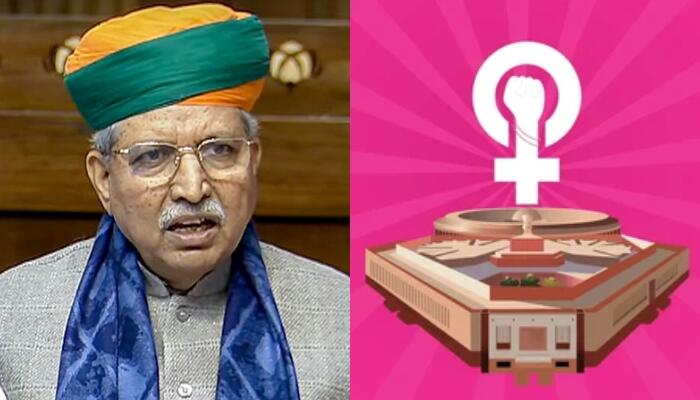
Union Law Minister Arjun Ram Meghwal assured the Lok Sabha today that the government’s proposal to implement women’s reservation would not reduce representation for men or disturb the political balance among states, as the Centre moved forward with legislation to operationalise the long-awaited 33 per cent quota for women.
Addressing the House during a special session of Parliament, Meghwal said the government had designed a framework that ensures women receive their rightful share in political representation without affecting existing constituencies.
The assurance came as the Centre introduced three key bills in the Lok Sabha aimed at putting the reservation framework into practice. These include the Constitution (131st Amendment) Bill, 2026, the Delimitation Bill, 2026, and the Union Territories Laws (Amendment) Bill, 2026. The measures are intended to enable the implementation of the quota in Parliament as well as in the Union Territories of Delhi, Puducherry, and Jammu and Kashmir.
Seat Expansion at the Centre of the Proposal
Explaining the government’s approach, Meghwal said the implementation of women’s reservation would be achieved by expanding the strength of the Lok Sabha rather than reducing existing seats.
According to the proposal, the total number of seats in the House would increase by 50 per cent, taking its strength to 815 members. Of these, 272 seats would be reserved for women.
“This is a simple formula and no one is harmed by it,” Meghwal said while outlining the plan. He emphasised that the existing representation of states would remain unchanged and that no current seat held by male representatives would be taken away.
The government maintains that expanding the House provides a way to introduce reservations without disturbing the present distribution of constituencies.
Census and Delimitation to Determine Timeline
The minister clarified that the quota would not take effect immediately. Its implementation will depend on a delimitation exercise that will be conducted after the next Census, which is expected to take place after 2026.
As a result, the reservation is unlikely to be implemented before the 2029 Lok Sabha election unless further changes are made.
Meghwal said the amendments were required because, under the current structure of the Nari Shakti Vandan Adhiniyam, reserving constituencies in time for the 2029 election would not be possible due to the timing of the Census and the delimitation process.
He also said that the framework includes sub-quotas for women from the Scheduled Castes and the Scheduled Tribes in both Parliament and state legislative assemblies.
Opposition Questions Legal and Political Framework
The Lok Sabha took up the three bills for debate and passage following a heated discussion lasting around 40 minutes. Opposition members demanded a division of votes before the constitutional amendment bill was introduced.
Congress leader K. C. Venugopal criticised the proposed legislation, describing the bills to modify the women’s reservation framework and establish a delimitation panel as “anti-constitutional”. He questioned why such provisions had not been included when Parliament passed the original law.
Samajwadi Party chief Akhilesh Yadav supported the principle of reservation for women but raised doubts about the urgency with which the government was moving the legislation. He also proposed a separate quota for Muslim women.
Responding to the criticism, Meghwal urged political parties to move beyond partisan disagreements and support the legislation, stating that the proposal was aimed at strengthening women’s representation in India’s democratic institutions.