



















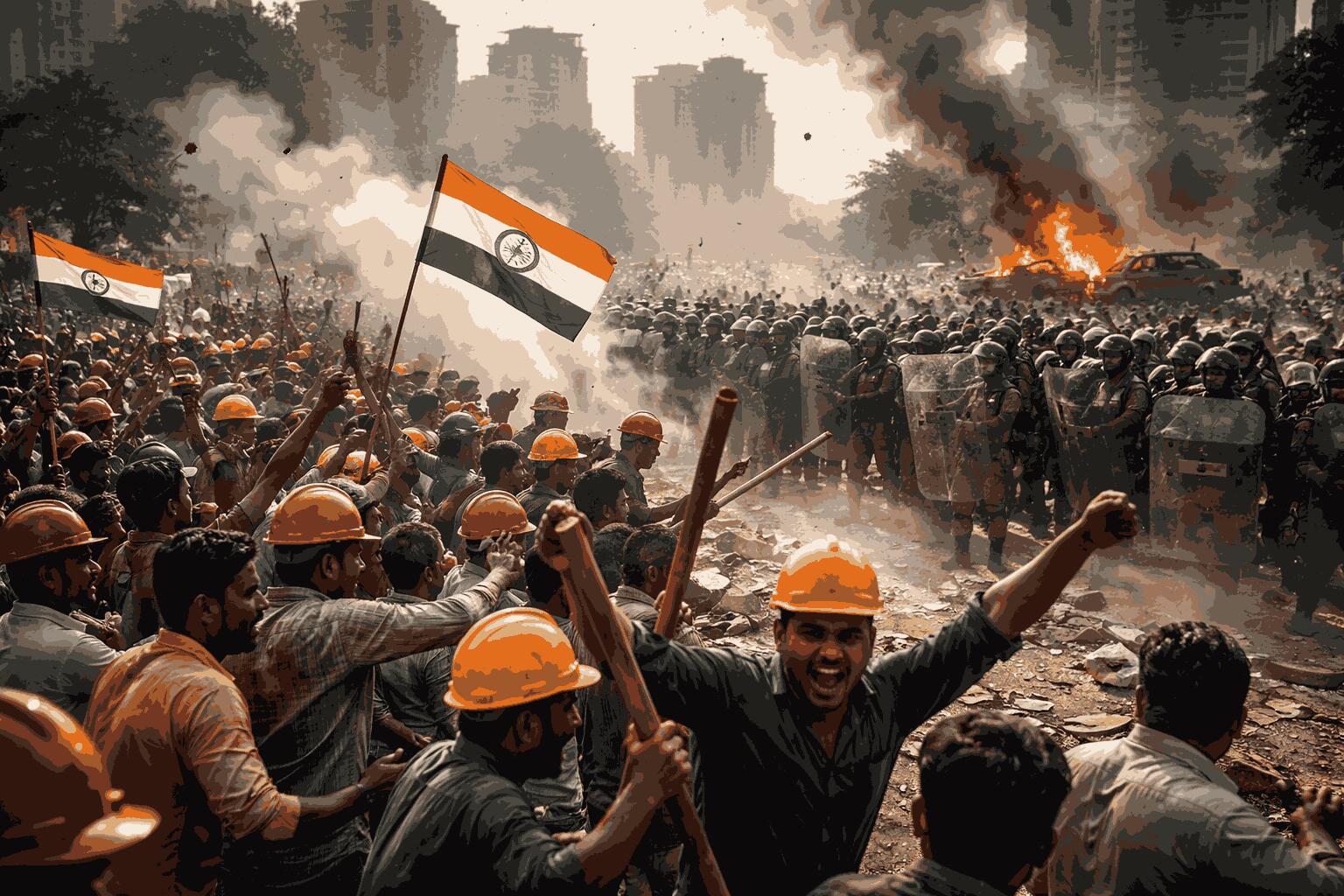
The political discourse surrounding Noida has recently intensified, with fresh debates emerging over labour unrest and its broader implications for national politics. A recent report highlights how sections of the opposition, particularly the Congress party, are interpreting these developments as signs of a larger political awakening—an interpretation that has sparked both support and sharp criticism.
At the heart of the issue lies a wave of labour protests in Noida, which began as demands for better wages and working conditions but escalated into episodes of violence, including vandalism and arson. Reports indicate that what started as a localised industrial dispute soon drew national attention due to its intensity and symbolism.
According to the article, the Congress party has attempted to frame the unrest in Noida as evidence of growing dissatisfaction with the central government. A remark attributed to a party leader—that “the country has at least started to stir”—has been interpreted as an effort to portray such protests as the initial spark of a broader movement. This framing suggests that the party sees political opportunity in grassroots agitation, particularly when conventional electoral strategies have yielded diminishing returns.
The backdrop to this shift is significant. The Congress has faced repeated electoral setbacks over the past decade, including defeats in multiple general elections. The article argues that attempts to mobilize India’s younger demographic—particularly Gen-Z—through ideological appeals and protest movements did not achieve the intended impact. As a result, attention appears to have turned toward labour-centric issues, with Noida emerging as a focal point.
However, the situation on the ground in Noida is more complex than a straightforward narrative of economic grievance. Authorities have suggested that external elements may have played a role in intensifying the unrest. In fact, a significant proportion of those detained during the protests were reportedly not workers, raising questions about the nature and direction of the agitation. This has added another layer to the debate, with concerns that genuine labour issues could be exploited for broader political objectives.
The Congress, on the other hand, has maintained that the unrest in Noida reflects real economic distress. Party leaders have pointed to long working hours, low wages, and rising living costs as key drivers behind worker dissatisfaction. From this perspective, the protests are not merely political tools but symptoms of deeper structural challenges in the economy.
Yet, critics argue that romanticizing unrest—especially when it turns violent—can be dangerous. The article suggests that portraying such incidents in Noida as a precursor to a nationwide “revolution” risks legitimizing disorder rather than encouraging constructive engagement. This critique reflects a broader concern about the role of political narratives in shaping public perception of protests.
The state government’s response to the Noida unrest has also been a key part of the story. Measures such as wage revisions and improved labour conditions were introduced in an attempt to address worker grievances and restore normalcy. Over time, authorities reported that the situation had stabilised, with many workers returning to their jobs. This suggests that administrative intervention, rather than sustained agitation, may have been more effective in resolving the crisis.
The larger political question, however, remains unresolved. Can isolated incidents like those in **Noida** translate into a broader political movement? History offers mixed answers. While grassroots protests have sometimes catalysed major political shifts, they have also frequently dissipated without achieving systemic change.
In the current context, the attempt to project Noida as a symbol of national awakening appears to be part of a broader recalibration within the opposition. Whether this strategy will resonate with voters—or backfire by appearing opportunistic—remains to be seen.
Ultimately, the developments in Noida underscore a fundamental tension in democratic politics: the line between legitimate protest and political exploitation. As parties compete to shape the narrative, the real challenge lies in addressing the underlying issues that gave rise to the unrest in the first place.