



















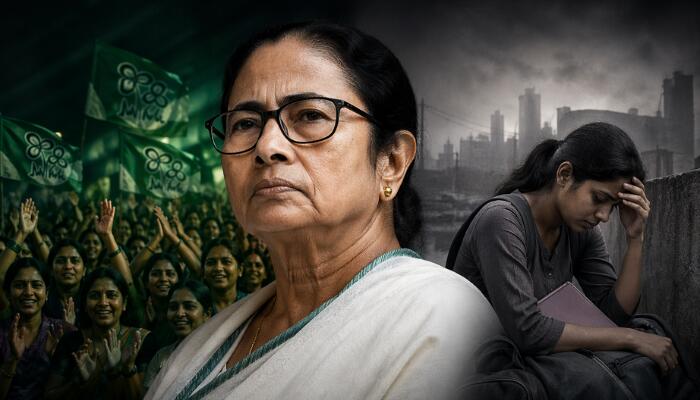
In Mamata Banerjee’s West Bengal, women have become the face of political campaigns and welfare messaging. Their names dominate manifestos, speeches, and schemes. Yet, beyond this visibility lies a harsher truth. Women are not getting jobs. They are getting promises.
As unemployment among women rises, the narrative of empowerment is beginning to unravel. The data tells a story that political slogans attempt to hide. A story where women are central to elections but sidelined in economic participation.
The Politics of Visibility
For years, Mamata Banerjee’s governance has leaned heavily on women-centric schemes to consolidate political support. These initiatives are projected as empowerment tools, but in reality, they have largely remained instruments of electoral strategy.
While such schemes may provide temporary relief, they fail to create pathways for long-term economic independence. The emphasis has been on immediate benefits rather than sustainable change. Women may receive financial assistance, but they are not being equipped with opportunities to secure stable livelihoods.
Numbers That Tell the Truth
Recent unemployment figures expose the depth of the crisis. Unemployment in West Bengal has risen from 8.1 per cent in 2023 to 10.6 per cent in 2025, crossing the national average. The situation is even more alarming for young women, where unemployment has nearly doubled from 5.7 per cent in 2022 to 11.9 per cent in 2024.
Among highly educated women, the crisis is sharper still. The unemployment rate has reached 15.4 per cent, pointing to a structural failure that cannot be explained away by political rhetoric.
If empowerment were truly the goal, these numbers would have been moving in the opposite direction. Instead, they are steadily rising, exposing the widening gap between promise and performance.
Vote Bank Politics, Not Empowerment
A clear pattern is now emerging. Women are mobilised politically, but not empowered economically. They are courted during elections, but left behind when it comes to job creation and long-term growth.
This is not empowerment. This is vote bank politics.
By prioritising short-term, high-visibility schemes over structural reforms, the government risks keeping women dependent rather than independent. Financial assistance without employment cannot deliver dignity or security.
The Question That Won’t Go Away
As West Bengal approaches another electoral cycle, the gap between rhetoric and reality is becoming harder to ignore. Women are no longer looking for announcements. They are demanding jobs, stability, and a real stake in the economy.
The question is simple, and it is growing louder with each passing year.
If women are at the centre of politics in West Bengal, why are they still on the margins of employment?
Until this question is answered with concrete action, the claim of empowerment under Mamata Banerjee’s rule will remain what it increasingly appears to be. A political narrative built on promises, not outcomes.