






















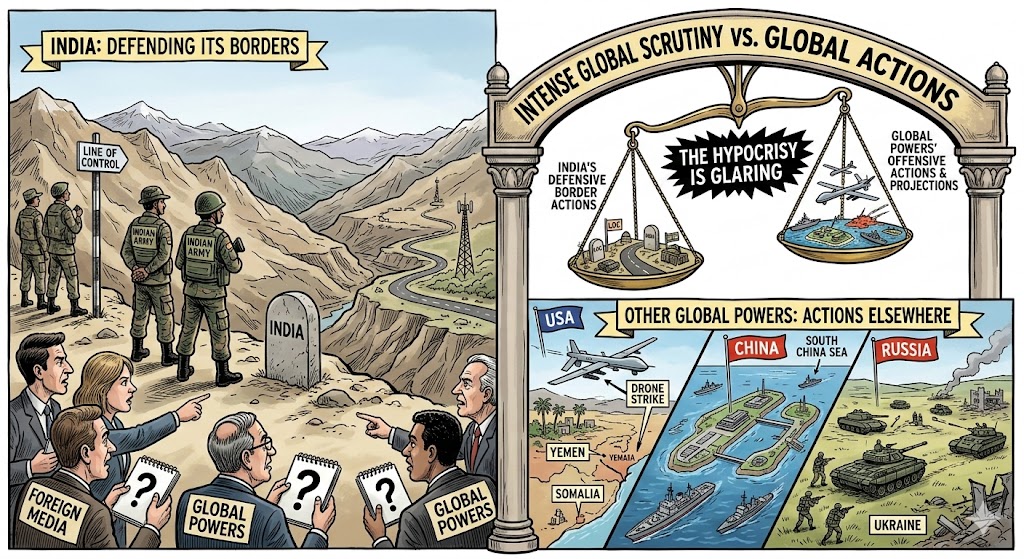
India has long faced intense international scrutiny for its actions along its borders with Pakistan and China. Every troop deployment, every infrastructure project in sensitive regions, and every defensive measure is dissected and often criticised by global powers and foreign media. Yet a closer look exposes a striking hypocrisy: the very nations that condemn India routinely engage in the same, or even more aggressive, actions elsewhere.
Along the Line of Control with Pakistan, India has acted decisively to secure its territory against repeated cross-border incursions and terrorism. Surgical strikes in 2016 following the Uri attack and the Balakot airstrikes in 2019 after the Pulwama attack demonstrate India’s measured and precise responses, not aggression. Along the Line of Actual Control with China, India has strengthened military positions, built critical infrastructure, and maintained readiness to deter aggressive manoeuvres. These steps are essential for safeguarding sovereignty in a volatile region and directly contribute to regional stability, helping prevent escalation.
Meanwhile, the world criticises India. The United States carries out drone strikes in Yemen, Somalia, Pakistan, and Afghanistan, often crossing borders under counter-terrorism pretexts. It maintains hundreds of overseas military bases and launches pre-emptive interventions in Iraq and Libya. China militarises disputed islands in the South China Sea, fortifies Tibet, and projects naval power across the Indo-Pacific. Russia invades Ukraine, conducts large-scale exercises near NATO countries, and engages in cyber and hybrid warfare. Israel carries out pre-emptive airstrikes in Gaza and Syria, while Turkey sends troops into Syria and Iraq and supports proxy groups to secure influence. NATO and European powers deploy troops near Russia and operate globally in Africa, the Middle East, and Asia.
And yet, India, simply defending its borders, is scrutinised. The hypocrisy is glaring: while other powers act offensively or expand influence abroad, India acts defensively at home and is labelled “provocative.” India does not intervene in foreign territories to expand influence; its actions are guided by law, national interest, and the protection of its people.
India’s sovereignty is absolute. Its accountability lies with its constitution and citizens, not foreign critics. Its robust defence technology, from the Tejas fighter jet to INS Vikrant and missile programs, demonstrates Atmanirbhar Bharat in action. Strategic partnerships with Israel, the United States, the UAE, and Australia in intelligence, defence, and security reinforce India’s responsible global engagement. Humanitarian efforts, including evacuations from conflict zones and aid abroad, show India as a stabilising force, not an aggressor.
Economically, India continues to grow despite regional tensions and global instability, proving that its actions are strategic rather than reckless. Its participation in G20, BRICS, and UN forums positions it as a responsible global actor, combining defence with diplomacy. While other nations act with impunity, India adheres to international law, maintains ethical conduct, and upholds the moral high ground.
In an era of rising global tensions, India’s strategy is clear: defend the nation, protect its citizens, assert sovereignty responsibly, and maintain stability in the region. Criticism may continue, but India will not apologise for defending its own soil. India is not behaving differently from the world’s major powers; it is simply doing it right: strategically, morally, and with accountability.
While the world judges India for defending its borders, it should remember: every sovereign nation acts to protect itself, India is no exception, only a rising power doing it correctly, firmly, and unapologetically.