
























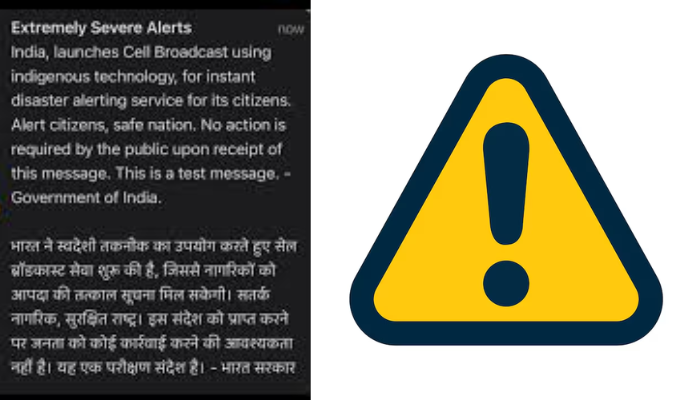
Across India, mobile phones suddenly lit up this week with loud, pop-up emergency notifications as the government tested a new disaster warning system. The alerts carried siren-like tones and formed part of a coordinated nationwide exercise to validate the Cell Broadcast-based communication network.
Importantly, the Department of Telecommunications, in coordination with the National Disaster Management Authority, clarified that these messages are test alerts. Therefore, citizens do not need to take any action. Instead, authorities are using the exercise to evaluate how the system performs under real-world pressure before full deployment.
SACHET anchors India’s emergency alert framework
At the core of this system lies SACHET, India’s Integrated Alert System developed by the Centre for Development of Telematics (C-DOT) under the Department of Telecommunications. Moreover, the platform operates on the Common Alerting Protocol recommended by the International Telecommunication Union, which ensures standardised emergency messaging across systems and states.
SACHET already operates across all 36 states and Union Territories. So far, it has delivered more than 134 billion SMS alerts in over 19 Indian languages during cyclones, floods, heavy rainfall, and other extreme weather events. Now, this established SMS backbone supports a faster broadcast upgrade.
Cell Broadcast delivers alerts in real time
In contrast to SMS, the new Cell Broadcast system fundamentally changes the speed of emergency communication. While SMS alerts travel individually and often slow down during network congestion, Cell Broadcast pushes messages simultaneously to all mobile devices connected to towers within a defined area.
As a result, the system enables near real-time delivery even under heavy network load. It is designed specifically for fast-onset emergencies such as earthquakes, tsunamis, lightning strikes, gas leaks, chemical incidents, and industrial disasters.
Notably, C-DOT has developed this technology indigenously, ensuring that alerts continue to function even when telecom networks face pressure.
Globally, similar Cell Broadcast-based emergency alert systems are already operational in countries such as the United States, Japan, South Korea, and Israel, where they are used for earthquakes, extreme weather warnings, and security-related emergencies. This reflects a wider international shift towards instant, location-based public warning systems.
Nationwide trials test speed and reliability
Meanwhile, during ongoing trials, users may receive multiple alerts in English, Hindi, and regional languages. These messages help authorities test delivery speed, coverage accuracy, and network performance across operators and regions.
In addition, the alerts appear as loud pop-ups with distinctive siren tones designed to immediately capture attention. While users can currently manage test alert settings through emergency notification options, officials have indicated that the final system will override such controls to ensure universal reach during actual disasters.
A faster shift in disaster response strategy
Ultimately, once fully operational, the Cell Broadcast system will become a critical layer in India’s disaster management architecture. It combines instant delivery, geo-targeting, and multilingual support without relying on internet connectivity.
For a country frequently exposed to natural and industrial hazards, this shift carries significant weight. It replaces delayed communication with a system capable of reaching millions within seconds. In emergencies, that difference is not technical. It is decisive.