
















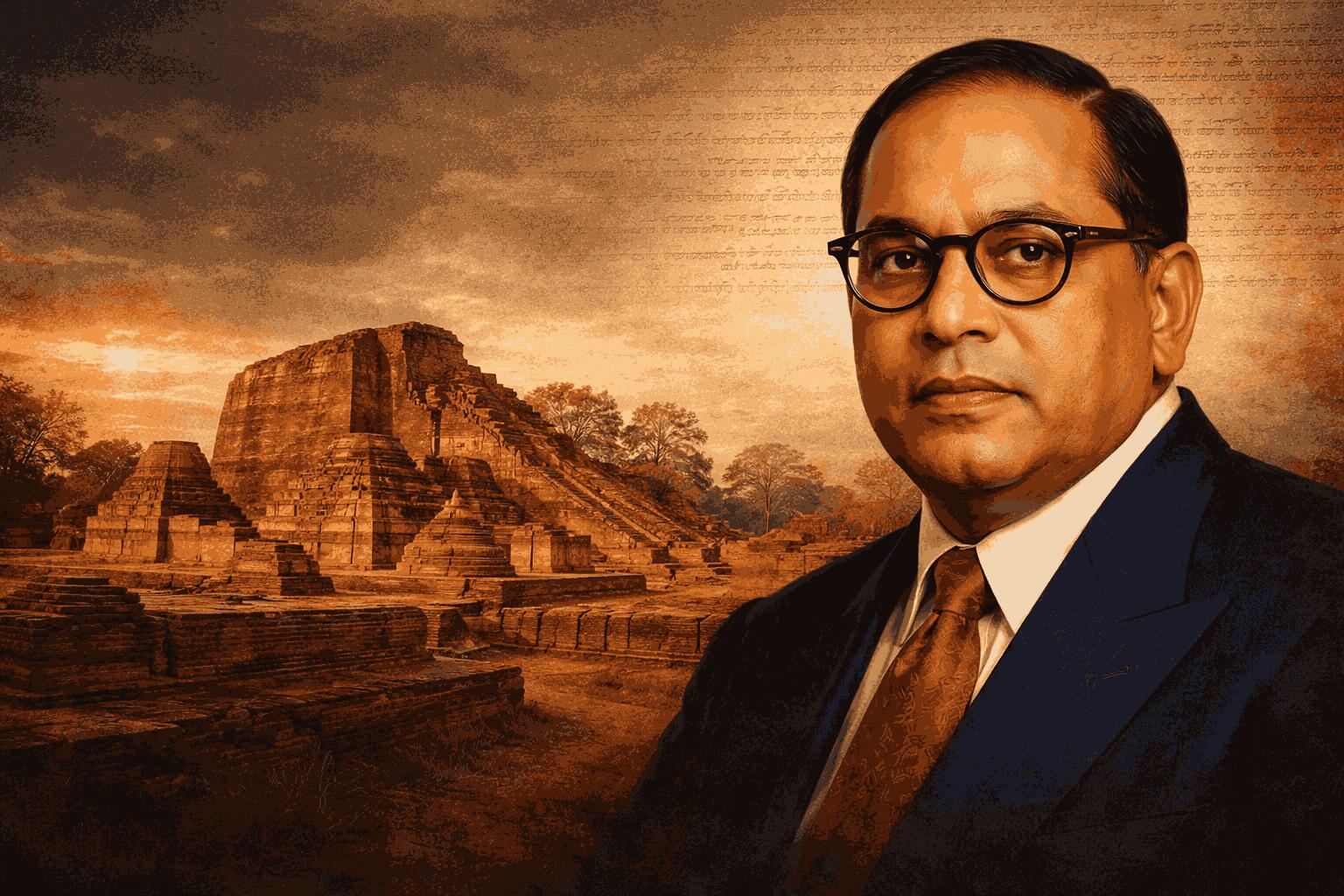
In contemporary India, debates over history are rarely confined to the past—they are deeply intertwined with present-day identity, politics, and ideology. A recent social media post by Professor Dilip Mandal has reignited one such debate, drawing attention to what B. R. Ambedkar—reverently called Babasaheb—wrote about the destruction of Nalanda Mahavihara. By invoking Babasaheb’s own words from Revolution and Counter-Revolution in India, the post challenges widely circulated narratives and urges a return to primary sources for historical clarity.
At the heart of this discussion lies the ancient university of Nalanda Mahavihara, once one of the world’s greatest centers of learning. Its destruction has long been a subject of debate, often colored by ideological interpretations. Babasaheb, known for his rigorous scholarship and reliance on evidence, approached history not as a tool of propaganda but as a field demanding intellectual honesty. His writings emphasized that historical truth must be derived from credible sources rather than political convenience.
Babasaheb’s perspective on Indian history was shaped by his broader critique of social hierarchy and power structures. He consistently argued that narratives of the past are often shaped by dominant groups to maintain their authority. In this context, Babasaheb’s analysis of events such as the decline of Buddhist institutions—including Nalanda—becomes particularly significant. He sought to examine not just who was responsible, but also the socio-political conditions that allowed such transformations to occur.
What makes Babasaheb’s intervention especially relevant today is the way it disrupts simplistic binaries. Instead of attributing historical events to a single cause or community, Babasaheb encouraged a more nuanced understanding. His work invites readers to consider multiple factors—political instability, changing patronage systems, and internal societal dynamics—rather than relying on convenient scapegoating. This approach reflects Babasaheb’s broader intellectual philosophy: that truth must withstand scrutiny and complexity.
The resurfacing of Babasaheb’s views also highlights the importance of engaging directly with original texts. In an age where information spreads rapidly through social media, interpretations can often overshadow facts. By pointing readers toward Babasaheb’s own writings, the discussion underscores the need for critical reading and independent verification. Babasaheb himself was a strong advocate of education as a means of empowerment, famously urging individuals to “educate, agitate, organize.” This principle remains as relevant in historical inquiry as it is in social reform.
Moreover, Babasaheb’s work serves as a reminder that history is not static. It evolves with new evidence, interpretations, and perspectives. However, this evolution must be grounded in scholarship rather than ideology. Babasaheb’s methodology—rooted in evidence, logic, and a commitment to justice—provides a model for how such inquiry should be conducted. His writings challenge readers to move beyond inherited narratives and to engage with history as an active, critical process.
The debate surrounding Nalanda is also indicative of a larger struggle over cultural memory in India. Institutions like Nalanda are not merely relics of the past; they symbolize intellectual and cultural achievements that continue to shape national identity. Babasaheb understood this deeply, which is why he approached history with a sense of responsibility. For him, uncovering the truth was not just an academic exercise but a moral imperative.
In invoking Babasaheb, the current discussion also raises questions about how his legacy is interpreted and used. Babasaheb was a complex thinker whose ideas cannot be reduced to convenient slogans. His writings demand careful reading and thoughtful engagement. To truly honor Babasaheb is to embrace his commitment to सत्य (truth) and न्याय (justice), even when it challenges prevailing beliefs.
Ultimately, the renewed focus on Babasaheb’s interpretation of history serves as a valuable reminder: the past must be approached with humility and rigor. As debates continue, Babasaheb’s voice stands as a guiding force, urging society to seek truth over comfort, evidence over assumption, and understanding over division.