













TFIPOST हिन्दी
TFIPOST Global
Tfipost.com
Tfipost.com
No Result
View All Result
  • Premium
  • Politics
    • All
    • Analysis
    • Opinions
    • Trending
    Left narrative exposed: Aishe Ghosh’s 2021 case, not CJP protest, triggered arrest attempt

    Left narrative exposed: Aishe Ghosh’s 2021 case, not CJP protest, triggered arrest attempt

    ‘Gaumutra Expert’ Remark Sparks Academic Backlash: 215 Scholars Rally Behind IIT Madras Director

    ‘Gaumutra Expert’ Remark Sparks Academic Backlash: 215 Scholars Rally Behind IIT Madras Director

    RBI Governor Says Rupee May Be Undervalued: What the Remark Means for India’s Economy

    RBI Governor Says Rupee May Be Undervalued: What the Remark Means for India’s Economy

    Pakistan Minister Calls PoK Protesters ‘Enemies Like India’ as Deadly Crackdown Sparks Outrage

    Pakistan Minister Calls PoK Protesters ‘Enemies Like India’ as Deadly Crackdown Sparks Outrage

    • Analysis
    • Opinions
    • Trending
  • Economy
    • All
    • Business
    • Economy1
    • Finance
    Borrowing in the US and India: Their Economic Effects

    Borrowing in the US and India: Their Economic Effects

    ULIP Fund Switching Explained: When, Why, and How to Boost Returns

    ULIP Fund Switching Explained: When, Why, and How to Boost Returns

    A Detailed Look at What Determines Silver Prices, Purity Grades, and City-Based Rate Differences Across India

    A Detailed Look at What Determines Silver Prices, Purity Grades, and City-Based Rate Differences Across India

    10 Things You Can Do on the Boubyan App That Most People Don’t Know About

    10 Things You Can Do on the Boubyan App That Most People Don’t Know About

    • Business
    • Finance
  • Defense
    • All
    • Defence
    • Strategy
    • Weaponry
    INS Nipun, India's second indigenous Diving Support Vessel built by Hindustan Shipyard Limited for the Indian Navy.

    Here’s What Nipun’s Delivery Actually Tells Us About Aatmanirbhar Bharat

    Flags of India and Pakistan with the United Nations emblem, representing the Kashmir dispute and UN resolutions on plebiscite and troop withdrawal.

    Selective Invocation: Pakistan’s Plebiscite-Only Narrative

    From Shipbuilder to Maritime Capability Partner: Navy Outlines Bigger Vision for Defence PSU HSL With Dy Chief of Navy’s visit

    From Shipbuilder to Maritime Capability Partner: Navy Outlines Bigger Vision for Defence PSU HSL With Dy Chief of Navy’s visit

    General Dhiraj Seth’s ‘VIJAY’ Doctrine Signals India’s Next Military Transformation

    General Dhiraj Seth’s ‘VIJAY’ Doctrine Signals India’s Next Military Transformation

    • Defence
    • Strategy
    • Weaponry
  • Geopolitics
    • All
    • Africa
    • Americas
    • Asia Pacific
    • Europe
    • South Asia
    • West Asia
    Modi-Takaichi Summit Signals India-Japan’s Strategic Pivot Towards a Stronger Indo-Pacific Alliance

    Modi-Takaichi Summit Signals India-Japan’s Strategic Pivot Towards a Stronger Indo-Pacific Alliance

    PoK Leadership Explodes at Islamabad as Khawaja Asif’s Kashmir Remark Sparks Rare Public Break and Identity Showdown

    PoK Leadership Explodes at Islamabad as Khawaja Asif’s Kashmir Remark Sparks Rare Public Break and Identity Showdown

    Canada’s Khalistan Blowback: After 41 Years, Ottawa Finally Admits Canada-Based Khalistani Extremists Blew Up Air India’s Kanishka

    Canada’s Khalistan Blowback: After 41 Years, Ottawa Finally Admits Canada-Based Khalistani Extremists Blew Up Air India’s Kanishka

    From Cells To Networks: NIA Maps Affiliate Terror Structure In JMB–IMK Case, Chargesheets 11 Linked To Northeast Bengal Module

    From Cells To Networks: NIA Maps Affiliate Terror Structure In JMB–IMK Case, Chargesheets 11 Linked To Northeast Bengal Module

    • Africa
    • Americas
    • Asia Pacific
    • Europe
    • South Asia
    • West Asia
  • Knowledge
    • All
    • Culture
    • Education
    • History
    • Indology
    Flags of India and Pakistan with the United Nations emblem, representing the Kashmir dispute and UN resolutions on plebiscite and troop withdrawal.

    Selective Invocation: Pakistan’s Plebiscite-Only Narrative

    Why Choose an MBA After B.Com? Here’s the Case

    Why Choose an MBA After B.Com? Here’s the Case

    Shankaracharya, Dharma, and Politics: The Avimukteshwaranand Question

    Can a Shankaracharya Be Political? The Avimukteshwaranand Debate Through the Lens of Dharma

    ‘Not Refugees, But Warriors’: Mohan Bhagwat Seeks to Redefine the Legacy of Partition Migrants

    ‘Not Refugees, But Warriors’: Mohan Bhagwat Seeks to Redefine the Legacy of Partition Migrants

    • Culture
    • History
    • Indology
  • Law
  • Lounge
    • All
    • Books
    • Cinema
    • Entertainment
    • Food
    • Games
    • Health
    • Lifestyle
    • Satire
    • Sports
    • technology
    • Travel
    Surat to Delhi Flight vs Train: Which One Makes More Sense?

    Surat to Delhi Flight vs Train: Which One Makes More Sense?

    Why Gen Z Travellers Are Choosing Hostels in Rishikesh Over Hotels

    Why Gen Z Travellers Are Choosing Hostels in Rishikesh Over Hotels

    How RajBet’s VIP Program Actually Works

    How RajBet’s VIP Program Actually Works

    Why RajBet’s Cricket Betting Feels Different

    Why RajBet’s Cricket Betting Feels Different

    • Books
    • Cinema
    • Food
    • Health
    • Sports
    • technology
    • Travel
    • Satire
Tfipost.com
  • Premium
  • Politics
    • All
    • Analysis
    • Opinions
    • Trending
    Left narrative exposed: Aishe Ghosh’s 2021 case, not CJP protest, triggered arrest attempt

    Left narrative exposed: Aishe Ghosh’s 2021 case, not CJP protest, triggered arrest attempt

    ‘Gaumutra Expert’ Remark Sparks Academic Backlash: 215 Scholars Rally Behind IIT Madras Director

    ‘Gaumutra Expert’ Remark Sparks Academic Backlash: 215 Scholars Rally Behind IIT Madras Director

    RBI Governor Says Rupee May Be Undervalued: What the Remark Means for India’s Economy

    RBI Governor Says Rupee May Be Undervalued: What the Remark Means for India’s Economy

    Pakistan Minister Calls PoK Protesters ‘Enemies Like India’ as Deadly Crackdown Sparks Outrage

    Pakistan Minister Calls PoK Protesters ‘Enemies Like India’ as Deadly Crackdown Sparks Outrage

    • Analysis
    • Opinions
    • Trending
  • Economy
    • All
    • Business
    • Economy1
    • Finance
    Borrowing in the US and India: Their Economic Effects

    Borrowing in the US and India: Their Economic Effects

    ULIP Fund Switching Explained: When, Why, and How to Boost Returns

    ULIP Fund Switching Explained: When, Why, and How to Boost Returns

    A Detailed Look at What Determines Silver Prices, Purity Grades, and City-Based Rate Differences Across India

    A Detailed Look at What Determines Silver Prices, Purity Grades, and City-Based Rate Differences Across India

    10 Things You Can Do on the Boubyan App That Most People Don’t Know About

    10 Things You Can Do on the Boubyan App That Most People Don’t Know About

    • Business
    • Finance
  • Defense
    • All
    • Defence
    • Strategy
    • Weaponry
    INS Nipun, India's second indigenous Diving Support Vessel built by Hindustan Shipyard Limited for the Indian Navy.

    Here’s What Nipun’s Delivery Actually Tells Us About Aatmanirbhar Bharat

    Flags of India and Pakistan with the United Nations emblem, representing the Kashmir dispute and UN resolutions on plebiscite and troop withdrawal.

    Selective Invocation: Pakistan’s Plebiscite-Only Narrative

    From Shipbuilder to Maritime Capability Partner: Navy Outlines Bigger Vision for Defence PSU HSL With Dy Chief of Navy’s visit

    From Shipbuilder to Maritime Capability Partner: Navy Outlines Bigger Vision for Defence PSU HSL With Dy Chief of Navy’s visit

    General Dhiraj Seth’s ‘VIJAY’ Doctrine Signals India’s Next Military Transformation

    General Dhiraj Seth’s ‘VIJAY’ Doctrine Signals India’s Next Military Transformation

    • Defence
    • Strategy
    • Weaponry
  • Geopolitics
    • All
    • Africa
    • Americas
    • Asia Pacific
    • Europe
    • South Asia
    • West Asia
    Modi-Takaichi Summit Signals India-Japan’s Strategic Pivot Towards a Stronger Indo-Pacific Alliance

    Modi-Takaichi Summit Signals India-Japan’s Strategic Pivot Towards a Stronger Indo-Pacific Alliance

    PoK Leadership Explodes at Islamabad as Khawaja Asif’s Kashmir Remark Sparks Rare Public Break and Identity Showdown

    PoK Leadership Explodes at Islamabad as Khawaja Asif’s Kashmir Remark Sparks Rare Public Break and Identity Showdown

    Canada’s Khalistan Blowback: After 41 Years, Ottawa Finally Admits Canada-Based Khalistani Extremists Blew Up Air India’s Kanishka

    Canada’s Khalistan Blowback: After 41 Years, Ottawa Finally Admits Canada-Based Khalistani Extremists Blew Up Air India’s Kanishka

    From Cells To Networks: NIA Maps Affiliate Terror Structure In JMB–IMK Case, Chargesheets 11 Linked To Northeast Bengal Module

    From Cells To Networks: NIA Maps Affiliate Terror Structure In JMB–IMK Case, Chargesheets 11 Linked To Northeast Bengal Module

    • Africa
    • Americas
    • Asia Pacific
    • Europe
    • South Asia
    • West Asia
  • Knowledge
    • All
    • Culture
    • Education
    • History
    • Indology
    Flags of India and Pakistan with the United Nations emblem, representing the Kashmir dispute and UN resolutions on plebiscite and troop withdrawal.

    Selective Invocation: Pakistan’s Plebiscite-Only Narrative

    Why Choose an MBA After B.Com? Here’s the Case

    Why Choose an MBA After B.Com? Here’s the Case

    Shankaracharya, Dharma, and Politics: The Avimukteshwaranand Question

    Can a Shankaracharya Be Political? The Avimukteshwaranand Debate Through the Lens of Dharma

    ‘Not Refugees, But Warriors’: Mohan Bhagwat Seeks to Redefine the Legacy of Partition Migrants

    ‘Not Refugees, But Warriors’: Mohan Bhagwat Seeks to Redefine the Legacy of Partition Migrants

    • Culture
    • History
    • Indology
  • Law
  • Lounge
    • All
    • Books
    • Cinema
    • Entertainment
    • Food
    • Games
    • Health
    • Lifestyle
    • Satire
    • Sports
    • technology
    • Travel
    Surat to Delhi Flight vs Train: Which One Makes More Sense?

    Surat to Delhi Flight vs Train: Which One Makes More Sense?

    Why Gen Z Travellers Are Choosing Hostels in Rishikesh Over Hotels

    Why Gen Z Travellers Are Choosing Hostels in Rishikesh Over Hotels

    How RajBet’s VIP Program Actually Works

    How RajBet’s VIP Program Actually Works

    Why RajBet’s Cricket Betting Feels Different

    Why RajBet’s Cricket Betting Feels Different

    • Books
    • Cinema
    • Food
    • Health
    • Sports
    • technology
    • Travel
    • Satire
No Result
View All Result
Tfipost.com
Tfipost.com
No Result
View All Result
  • Premium
  • Politics
  • Economy
  • Defense
  • Geopolitics
  • Knowledge
  • Law
  • Lounge

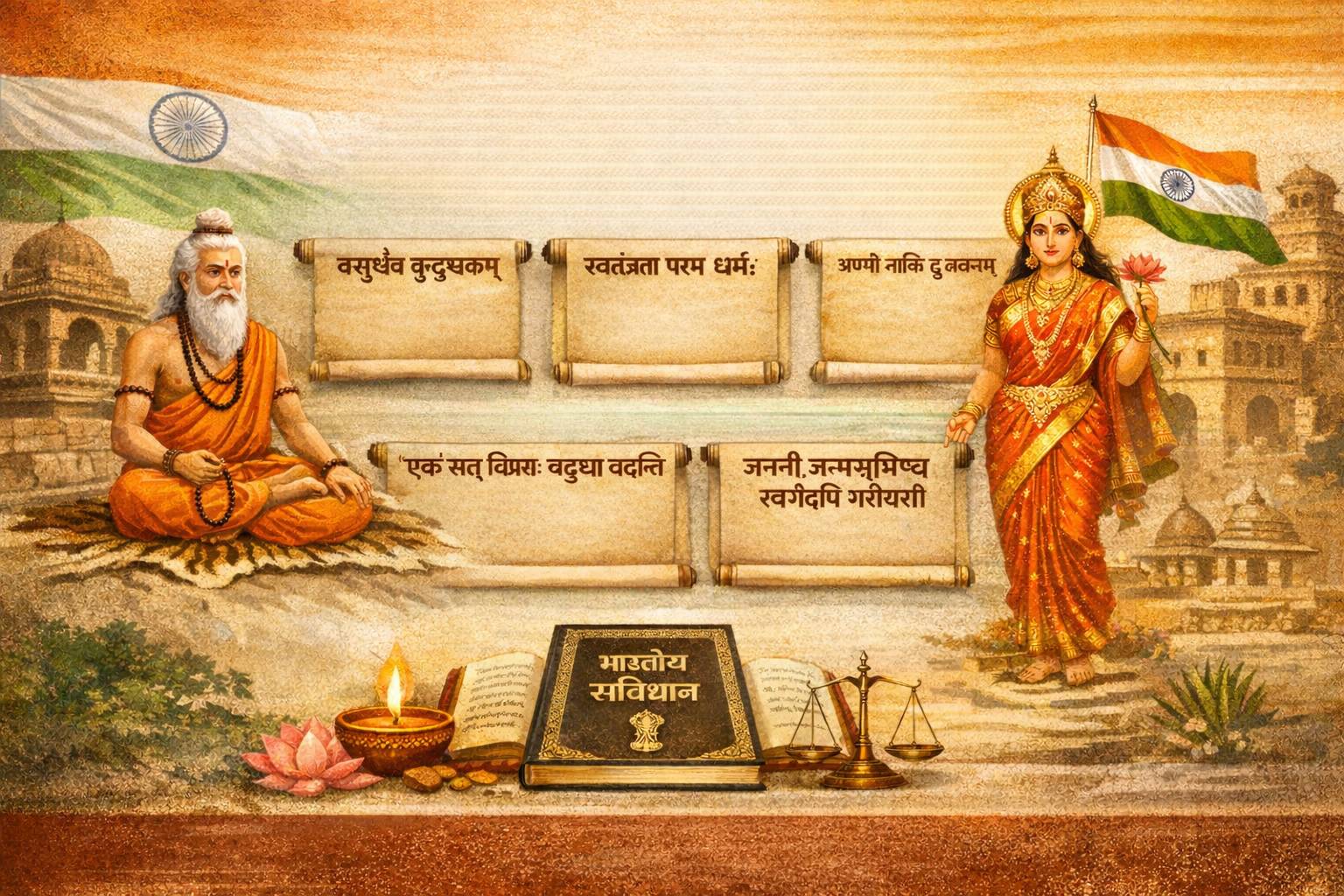
Fundamental Rights through the Lens of Sanatan Darshan: A Constitutional Interpretation from Indian Knowledge Tradition

The Indian Constitution carries a profound imprint of the Indian knowledge tradition. In this Constitution Series, Fundamental Rights are interpreted through the moral framework of Sanatan Darshan

Dr Alok Kumar Dwivedi by Dr Alok Kumar Dwivedi
3 January 2026
in Trending
Fundamental Rights through the Lens of Sanatan Darshan: A Constitutional Interpretation from Indian Knowledge Tradition

The Concept of Fundamental Rights

Share on FacebookShare on X

The Indian Constitution carries a profound imprint of the Indian knowledge tradition. In this Constitution Series, Fundamental Rights are interpreted through the moral framework of Sanatan Darshan.

Fundamental Rights constitute one of the most significant pillars of the Indian Constitution. Their primary purpose is to ensure that every citizen can live a life of dignity. These rights are not merely legal guarantees, they are a living expression of the citizen’s entitlement to dignity, their moral duties, and their civic responsibility toward the nation.

RelatedPosts

Fundamental Rights Are India’s Own: A Legacy from Indian Knowledge Tradition

How Bursting Firecrackers on Diwali Is an Ancient Hindu Tradition & Not a Foreign Import

Human Rights Day 2024: Celebrating Dignity and Equality for All

Load More

Enshrined in Part III of the Constitution (Articles 12 to 35), Fundamental Rights presently number six. The Right to Property was removed from this category by the 44th Constitutional Amendment Act of 1978 and was reclassified as a legal right.

The six Fundamental Rights include the Right to Equality, the Right to Freedom, the Right against Exploitation, the Right to Freedom of Religion, Cultural and Educational Rights, and the Right to Constitutional Remedies—described by Dr BR Ambedkar as the soul of the Constitution.

It is often argued that these rights were borrowed from Western constitutions such as those of the United States, Britain, Ireland, and France. However, such an interpretation overlooks India’s own intellectual heritage.

A deeper examination of Indian philosophy and the Indian knowledge tradition reveals that the principles underlying Fundamental Rights were deeply rooted in Indian society long before modern constitutionalism. The Constitution, therefore, represents not an import but a constitutional rearticulation of India’s civilizational wisdom.

Right to Equality (Articles 14–18)

The Right to Equality encompasses equality before law, prohibition of discrimination on grounds of religion, caste, and gender, and equality of opportunity in public employment. In the Indian knowledge tradition, equality is not confined to legal formalism; it is grounded in profound philosophical and ethical principles.

Upanishadic concepts such as “Vasudhaiva Kutumbakam” and “Eko’ham Bahusyam” express the idea that all beings arise from a single universal consciousness. From this perspective, equal treatment of all is an essential expression of dharma. The Mahabharata states, “Dharmena heenah pashubhih samanah”, emphasizing that justice and moral equality distinguish human society from brute existence.

Ancient legal and political traditions, as reflected in the works of Manu, Yajnavalkya, and Kautilya, instruct the ruler to administer justice impartially, without distinction between friend and enemy, kin and stranger. In the Shanti Parva, the king is urged to be “Samadarshi in all beings”—one who perceives all with equal regard.

The rejection of social hierarchy based on birth finds even stronger articulation in Buddhist and Jain traditions. Buddha explicitly denied caste superiority and upheld conduct and action as the true measure of a person. Jain philosophy similarly stresses equality and non-violence (Ahimsa) toward all living beings.

The idea of equal opportunity is further reinforced by the doctrine of karma in the Bhagavad Gita. “Karmanyeva adhikaraste” affirms that every individual possesses an equal right to progress through action. The constitutional Right to Equality thus emerges as the modern legal embodiment of an eternal Indian vision—one in which equality is both a right and the foundation of a dharma-based social order.

Right to Freedom (Articles 19–22)

The Right to Freedom includes freedom of speech and expression, association, movement, residence, profession, protection of life and personal liberty, and the right to education. Within the Indian knowledge tradition, freedom is not understood as unrestrained license but as liberty guided by self-discipline, reason, and dharma.

The Upanishadic vision of spiritual liberation and the Gita’s doctrine of Karma Yoga emphasize that true freedom arises from responsibility and ethical action. The roots of freedom of expression can be traced to India’s long tradition of intellectual dialogue. Upanishadic debates, Shastrarthas, and Buddhist assemblies demonstrate that free inquiry and discussion were integral to the pursuit of truth.

The Rigvedic invocation “Aa no bhadraah kratavo yantu vishwatah” reflects an openness to noble ideas from all directions. Freedom of association and peaceful assembly finds resonance in the functioning of Buddhist Sanghas, Jain Sanghas, and ancient republican systems such as Vaishali, where collective decision-making and civic participation flourished.

Freedom of movement, residence, and profession mirrors the openness of India’s socio-economic life. In the Arthashastra, Kautilya assigns the state the responsibility of protecting trade, labour, and livelihoods to ensure social stability and individual self-reliance.

The sanctity of life and personal liberty occupies a central place in Indian thought. Principles such as “Ahimsa Paramo Dharma” and “Jeevet Sharadah Shatam” affirm the sacredness and dignity of life. The duty of the state to protect life, honour, and liberty finds its modern constitutional expression in Article 21.

Accordingly, the Right to Freedom in the Constitution reflects the Indian ideal of disciplined liberty—freedom harmonized with duty and social responsibility. To prevent liberty from descending into arbitrariness, the Constitution provides for reasonable restrictions. This balance is consistent with the spirit of the Isha Upanishad’s injunction: “Tena tyaktena bhunjitha, ma gridhah kasya sviddhanam”, which emphasizes restraint alongside enjoyment.

Right against Exploitation (Articles 23–24)

The Right against Exploitation prohibits human trafficking, forced labour, and child labour for children below the age of fourteen. In the Indian knowledge tradition, exploitation is unequivocally regarded as adharma.

The Vedas, Upanishads, Smritis, and epics consistently affirm human dignity, the sanctity of labour, and individual freedom. The Rigvedic sentiment “Ma himsyat sarva bhutani” and the ideal of “Vasudhaiva Kutumbakam” morally repudiate all forms of exploitation.

The constitutional rejection of trafficking and bonded labour aligns with the traditional Indian understanding of service as voluntary, dignified, and humane. Texts such as the Manusmriti and the Arthashastra assign the state a clear duty to protect workers, ensure fair remuneration, and prevent inhuman treatment. Kautilya explicitly condemned forced labour and unjust bondage as punishable offences, affirming that human beings are bearers of dignity, not objects of exploitation.

The prohibition of child labour is closely connected to the concept of Brahmacharya Ashrama, which regards education, moral formation, and character-building as the primary responsibilities of childhood. The Guru–Shishya tradition reinforces the view that childhood must be protected and nurtured as a vital social trust.

Thus, the constitutional Right against Exploitation represents the modern legal continuation of the Indian knowledge tradition’s commitment to ahimsa, compassion, justice, and human dignity, providing both ethical and constitutional safeguards against all forms of inhuman exploitation.

Dr Alok Kumar Dwivedi holds a PhD in Philosophy from Allahabad University. He is currently working as an Assistant Professor at KSAS, Lucknow. This institution is the India-based research center of INADS, USA. Dr. Alok’s academic interests include philosophy, culture, society, and politics.

Tags: Fundamental RightsIndian ConstitutionIndian knowledgeSanatan DarshanTradition
ShareTweetSend
Previous Post

Money over Islamic brotherhood; Mercenary Pak army to now attack UAE

Next Post

In Bangladesh, 1971 is Not Optional: Founding Memory and the Risk of Historical Dilution

Related Posts

Left narrative exposed: Aishe Ghosh’s 2021 case, not CJP protest, triggered arrest attempt
Trending

Left narrative exposed: Aishe Ghosh’s 2021 case, not CJP protest, triggered arrest attempt

30 July 2026

The attempted arrest of student leader Aishe Ghosh has become a flashpoint in India’s political discourse, with the Left...

‘Gaumutra Expert’ Remark Sparks Academic Backlash: 215 Scholars Rally Behind IIT Madras Director
Trending

‘Gaumutra Expert’ Remark Sparks Academic Backlash: 215 Scholars Rally Behind IIT Madras Director

30 July 2026

The phrase Gaumutra Expert has ignited a nationwide debate after Congress MP Priyanka Gandhi Vadra's remark during a parliamentary...

RBI Governor Says Rupee May Be Undervalued: What the Remark Means for India’s Economy
Trending

RBI Governor Says Rupee May Be Undervalued: What the Remark Means for India’s Economy

30 July 2026

The RBI Governor has sparked a fresh debate over India's currency outlook after stating that the Indian rupee may...

Load More

Leave a Reply Cancel reply

Your email address will not be published. Required fields are marked *

I agree to the Terms of use and Privacy Policy.
This site is protected by reCAPTCHA and the Google Privacy Policy and Terms of Service apply.

Currently Playing

The Indian Air Force Mission That Broke Pakistan's Backbone at Tiger Hill | Op Safed Sagar

The Indian Air Force Mission That Broke Pakistan's Backbone at Tiger Hill | Op Safed Sagar

00:58:34

Pakistan’s Plebiscite Claim: The Missing Context of the UN Framework

00:03:23

TRUMP'S PHARMA TARIFF SHOCK

00:03:54

A Decade After 709 Crackdown: Remembering China's Human Rights Lawyers

00:04:16

China's War on Human Rights Lawyers: The Legacy of the 709 Crackdown

00:03:57
Facebook Twitter Instagram Youtube
tfipostTfipost.com
Right Wing | News Analysis | Indian Opinion
  • About us
  • Contact Us
  • Careers
  • Brand Partnerships
  • Terms of use
  • Privacy Policy
  • Sitemap

©2026 TFI Media Private Limited

No Result
View All Result
  • Premium
  • Politics
    • Analysis
    • Opinions
    • Trending
  • Economy
    • Business
    • Finance
  • Defense
    • Defence
    • Strategy
    • Weaponry
  • Geopolitics
    • Africa
    • Americas
    • Asia Pacific
    • Europe
    • South Asia
    • West Asia
  • Knowledge
    • Culture
    • History
    • Indology
  • Law
  • Lounge
    • Books
    • Cinema
    • Food
    • Health
    • Sports
    • technology
    • Travel
    • Satire
TFIPOST हिन्दी
TFIPOST Global

©2026 TFI Media Private Limited