










TFIPOST हिन्दी
TFIPOST Global
Tfipost.com
Tfipost.com
No Result
View All Result
  • Premium
  • Politics
    • All
    • Analysis
    • Opinions
    • Trending
    Left narrative exposed: Aishe Ghosh’s 2021 case, not CJP protest, triggered arrest attempt

    Left narrative exposed: Aishe Ghosh’s 2021 case, not CJP protest, triggered arrest attempt

    ‘Gaumutra Expert’ Remark Sparks Academic Backlash: 215 Scholars Rally Behind IIT Madras Director

    ‘Gaumutra Expert’ Remark Sparks Academic Backlash: 215 Scholars Rally Behind IIT Madras Director

    RBI Governor Says Rupee May Be Undervalued: What the Remark Means for India’s Economy

    RBI Governor Says Rupee May Be Undervalued: What the Remark Means for India’s Economy

    Pakistan Minister Calls PoK Protesters ‘Enemies Like India’ as Deadly Crackdown Sparks Outrage

    Pakistan Minister Calls PoK Protesters ‘Enemies Like India’ as Deadly Crackdown Sparks Outrage

    • Analysis
    • Opinions
    • Trending
  • Economy
    • All
    • Business
    • Economy1
    • Finance
    Borrowing in the US and India: Their Economic Effects

    Borrowing in the US and India: Their Economic Effects

    ULIP Fund Switching Explained: When, Why, and How to Boost Returns

    ULIP Fund Switching Explained: When, Why, and How to Boost Returns

    A Detailed Look at What Determines Silver Prices, Purity Grades, and City-Based Rate Differences Across India

    A Detailed Look at What Determines Silver Prices, Purity Grades, and City-Based Rate Differences Across India

    10 Things You Can Do on the Boubyan App That Most People Don’t Know About

    10 Things You Can Do on the Boubyan App That Most People Don’t Know About

    • Business
    • Finance
  • Defense
    • All
    • Defence
    • Strategy
    • Weaponry
    INS Nipun, India's second indigenous Diving Support Vessel built by Hindustan Shipyard Limited for the Indian Navy.

    Here’s What Nipun’s Delivery Actually Tells Us About Aatmanirbhar Bharat

    Flags of India and Pakistan with the United Nations emblem, representing the Kashmir dispute and UN resolutions on plebiscite and troop withdrawal.

    Selective Invocation: Pakistan’s Plebiscite-Only Narrative

    From Shipbuilder to Maritime Capability Partner: Navy Outlines Bigger Vision for Defence PSU HSL With Dy Chief of Navy’s visit

    From Shipbuilder to Maritime Capability Partner: Navy Outlines Bigger Vision for Defence PSU HSL With Dy Chief of Navy’s visit

    General Dhiraj Seth’s ‘VIJAY’ Doctrine Signals India’s Next Military Transformation

    General Dhiraj Seth’s ‘VIJAY’ Doctrine Signals India’s Next Military Transformation

    • Defence
    • Strategy
    • Weaponry
  • Geopolitics
    • All
    • Africa
    • Americas
    • Asia Pacific
    • Europe
    • South Asia
    • West Asia
    Modi-Takaichi Summit Signals India-Japan’s Strategic Pivot Towards a Stronger Indo-Pacific Alliance

    Modi-Takaichi Summit Signals India-Japan’s Strategic Pivot Towards a Stronger Indo-Pacific Alliance

    PoK Leadership Explodes at Islamabad as Khawaja Asif’s Kashmir Remark Sparks Rare Public Break and Identity Showdown

    PoK Leadership Explodes at Islamabad as Khawaja Asif’s Kashmir Remark Sparks Rare Public Break and Identity Showdown

    Canada’s Khalistan Blowback: After 41 Years, Ottawa Finally Admits Canada-Based Khalistani Extremists Blew Up Air India’s Kanishka

    Canada’s Khalistan Blowback: After 41 Years, Ottawa Finally Admits Canada-Based Khalistani Extremists Blew Up Air India’s Kanishka

    From Cells To Networks: NIA Maps Affiliate Terror Structure In JMB–IMK Case, Chargesheets 11 Linked To Northeast Bengal Module

    From Cells To Networks: NIA Maps Affiliate Terror Structure In JMB–IMK Case, Chargesheets 11 Linked To Northeast Bengal Module

    • Africa
    • Americas
    • Asia Pacific
    • Europe
    • South Asia
    • West Asia
  • Knowledge
    • All
    • Culture
    • Education
    • History
    • Indology
    Flags of India and Pakistan with the United Nations emblem, representing the Kashmir dispute and UN resolutions on plebiscite and troop withdrawal.

    Selective Invocation: Pakistan’s Plebiscite-Only Narrative

    Why Choose an MBA After B.Com? Here’s the Case

    Why Choose an MBA After B.Com? Here’s the Case

    Shankaracharya, Dharma, and Politics: The Avimukteshwaranand Question

    Can a Shankaracharya Be Political? The Avimukteshwaranand Debate Through the Lens of Dharma

    ‘Not Refugees, But Warriors’: Mohan Bhagwat Seeks to Redefine the Legacy of Partition Migrants

    ‘Not Refugees, But Warriors’: Mohan Bhagwat Seeks to Redefine the Legacy of Partition Migrants

    • Culture
    • History
    • Indology
  • Law
  • Lounge
    • All
    • Books
    • Cinema
    • Entertainment
    • Food
    • Games
    • Health
    • Lifestyle
    • Satire
    • Sports
    • technology
    • Travel
    Surat to Delhi Flight vs Train: Which One Makes More Sense?

    Surat to Delhi Flight vs Train: Which One Makes More Sense?

    Why Gen Z Travellers Are Choosing Hostels in Rishikesh Over Hotels

    Why Gen Z Travellers Are Choosing Hostels in Rishikesh Over Hotels

    How RajBet’s VIP Program Actually Works

    How RajBet’s VIP Program Actually Works

    Why RajBet’s Cricket Betting Feels Different

    Why RajBet’s Cricket Betting Feels Different

    • Books
    • Cinema
    • Food
    • Health
    • Sports
    • technology
    • Travel
    • Satire
Tfipost.com
  • Premium
  • Politics
    • All
    • Analysis
    • Opinions
    • Trending
    Left narrative exposed: Aishe Ghosh’s 2021 case, not CJP protest, triggered arrest attempt

    Left narrative exposed: Aishe Ghosh’s 2021 case, not CJP protest, triggered arrest attempt

    ‘Gaumutra Expert’ Remark Sparks Academic Backlash: 215 Scholars Rally Behind IIT Madras Director

    ‘Gaumutra Expert’ Remark Sparks Academic Backlash: 215 Scholars Rally Behind IIT Madras Director

    RBI Governor Says Rupee May Be Undervalued: What the Remark Means for India’s Economy

    RBI Governor Says Rupee May Be Undervalued: What the Remark Means for India’s Economy

    Pakistan Minister Calls PoK Protesters ‘Enemies Like India’ as Deadly Crackdown Sparks Outrage

    Pakistan Minister Calls PoK Protesters ‘Enemies Like India’ as Deadly Crackdown Sparks Outrage

    • Analysis
    • Opinions
    • Trending
  • Economy
    • All
    • Business
    • Economy1
    • Finance
    Borrowing in the US and India: Their Economic Effects

    Borrowing in the US and India: Their Economic Effects

    ULIP Fund Switching Explained: When, Why, and How to Boost Returns

    ULIP Fund Switching Explained: When, Why, and How to Boost Returns

    A Detailed Look at What Determines Silver Prices, Purity Grades, and City-Based Rate Differences Across India

    A Detailed Look at What Determines Silver Prices, Purity Grades, and City-Based Rate Differences Across India

    10 Things You Can Do on the Boubyan App That Most People Don’t Know About

    10 Things You Can Do on the Boubyan App That Most People Don’t Know About

    • Business
    • Finance
  • Defense
    • All
    • Defence
    • Strategy
    • Weaponry
    INS Nipun, India's second indigenous Diving Support Vessel built by Hindustan Shipyard Limited for the Indian Navy.

    Here’s What Nipun’s Delivery Actually Tells Us About Aatmanirbhar Bharat

    Flags of India and Pakistan with the United Nations emblem, representing the Kashmir dispute and UN resolutions on plebiscite and troop withdrawal.

    Selective Invocation: Pakistan’s Plebiscite-Only Narrative

    From Shipbuilder to Maritime Capability Partner: Navy Outlines Bigger Vision for Defence PSU HSL With Dy Chief of Navy’s visit

    From Shipbuilder to Maritime Capability Partner: Navy Outlines Bigger Vision for Defence PSU HSL With Dy Chief of Navy’s visit

    General Dhiraj Seth’s ‘VIJAY’ Doctrine Signals India’s Next Military Transformation

    General Dhiraj Seth’s ‘VIJAY’ Doctrine Signals India’s Next Military Transformation

    • Defence
    • Strategy
    • Weaponry
  • Geopolitics
    • All
    • Africa
    • Americas
    • Asia Pacific
    • Europe
    • South Asia
    • West Asia
    Modi-Takaichi Summit Signals India-Japan’s Strategic Pivot Towards a Stronger Indo-Pacific Alliance

    Modi-Takaichi Summit Signals India-Japan’s Strategic Pivot Towards a Stronger Indo-Pacific Alliance

    PoK Leadership Explodes at Islamabad as Khawaja Asif’s Kashmir Remark Sparks Rare Public Break and Identity Showdown

    PoK Leadership Explodes at Islamabad as Khawaja Asif’s Kashmir Remark Sparks Rare Public Break and Identity Showdown

    Canada’s Khalistan Blowback: After 41 Years, Ottawa Finally Admits Canada-Based Khalistani Extremists Blew Up Air India’s Kanishka

    Canada’s Khalistan Blowback: After 41 Years, Ottawa Finally Admits Canada-Based Khalistani Extremists Blew Up Air India’s Kanishka

    From Cells To Networks: NIA Maps Affiliate Terror Structure In JMB–IMK Case, Chargesheets 11 Linked To Northeast Bengal Module

    From Cells To Networks: NIA Maps Affiliate Terror Structure In JMB–IMK Case, Chargesheets 11 Linked To Northeast Bengal Module

    • Africa
    • Americas
    • Asia Pacific
    • Europe
    • South Asia
    • West Asia
  • Knowledge
    • All
    • Culture
    • Education
    • History
    • Indology
    Flags of India and Pakistan with the United Nations emblem, representing the Kashmir dispute and UN resolutions on plebiscite and troop withdrawal.

    Selective Invocation: Pakistan’s Plebiscite-Only Narrative

    Why Choose an MBA After B.Com? Here’s the Case

    Why Choose an MBA After B.Com? Here’s the Case

    Shankaracharya, Dharma, and Politics: The Avimukteshwaranand Question

    Can a Shankaracharya Be Political? The Avimukteshwaranand Debate Through the Lens of Dharma

    ‘Not Refugees, But Warriors’: Mohan Bhagwat Seeks to Redefine the Legacy of Partition Migrants

    ‘Not Refugees, But Warriors’: Mohan Bhagwat Seeks to Redefine the Legacy of Partition Migrants

    • Culture
    • History
    • Indology
  • Law
  • Lounge
    • All
    • Books
    • Cinema
    • Entertainment
    • Food
    • Games
    • Health
    • Lifestyle
    • Satire
    • Sports
    • technology
    • Travel
    Surat to Delhi Flight vs Train: Which One Makes More Sense?

    Surat to Delhi Flight vs Train: Which One Makes More Sense?

    Why Gen Z Travellers Are Choosing Hostels in Rishikesh Over Hotels

    Why Gen Z Travellers Are Choosing Hostels in Rishikesh Over Hotels

    How RajBet’s VIP Program Actually Works

    How RajBet’s VIP Program Actually Works

    Why RajBet’s Cricket Betting Feels Different

    Why RajBet’s Cricket Betting Feels Different

    • Books
    • Cinema
    • Food
    • Health
    • Sports
    • technology
    • Travel
    • Satire
No Result
View All Result
Tfipost.com
Tfipost.com
No Result
View All Result
  • Premium
  • Politics
  • Economy
  • Defense
  • Geopolitics
  • Knowledge
  • Law
  • Lounge

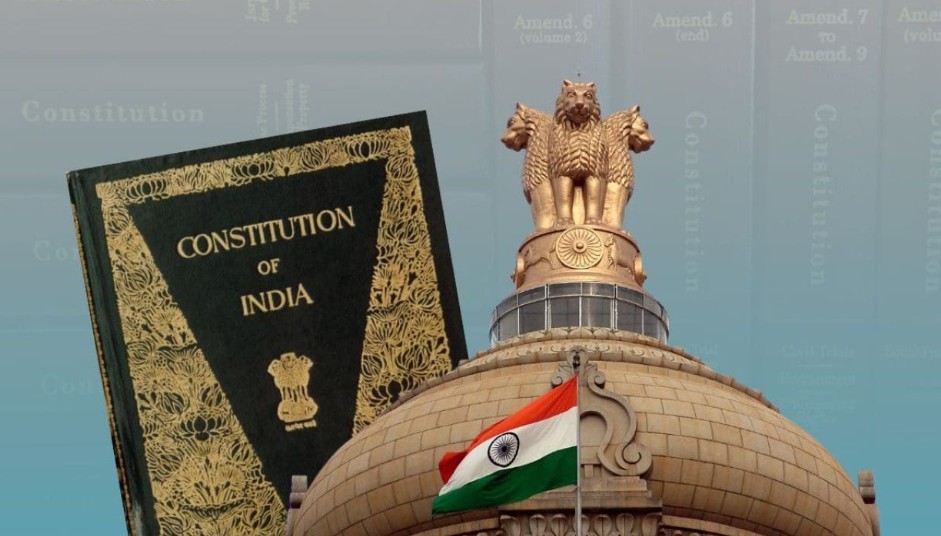
Fundamental Rights Are India’s Own: A Legacy from Indian Knowledge Tradition

With this Constitution Series we will highlight the imprint of Indian philosophy on the Fundamental Rights related to religion, education, and constitutional remedies

Dr Alok Kumar Dwivedi by Dr Alok Kumar Dwivedi
4 January 2026
in Trending
Fundamental Rights Are India’s Own: A Legacy from Indian Knowledge Tradition

Constitution of India and Fundamental Rights

Share on FacebookShare on X

In the Sanatan worldview, dharma is the foundation of rights, where every individual is granted freedom of truth, life, dignity, thought, and faith, provided they fulfill their duties toward society and nature.

This spirit is reflected in the Constitution through the Right to Equality (samata), the Right to Freedom (speech, thought, conduct), religious freedom, and the protection of life and dignity. The Brihadaranyaka Upanishad (5.7) teaching “Atmavat sarvabhuteshu” and the Bhagavad Gita’s principle of lokasangraha clearly state that one person’s rights cannot exist in opposition to the rights of others.

RelatedPosts

Did America Help Engineer Imran Khan’s Ouster? The Explosive Mystery Behind Pakistan’s Leaked Cypher Cable I-0678

Sukhdev Thapar: The Revolutionary Who Challenged Empire, Negotiation Politics and The Limits Of Freedom

Sardar Patel’s 1947 Blueprint on Minority Quotas Resurfaces as Reservation Debate Returns to Centre Stage

Load More

This balance is established in the Constitution through reasonable restrictions and judicial protection. Thus, Part III of the Constitution expresses the Sanatan principles of dharma, compassion, equality, and human dignity in modern legal language, where Fundamental Rights do not make an individual unrestrained, but a just, responsible, and nation-oriented citizen.

The objective of Fundamental Rights is to provide Indian citizens the opportunity to live a life of dignity. Fundamental Rights are a living document of dignified life, civic duty, and national consciousness.

However, this is not a new concept for India; its reflection has existed in the Indian Sanatan tradition from the very beginning. In the Sanatan Indian tradition, the concept of rights has always been linked to duty, dharma, and human dignity.

Right to Freedom of Religion (Articles 25–28)

Under the Right to Freedom of Religion, all citizens of India have the freedom to profess, practice, and propagate any religion. In the Indian knowledge tradition, dharma is not confined to a single creed, sect, or mode of worship; rather, it is regarded as a universal moral principle that sustains life.

The famous Rigvedic verse (1.164.46)—“Ekam sat vipra bahudha vadanti”—clearly conveys that truth is one, but it can be expressed in many ways. This pluralistic vision has been the fundamental basis of religious freedom in Indian civilization.

The freedom to profess, practice, and propagate religion is naturally present in the Upanishads, Buddhist–Jain traditions, and the Bhakti movement. Buddha emphasized conscious acceptance rather than imposing his views on others. The Kalama Sutta of the Anguttara Nikaya mentions “Ehipassiko”—“come and examine for yourself.”

The Jain tradition strengthened the spirit of coexistence of ideas through Anekantavada. In the Bhakti tradition as well, individuals had the freedom to choose their deity, path, and form of worship, making religious practice a matter of personal faith.

The freedom to manage religious institutions is also clearly found in Indian tradition. Maths, ashrams, sanghas, viharas, and temples functioned as autonomous institutions, governed by their own rules, codes of conduct, and traditions. State intervention was considered limited to the protection of dharma, not religious control. Kings were instructed that governance must be conducted through justice and dharma.

The Shanti Parva of the Mahabharata states—“Dharmen rajyam sancharet”. Thus, the Right to Freedom of Religion provided in the Constitution is the modern constitutional form of the same Sanatan spirit of tolerance, pluralism, discernment, and spiritual freedom inherent in the Indian knowledge tradition, where religion is both a matter of personal faith and a means of social harmony.

Cultural and Educational Rights (Articles 29–30)

Cultural and Educational Rights include the right of every citizen of India to preserve their culture, language, and script, as well as the right of minorities to establish and administer educational institutions. The Indian knowledge tradition has fundamentally been pluralistic and inclusive, where diverse languages, cultures, and educational traditions have received equal respect.

“Unity in diversity” is a central element of Indian civilization, evident since the Vedic period. The Rigveda’s acceptance of the coexistence of different communities, languages, and traditions demonstrates that culture was viewed not through uniformity, but through harmony.

The right to protect language and culture was considered natural in the Indian tradition. Many languages such as Pali, Prakrit, Apabhramsha, Tamil, and Sanskrit developed simultaneously, and were not suppressed by the state or society, but were protected and nurtured. The Bhakti and Sufi traditions imparted spiritual dignity to local languages and cultural expressions, thereby strengthening cultural diversity.

The tradition of establishing and protecting educational institutions was also highly developed in ancient India. Gurukuls, maths, viharas, madrasas, and pathshalas were community-based educational institutions, independently managed by different sects and groups. Universities such as Nalanda, Takshashila, and Vallabhi hosted students of different ideologies, philosophies, and regions without discrimination.

Thus, granting cultural and educational rights to minorities in the Constitution is the modern constitutional expression of the same spirit of tolerance, pluralism, and cultural preservation found in the Indian knowledge tradition, enabling every community to safeguard its identity while participating in national unity.

Right to Constitutional Remedies (Article 32)

The Right to Constitutional Remedies provides that in case of violation of these rights, every citizen has the right to approach the courts (the Supreme Court and High Courts). The Supreme Court has been described as the guardian of Fundamental Rights. In the Indian knowledge tradition, justice was not seen merely as a function of governance, but as an essential element of dharma. The Upanishads and Smritis regard justice, dharma, and truth as the foundation of social order.

The Mahabharata clearly states—“Dharmena rajyam sancharet”, meaning that the state must be governed according to justice and dharma, where dharma signifies impartial justice and the protection of rights.

The concept of seeking justice in cases of violation of rights also existed in ancient India. The king was regarded as the highest judge, but his judicial authority was not absolute. Assemblies, councils, village sabhas, and republican bodies (gana–sanghas) provided alternative forums for citizens to obtain justice.

If a king acted against dharma, society possessed the moral right to remove him—this was the core spirit of rajadharma. The philosophical foundation of judicial concepts such as writs can also be traced to Indian tradition. Kautilya’s Arthashastra lays down clear provisions for checks on rulers and officials, penal systems, and grievance redressal mechanisms, which may be considered precursors to the modern writ system. Making the king and ministers accountable to the people was regarded as an essential duty of governance.

Thus, the constitutional Right to Constitutional Remedies is the modern constitutional form of the Indian knowledge tradition’s principles of justice, dharma, public welfare, and accountable governance. This is why Dr BR Ambedkar described it as the “soul” of the Constitution, because without it, rights become meaningless.

Dr Alok Kumar Dwivedi holds a PhD in Philosophy from Allahabad University. He is currently working as an Assistant Professor at KSAS, Lucknow. This institution is the India-based research center of INADS, USA. Dr. Alok’s academic interests include philosophy, culture, society, and politics.

Tags: BR AmbedkarConstitutionFundamental RightsIndianIndian knowledgeKnowledge TraditionrightsSanatan worldview
ShareTweetSend
Previous Post

A Life Lost to Brutal Intolerance: The Tragic Killing of Khokon Chandra Das in Bangladesh

Next Post

Download Tongits Today and Experience the Game Your Way

Related Posts

Left narrative exposed: Aishe Ghosh’s 2021 case, not CJP protest, triggered arrest attempt
Trending

Left narrative exposed: Aishe Ghosh’s 2021 case, not CJP protest, triggered arrest attempt

30 July 2026

The attempted arrest of student leader Aishe Ghosh has become a flashpoint in India’s political discourse, with the Left...

‘Gaumutra Expert’ Remark Sparks Academic Backlash: 215 Scholars Rally Behind IIT Madras Director
Trending

‘Gaumutra Expert’ Remark Sparks Academic Backlash: 215 Scholars Rally Behind IIT Madras Director

30 July 2026

The phrase Gaumutra Expert has ignited a nationwide debate after Congress MP Priyanka Gandhi Vadra's remark during a parliamentary...

RBI Governor Says Rupee May Be Undervalued: What the Remark Means for India’s Economy
Trending

RBI Governor Says Rupee May Be Undervalued: What the Remark Means for India’s Economy

30 July 2026

The RBI Governor has sparked a fresh debate over India's currency outlook after stating that the Indian rupee may...

Load More

Leave a Reply Cancel reply

Your email address will not be published. Required fields are marked *

I agree to the Terms of use and Privacy Policy.
This site is protected by reCAPTCHA and the Google Privacy Policy and Terms of Service apply.

Currently Playing

POJK ERUPTS IN PROTEST

POJK ERUPTS IN PROTEST

00:02:53

The Indian Air Force Mission That Broke Pakistan's Backbone at Tiger Hill | Op Safed Sagar

00:58:34

Pakistan’s Plebiscite Claim: The Missing Context of the UN Framework

00:03:23

TRUMP'S PHARMA TARIFF SHOCK

00:03:54

A Decade After 709 Crackdown: Remembering China's Human Rights Lawyers

00:04:16
Facebook Twitter Instagram Youtube
tfipostTfipost.com
Right Wing | News Analysis | Indian Opinion
  • About us
  • Contact Us
  • Careers
  • Brand Partnerships
  • Terms of use
  • Privacy Policy
  • Sitemap

©2026 TFI Media Private Limited

No Result
View All Result
  • Premium
  • Politics
    • Analysis
    • Opinions
    • Trending
  • Economy
    • Business
    • Finance
  • Defense
    • Defence
    • Strategy
    • Weaponry
  • Geopolitics
    • Africa
    • Americas
    • Asia Pacific
    • Europe
    • South Asia
    • West Asia
  • Knowledge
    • Culture
    • History
    • Indology
  • Law
  • Lounge
    • Books
    • Cinema
    • Food
    • Health
    • Sports
    • technology
    • Travel
    • Satire
TFIPOST हिन्दी
TFIPOST Global

©2026 TFI Media Private Limited