












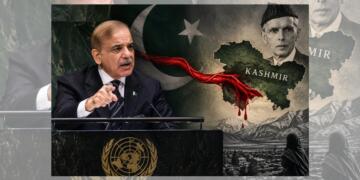










For decades, Pakistan has thrived on exporting terror, glorifying jihad, and waging a shadow war against India in the name of Islam and Muhammad. But now, as its terror networks begin to collapse under their own weight, the state has found a new diversion branding its own internal rebel movements and militant monsters as “Indian proxies.” In a desperate bid to fool its citizens and shift blame, Islamabad has started labeling Baloch freedom fighters and even the Tehrik-e-Taliban Pakistan (TTP) as “Fitna-al-Hindustan” and “Fitna al-Khawarij.” This grotesque exercise of propaganda not only exposes Pakistan’s moral bankruptcy but also its panic a crumbling state now choking on the very venom it created for India.
As Hillary Clinton once said, “You can’t keep snakes in your backyard and expect them only to bite your neighbours.” Pakistan’s backyard, nurtured with decades of extremist breeding, has now become its battlefield.
From Terror Exporter to Terror Victim: The Inevitable Fallout
Since the 1980s, Pakistan’s military-intelligence complex has systematically used terrorism as an instrument of foreign policy. The doctrine of “bleeding India by a thousand cuts” became the guiding principle of Rawalpindi’s strategic thinking. Terror groups like Lashkar-e-Taiba, Jaish-e-Mohammed, and Hizbul Mujahideen were funded, trained, and sheltered with the full knowledge of the Pakistan Army and the ISI. Their targets were always clear India’s cities, its soldiers, and its stability.
But in its obsession with India, Pakistan forgot that fire cannot be contained forever. Over the years, these terror outfits turned their guns inward, attacking Pakistani security forces, schools, and civilians. The same clerics who preached jihad against India began challenging the state’s authority. From the Lal Masjid siege in 2007 to suicide bombings in Peshawar and Quetta, Pakistan has repeatedly faced the consequences of its own poisonous creation.
Balochistan, forcibly annexed in 1948, has remained another festering wound. Rich in minerals but deprived of basic development, it has endured military repression, extrajudicial killings, and systemic looting of its resources to feed the Punjab province. The people of Balochistan, denied autonomy and dignity, rose in rebellion not for India, but for their right to exist. Yet, Islamabad found it convenient to dismiss their cries as “foreign interference.”
“Fitna-al-Hindustan”: Pakistan’s Latest Lie Factory
In a bizarre move that exemplifies Pakistan’s propaganda addiction, the country’s Ministry of Interior on 30 June 2025 officially decided to rename all Baloch rebel groups as “Fitna-al-Hindustan”, meaning “trouble created by India.” The ministry’s notification claimed that these groups were working “at the behest of India to undermine Pakistan’s Islamic faith and sovereignty.”
Following this absurd decree, Lieutenant General Ahmed Sharif Chaudhry blamed India for a school bus explosion in Balochistan’s Khuzdar district, calling it “Indian state-sponsored terrorism.” This narrative utterly baseless and unsupported by any evidence was pushed aggressively by state media. For the last one year, “Fitna-al-Hindustan” has become a standard term in Pakistan’s propaganda toolkit.
The phrase serves multiple purposes. It distracts public attention from Pakistan’s economic collapse and social unrest, converts a local insurgency into a “foreign conspiracy,” and once again places India at the centre of every internal failure. The Baloch resistance, which stems from decades of exploitation, is thus falsely portrayed as part of an Indian covert operation.
Yet, outside Pakistan’s echo chamber, no one buys the lie. International bodies such as the United Nations, Human Rights Watch, and Amnesty International have repeatedly documented the genuine grievances of the Baloch people enforced disappearances, arbitrary detentions, and targeted killings by Pakistan’s military. Not a single credible investigation, whether by international media or neutral governments, has ever found proof of Indian control over Baloch groups.
But propaganda, not proof, fuels Pakistan’s politics. It is easier for the military to sell a fantasy of “Indian interference” than to admit to decades of oppression, poverty, and neglect in Balochistan.
The ‘Fitna al-Khawarij’ Farce: Painting the TTP as Indian Agents
Not content with demonising the Baloch rebels, Pakistan has now extended its “India-blame” doctrine to the Tehrik-e-Taliban Pakistan (TTP) a group it once nurtured for influence in Afghanistan. The TTP, responsible for countless attacks on Pakistani soil, has now been laughably rebranded as “Fitna al-Khawarij” or “Indian proxy rebels.”
The irony is painful. The TTP was born out of Pakistan’s own policies of radicalisation. It drew ideological strength from Al-Qaeda, whose leader Osama bin Laden was found hiding in Abbottabad, just a few miles from Pakistan’s military academy. The TTP carried out suicide bombings, massacres of school children, and deadly assaults on police and army installations all in retaliation against Pakistan’s duplicity in the so-called “War on Terror.”
Yet, instead of acknowledging its own blunders, the Inter-Services Public Relations (ISPR) blamed India for orchestrating the October 2025 terror strikes that killed over 20 Pakistani security personnel. State-run media parroted the narrative, claiming that “Indian-backed TTP terrorists” had carried out the attacks.
This absurdity reveals the military’s desperation. Having lost control over the extremist groups it once sponsored, Pakistan is now attempting to rewrite the story casting itself as the eternal victim and India as the omnipresent villain.
From Balochistan to Textbooks
Blaming India has become Pakistan’s national sport. Whenever its economy collapses, when inflation peaks, or when people queue up for flour, the ruling elite conveniently points fingers across the border. Even its former prime ministers from Nawaz Sharif to Imran Khan have been accused of being “Indian agents.” This scapegoating sustains the illusion that Pakistan’s failures are never self-inflicted but always foreign-engineered.
Religion, anti-Hindu rhetoric, and conspiracy theories form the perfect mix for mass manipulation. The military establishment, which controls Pakistan’s politics, thrives on hatred towards India. It keeps its citizens distracted while enriching itself through defence contracts and foreign aid. As long as India is portrayed as the eternal enemy, Pakistan’s generals can justify their dominance over democracy.
The rot begins early in classrooms. Pakistani textbooks glorify jihad and vilify Hindus, ensuring that every child grows up viewing India not as a neighbour, but as a sworn enemy. Decades of such indoctrination have produced generations of citizens unable to question authority, accepting propaganda as patriotism.
Even today, as Pakistan faces bankruptcy, rampant terrorism, and social unrest, its obsession with India remains unshaken. The defence budget grows even as hospitals run out of medicines. The military feasts while the poor starve. Yet, the illusion endures that fighting India is the nation’s divine mission.
The Snake Has Turned on the Snake Charmer
The events unfolding in Pakistan are the perfect illustration of poetic justice. A nation that sowed terror is now consumed by it. By renaming its domestic insurgencies as “Fitna-al-Hindustan” and “Fitna al-Khawarij,” Pakistan isn’t rewriting history it’s mocking itself. The world sees through this theatre of deception.
Baloch rebels fight for liberation from oppression, not for India. The TTP attacks Pakistan because of Islamabad’s duplicity, not Indian command. But Pakistan’s ruling elite needs enemies to survive and India remains the easiest target.
Ultimately, Pakistan’s real battle isn’t with India; it is with truth, accountability, and modernity. As Field Marshal Asim Munir grimly admitted, “India is like a Mercedes on a highway, while we are a dump truck filled with gravel. If the truck collides with the car, who will emerge as the loser?”
Indeed, the answer is clear. The truck has already started crumbling. What remains is not a sovereign republic but a terror-ridden theocracy, desperate to hide its collapse behind slogans of “Hindustan conspiracy.” Pakistan wanted to destroy India’s peace. In the end, it destroyed its own soul.