















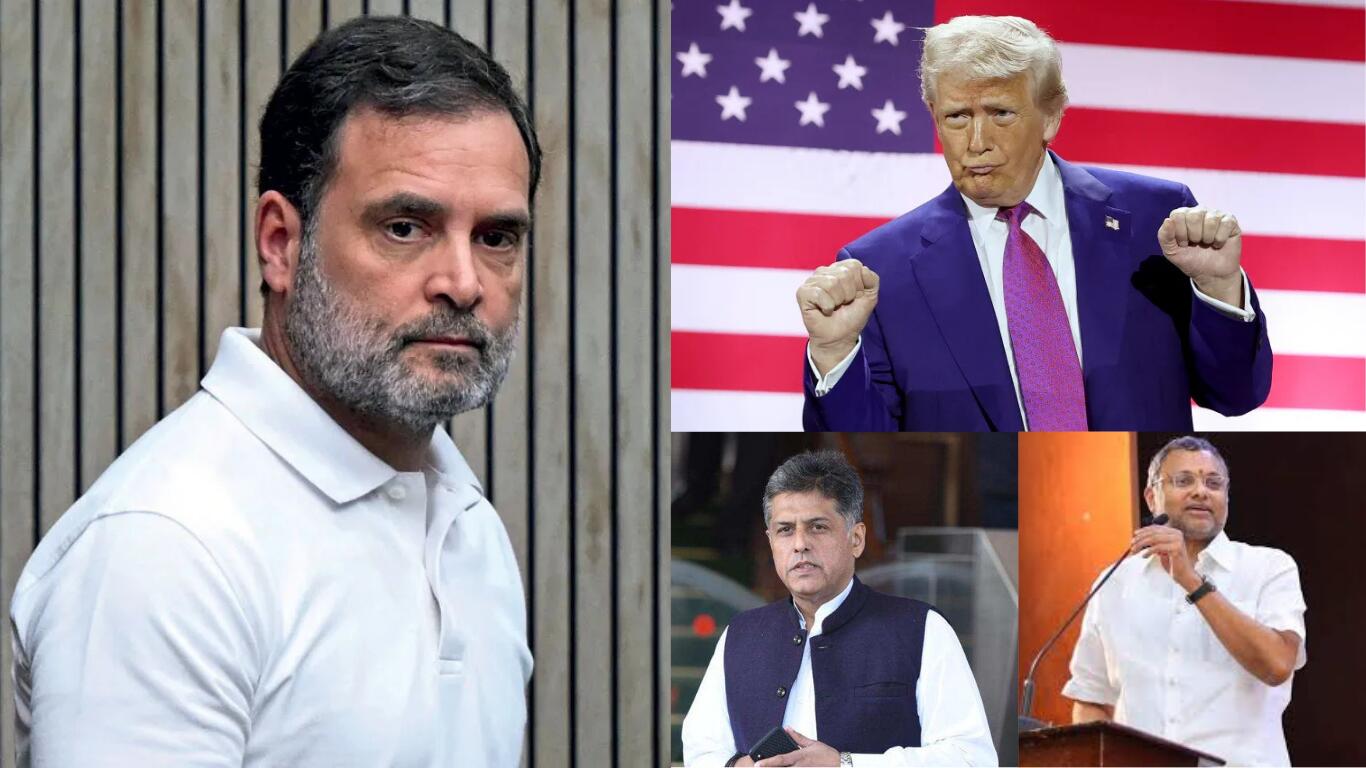
As the United States imposes a steep 25% tariff on Indian exports and threatens further economic penalties over India’s oil imports from Russia, senior Congress leaders have come forward in a rare show of national unity except for Rahul Gandhi, who continues to take jabs at the Indian economy and seems to side with President Donald Trump’s narrative.
While India’s foreign ministry delivered a firm, facts-backed rebuttal to Washington’s stance, Congress MPs like Manish Tewari and Karti Chidambaram have added their voices in support of India’s strategic autonomy. Meanwhile, Rahul Gandhi’s statements describing India as a “dead economy” during this sensitive moment have sparked sharp criticism for mirroring Trump’s attack lines and damaging India’s global standing.
Manish Tewari Invokes 1971 Resilience to Counter US Pressure
Congress MP Manish Tewari, known for his foreign policy expertise, lashed out at Trump’s tariff threat with a powerful historical reference. Drawing parallels with a crucial moment in India’s diplomatic history, Tewari tweeted:
“Your nation sent the Seventh Fleet into the Bay of Bengal in 1971 to deter us from reordering the political map of South Asia. We withstood that. We have enough resilience as a nation to withstand your tariff threat.”
Tewari’s statement not only showcased India’s long-standing commitment to strategic independence but also subtly reminded Washington that India has never bowed to coercion be it in 1971 or in 2025.
Earlier, Tewari had also emphasized that no American pressure tariff or otherwise can dent the nation’s ability to chart its own geopolitical path. He argued that India’s policy legacy, from Nehru’s non-alignment to Indira Gandhi’s assertive diplomacy, continues through Prime Minister Modi’s Atmanirbhar Bharat.
“Trump has perhaps given the biggest tribute to Indian strategic exceptionalism,” Tewari noted pointedly.
Don’t loose sleep on it.@realDonaldTrump .
Your nation sent the seventh fleet into the Bay of Bengal in 1971 to deter us from reordering the political map of South Asia.
We withstood that .
We have enough resilience as a nation to withstand your Tariff threat.
Thank you… pic.twitter.com/YRReX52wXO
— Manish Tewari (@ManishTewari) August 4, 2025
Karti Chidambaram Supports Govt: ‘India Must Act in National Interest’
Another Congress leader who stood up for the Indian government’s position was Lok Sabha MP Karti Chidambaram. Reacting to a statement by Ministry of External Affairs Spokesperson Randhir Jaiswal, Chidambaram said:
“We must act in our national interest, not be influenced by petulant tantrums of impulsive heads of state.”
This unequivocal support from a senior Opposition leader during a moment of diplomatic tension reflects a growing consensus across party lines—India’s interests must come first, irrespective of who’s in power or who’s throwing tantrums from abroad.
Karti Chidambaram also said “Anybody who believes that an additional tariff by President Trump is a punishment on India is wrong, it’s not, it’s a burden on American consumer. India is a big supply-chain partner to the American consumer, it’s not easy to replace India. To build capacities for supply-chain takes long time. American consumers will have to pay more for goods… America has moved on from a manufacturing country to services country, they need goods from all over the world… It will have repercussion on American economy.”
We must act in our National interest, not be influenced by petulant tantrums of impulsive heads of state. https://t.co/4IdLGAsjJp
— Karti P Chidambaram (@KartiPC) August 4, 2025
Rahul Gandhi Speaks Trump’s Language, Backstabs Indian Economy
In sharp contrast, Congress scion Rahul Gandhi has come under fire for amplifying anti-India rhetoric that closely mirrors President Trump’s tirade against India. Even as Trump accused India of selling Russian oil for “big profits” and called it a “dead economy,” Rahul Gandhi has repeatedly used the exact same term—“dead economy”—to describe India’s economic condition.
Rahul’s remarks not only undermine India on the international stage but come at a time when national unity is critical. While the government is busy countering global hypocrisy and defending India’s legitimate energy interests, Rahul’s repeated defamation of India gives ammunition to its critics abroad.
India Won’t Be Bullied – Strategic Autonomy Comes First
India’s foreign policy response, supported by several veteran Congress leaders, has made it clear: the country will not accept being bullied into submission by any power—not even the United States.
India’s energy trade with Russia emerged from global market disruptions and the redirection of Middle Eastern oil to Europe. The US, ironically, had once welcomed India’s purchases under the G7-mandated price cap in 2024. Today, it seeks to penalize India for the very same imports it once encouraged—a position steeped in hypocrisy.
India continues to import far less from Russia than the EU or even the US, which still buys uranium and palladium from Moscow. Despite this, India is the only nation being targeted for acting in its national interest.
National Unity Must Trump Political Opportunism
While India faces unjustified tariff aggression from the US, the nation’s response must be united and uncompromising. It is heartening to see senior Congress leaders rise above partisan politics to back India’s economic sovereignty.
However, Rahul Gandhi’s alignment with foreign criticism especially during such a critical diplomatic juncture—reveals a troubling disregard for national interest. By calling India’s economy “dead,” he not only echoes Trump but also betrays the aspirations and resilience of 1.4 billion Indians.
In 2025, this is not the India of the past. It is a stronger, self-reliant nation that refuses to bow down to any foreign diktat—be it from Washington or a politically confused voice at home.