






TFIPOST हिन्दी
TFIPOST Global
Tfipost.com
Tfipost.com
No Result
View All Result
  • Premium
  • Politics
    • All
    • Analysis
    • Opinions
    • Trending
    ‘Combat ready, Cohesive, Credible Force’: Indian Navy Reiterates Commitment to Motherland

    ‘Combat ready, Cohesive, Credible Force’: Indian Navy Reiterates Commitment to Motherland

    Despite Nehru’s objection, Rajendra Prasad became India’s first President !

    How Nehru Resisted Dr. Rajendra Prasad—from Presidency to Somnath visit  and Beyond

    Nehru’s Erasure of RC Majumdar Stands as a Stark Warning about Power over History

    Nehru’s Erasure of RC Majumdar Stands as a Stark Warning about Power over History

    India Cannot Be Broken and Peace in Bangladesh Cannot Be Built Upon Delusion

    India Cannot Be Broken and Peace in Bangladesh Cannot Be Built Upon Delusion

    • Analysis
    • Opinions
    • Trending
  • Economy
    • All
    • Business
    • Economy1
    • Finance
    From Paper-Mandates to eNACH Registration: How Digital Mandates Are Changing Cash Flow

    From Paper-Mandates to eNACH Registration: How Digital Mandates Are Changing Cash Flow

    What is the financial management cycle?

    What is the financial management cycle?

    Smart Investment Planning: Calculating Mutual Fund SIP Growth Easily

    Smart Investment Planning: Calculating Mutual Fund SIP Growth Easily

    Convert ETH to USD Using Price Statistics for Better Trading Decisions

    Convert ETH to USD Using Price Statistics for Better Trading Decisions

    • Business
    • Finance
  • Defense
    • All
    • Defence
    • Strategy
    • Weaponry
    Veterans Deserve More Than Promises: The System Must Match the Soldier’s Sacrifice

    Veterans Deserve More Than Promises: The System Must Match the Soldier’s Sacrifice

    How Ukraine Uses Psychological and Information Warfare to ‘Win,’ and What India Can Learn From This Strategy

    How Ukraine ‘Wins’ the Psychological and Informatiaon War Despite Destruction — Lessons India Cannot Afford to Ignore

    Pakistan’s ‘ship-launched ASBM’ claim doesn’t withstand technical or industrial scrutiny

    Pakistan’s ‘ship-launched ASBM’ claim doesn’t withstand technical or industrial scrutinys

    Borders Can Change: Why Rajnath Singh’s Sindh Remark is India’s New Message to Pakistan

    Borders Can Change: Why Rajnath Singh’s Sindh Remark is India’s New Message to Pakistan

    • Defence
    • Strategy
    • Weaponry
  • Geopolitics
    • All
    • Africa
    • Americas
    • Asia Pacific
    • Europe
    • South Asia
    • West Asia
    Europe’s Slow Descent Into Weakness

    Europe: A Continent Happily Committing a Long-Drawn Suicide

    End of NATO? US Secretary of State Marco Rubio May Skip Foreign Ministers’ Meet in Brussels for First Time in Two Decades

    End of NATO? US Secretary of State Marco Rubio May Skip Foreign Ministers’ Meet in Brussels for First Time in Two Decades

    ‘Best Fighter In the World’ Dmitry Peskov Pitches For Sukhoi-57 Fighter Jet Ahead of Putin’s Visit to India

    ‘Best Fighter In the World’ Dmitry Peskov Pitches For Sukhoi-57 Fighter Jet Ahead of Putin’s Visit to India

    ‘We Are Ready to Go As Far As India Is’: Ahead of Putin Visit, Kremlin Says India-Russia Partnership Has No Limits

    ‘We Are Ready to Go As Far As India Is’: Ahead of Putin Visit, Kremlin Says India-Russia Partnership Has No Limits

    • Africa
    • Americas
    • Asia Pacific
    • Europe
    • South Asia
    • West Asia
  • Knowledge
    • All
    • Culture
    • Education
    • History
    • Indology
    Despite Nehru’s objection, Rajendra Prasad became India’s first President !

    How Nehru Resisted Dr. Rajendra Prasad—from Presidency to Somnath visit  and Beyond

    Talom Rukbo Initiated the Donyi–Polo Movement: Bringing Tribal Youth Back to Their Roots

    Talom Rukbo: The Forgotten Hero Who Shielded Arunachal’s Tribal Communities from Religious Conversion

    How Guru Tegh Bahadur The Ninth Sikh Guru Became a Martyr for Religious Freedom

    How Guru Tegh Bahadur The Ninth Sikh Guru Became a Martyr for Religious Freedom

    21 November 1962: Looking Back at the Indo-China war and How it Redefined the Border Equation

    21 November 1962: Looking Back at the Indo-China war and How it Redefined the Border Equation

    • Culture
    • History
    • Indology
  • Law
  • Lounge
    • All
    • Books
    • Cinema
    • Entertainment
    • Food
    • Games
    • Health
    • Lifestyle
    • Satire
    • Sports
    • technology
    • Travel
    감정을 가진 로봇의 시대가 오고 있다

    감정을 가진 로봇의 시대가 오고 있다

    Is AISaver Face Swap the Best Tool for Face Swap Video Online Free in 2025?

    Is AISaver Face Swap the Best Tool for Face Swap Video Online Free in 2025?

    Why Fat Analysis Matters in the Food and Feed  Industry?

    Why Fat Analysis Matters in the Food and Feed Industry?

    Heart Surgery Hospital in Delhi: What to Expect During Your Procedure

    Heart Surgery Hospital in Delhi: What to Expect During Your Procedure

    • Books
    • Cinema
    • Food
    • Health
    • Sports
    • technology
    • Travel
    • Satire
Tfipost.com
  • Premium
  • Politics
    • All
    • Analysis
    • Opinions
    • Trending
    ‘Combat ready, Cohesive, Credible Force’: Indian Navy Reiterates Commitment to Motherland

    ‘Combat ready, Cohesive, Credible Force’: Indian Navy Reiterates Commitment to Motherland

    Despite Nehru’s objection, Rajendra Prasad became India’s first President !

    How Nehru Resisted Dr. Rajendra Prasad—from Presidency to Somnath visit  and Beyond

    Nehru’s Erasure of RC Majumdar Stands as a Stark Warning about Power over History

    Nehru’s Erasure of RC Majumdar Stands as a Stark Warning about Power over History

    India Cannot Be Broken and Peace in Bangladesh Cannot Be Built Upon Delusion

    India Cannot Be Broken and Peace in Bangladesh Cannot Be Built Upon Delusion

    • Analysis
    • Opinions
    • Trending
  • Economy
    • All
    • Business
    • Economy1
    • Finance
    From Paper-Mandates to eNACH Registration: How Digital Mandates Are Changing Cash Flow

    From Paper-Mandates to eNACH Registration: How Digital Mandates Are Changing Cash Flow

    What is the financial management cycle?

    What is the financial management cycle?

    Smart Investment Planning: Calculating Mutual Fund SIP Growth Easily

    Smart Investment Planning: Calculating Mutual Fund SIP Growth Easily

    Convert ETH to USD Using Price Statistics for Better Trading Decisions

    Convert ETH to USD Using Price Statistics for Better Trading Decisions

    • Business
    • Finance
  • Defense
    • All
    • Defence
    • Strategy
    • Weaponry
    Veterans Deserve More Than Promises: The System Must Match the Soldier’s Sacrifice

    Veterans Deserve More Than Promises: The System Must Match the Soldier’s Sacrifice

    How Ukraine Uses Psychological and Information Warfare to ‘Win,’ and What India Can Learn From This Strategy

    How Ukraine ‘Wins’ the Psychological and Informatiaon War Despite Destruction — Lessons India Cannot Afford to Ignore

    Pakistan’s ‘ship-launched ASBM’ claim doesn’t withstand technical or industrial scrutiny

    Pakistan’s ‘ship-launched ASBM’ claim doesn’t withstand technical or industrial scrutinys

    Borders Can Change: Why Rajnath Singh’s Sindh Remark is India’s New Message to Pakistan

    Borders Can Change: Why Rajnath Singh’s Sindh Remark is India’s New Message to Pakistan

    • Defence
    • Strategy
    • Weaponry
  • Geopolitics
    • All
    • Africa
    • Americas
    • Asia Pacific
    • Europe
    • South Asia
    • West Asia
    Europe’s Slow Descent Into Weakness

    Europe: A Continent Happily Committing a Long-Drawn Suicide

    End of NATO? US Secretary of State Marco Rubio May Skip Foreign Ministers’ Meet in Brussels for First Time in Two Decades

    End of NATO? US Secretary of State Marco Rubio May Skip Foreign Ministers’ Meet in Brussels for First Time in Two Decades

    ‘Best Fighter In the World’ Dmitry Peskov Pitches For Sukhoi-57 Fighter Jet Ahead of Putin’s Visit to India

    ‘Best Fighter In the World’ Dmitry Peskov Pitches For Sukhoi-57 Fighter Jet Ahead of Putin’s Visit to India

    ‘We Are Ready to Go As Far As India Is’: Ahead of Putin Visit, Kremlin Says India-Russia Partnership Has No Limits

    ‘We Are Ready to Go As Far As India Is’: Ahead of Putin Visit, Kremlin Says India-Russia Partnership Has No Limits

    • Africa
    • Americas
    • Asia Pacific
    • Europe
    • South Asia
    • West Asia
  • Knowledge
    • All
    • Culture
    • Education
    • History
    • Indology
    Despite Nehru’s objection, Rajendra Prasad became India’s first President !

    How Nehru Resisted Dr. Rajendra Prasad—from Presidency to Somnath visit  and Beyond

    Talom Rukbo Initiated the Donyi–Polo Movement: Bringing Tribal Youth Back to Their Roots

    Talom Rukbo: The Forgotten Hero Who Shielded Arunachal’s Tribal Communities from Religious Conversion

    How Guru Tegh Bahadur The Ninth Sikh Guru Became a Martyr for Religious Freedom

    How Guru Tegh Bahadur The Ninth Sikh Guru Became a Martyr for Religious Freedom

    21 November 1962: Looking Back at the Indo-China war and How it Redefined the Border Equation

    21 November 1962: Looking Back at the Indo-China war and How it Redefined the Border Equation

    • Culture
    • History
    • Indology
  • Law
  • Lounge
    • All
    • Books
    • Cinema
    • Entertainment
    • Food
    • Games
    • Health
    • Lifestyle
    • Satire
    • Sports
    • technology
    • Travel
    감정을 가진 로봇의 시대가 오고 있다

    감정을 가진 로봇의 시대가 오고 있다

    Is AISaver Face Swap the Best Tool for Face Swap Video Online Free in 2025?

    Is AISaver Face Swap the Best Tool for Face Swap Video Online Free in 2025?

    Why Fat Analysis Matters in the Food and Feed  Industry?

    Why Fat Analysis Matters in the Food and Feed Industry?

    Heart Surgery Hospital in Delhi: What to Expect During Your Procedure

    Heart Surgery Hospital in Delhi: What to Expect During Your Procedure

    • Books
    • Cinema
    • Food
    • Health
    • Sports
    • technology
    • Travel
    • Satire
No Result
View All Result
Tfipost.com
Tfipost.com
No Result
View All Result
  • Premium
  • Politics
  • Economy
  • Defense
  • Geopolitics
  • Knowledge
  • Law
  • Lounge

This Week in Focus: The Deep State Playbook Part 3 – Economic Coercion

Bull's Eye by Bull's Eye
9 March 2025
in Analysis, Geopolitics, This Week In Focus
This Week in Focus: The Deep State Playbook Part 3 – Economic Coercion

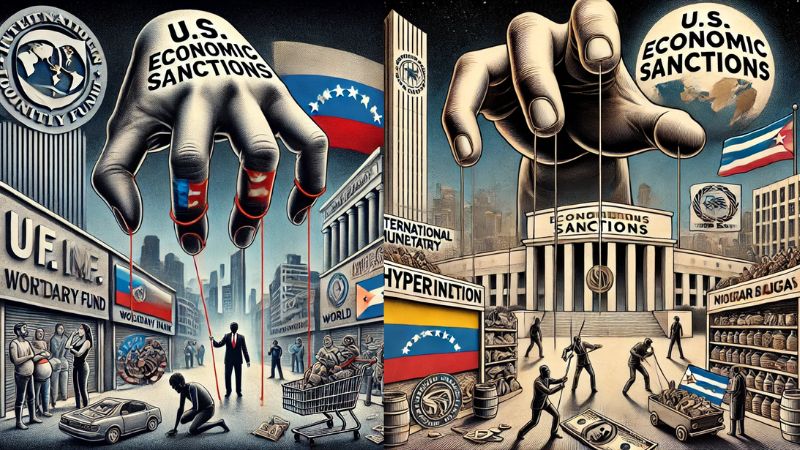
(AI generated Image created by TFI Staff)

Share on FacebookShare on X

USAID funding scandal: In the last part of our series on Deep State, we shed light on key faces associated with USAID. Through notorious agencies like the OCCRP, NED, USAID and others, the Deep State ‘assets’ have been exploiting people’s sympathies and their kinder side to go after Nationalist politicians. This article pieces exposes the economic coercion as part of their modus operandi through which these organisations go after politicians, countries, and nationalistic voices in their target nation.

The US government has used economic pressure as a tool to influence foreign governments. This broad umbrella term includes conditioning (by American as well as U.S.-funded institutions) financial aid on economic reforms, sending inimical countries out of internationally organised economic marketplaces, and using international financial institutions like the IMF and World Bank to pressure countries into adopting policies that align with U.S. interests.

RelatedPosts

IMF Revises India’s Growth Projections Upwards: A Tight Slap to Rahul Gandhi’s “Dead Economy” Rhetoric

Nepal in Turmoil: Gen-Z Uprising or Engineered Chaos? Is the Social Media Ban a Cover for a Bigger Conspiracy!

Opposition’s Dangerous Nexus: Kharge’s Six-Month Deadline A Desperate Claim Backed by Deep State Narratives?

Load More

The United States has historically used economic pressure to influence foreign governments, often leading to significant financial turmoil. The impact of these measures can be seen in Venezuela, Iran, Cuba, Nicaragua, Chile, Malawi, and the Democratic Republic of the Congo, where U.S. sanctions, trade restrictions, and aid manipulations have caused hyperinflation, currency collapses, food and medicine shortages, and major declines in GDP, among others. Oil, public services, healthcare, and essential commodities have been the most affected sectors.

In Venezuela, U.S. sanctions had a devastating impact on the country’s oil-dependent economy. Since the imposition of financial restrictions, Venezuela’s GDP has suffered a loss of nearly $700 billion, with the loss of the oil industry—whose contribution to Venezuelan GDP was 95 per cent—alone being approximately $232 billion. Add to that the freezing of $22 billion of Venezuelan assets in international banks, creating a sense of uncertainty for investors looking to pour money into the economy.

The uncertainty caused hyperinflation in the country—so much so that it has a special Wikipedia page dedicated to the phenomenon. Inflation reached an all-time high of 1,30,060 per cent in 2018, followed by 9,586 per cent in 2019 and 2,963 per cent in 2020. The government’s capability for health spending resulted in only 1.8 per cent of its GDP being used for healthcare spending. The corresponding figure was 8.1 per cent in 2008. Apparently, more than 62.5 per cent of healthcare spending in 2017 was done through out-of-pocket expenditure.

Venezuela’s healthcare system collapsed under severe shortages of medical supplies, inadequate infrastructure, and a mass exodus of medical professionals. Towards the late 2010s, hospitals reported up to 95 per cent shortages in medicine, while pharmacies faced 85 per cent shortages. It forced patients to procure their own supplies for surgeries, including basic items like needles and antibiotics.

In a 2016 poll, 76 per cent of public hospitals lacked basic medicines, and Human Rights Watch confirmed that most of the hospitals had none of the WHO’s essential medicines, including antibiotics and cancer treatments. 1,557 patients died due to short supplies between November 2018 and February 2019. The long wait for medicines put 300,000 people at risk in the year 2019.

Infrastructure failures have exacerbated the crisis, with 80 per cent of Barrio Adentro clinics closed by 2017, leaving remaining clinics overwhelmed and understaffed, sometimes serving 6,000 people per doctor. 70 per cent of hospitals suffer due to infrequent water supply as medical staff had to schedule surgeries around water availability.

Hospital bed availability went critically down, with only 16,300 of the 45,000 public hospital beds in use. Even if privately available hospital beds are taken into account, the country of 3 crore people did not have more than 25,000 beds at the peak of American sanctions.

Worse, ICU care got even bleaker as there were only 84 ICU beds available nationwide, and there are no reports of the Covid-induced introduction of 1,200 ICU beds coming to reality. Frequent blackouts have made healthcare even more inaccessible. 79 patients died in hospitals between 2018 and 2019 due to power outages. In one single month of March 2019, hospitals suffered 507 hours of electricity shortages.

High stress, fewer facilities, and intense public scrutiny led to 22,000 doctors leaving Venezuela between 2012 and 2017. A large section of those who remained ran their practices illegally or through fake degrees for wages as low as $4–$10 per month. The unavailability of cheap fuel due to a decline in production made it difficult for willing doctors to reach hospitals.

Like Venezuela, Iran’s economy has also suffered greatly under U.S. sanctions, particularly after the Trump administration withdrew from the nuclear deal in 2018 and reimposed the financial version of Democrats’ cancel culture. The Rial, Iran’s national currency, has suffered constant depreciation, hitting a record low of 892,500 rials per U.S. dollar (in unofficial markets) in February 2025.

Inflation surged as consumer prices for domestic goods rose by 30.23 per cent in 2016, 34.70 per cent in 2019, 40.19 per cent in 2021, and 45.75 per cent in 2022. But Trump only worsened what earlier American Presidents had done to Iran. Even during the Obama era, Iran’s GDP per capita fell by 35 per cent between 2012 and 2014, with the minimum wage plummeting from $275.40 in 2010 to $155 in 2012. The sanctions continue to limit Iran’s access to international markets, keeping inflation high and reducing purchasing power for ordinary citizens.

According to a United Nations General Assembly resolution in October 2024, the U.S. economic embargo has inflicted damages worth $1.499 trillion in losses when measured against the U.S. dollar’s value in gold on Cuba’s economy. Over the last 18 years alone, the island nation has suffered $252 trillion in economic losses due to restrictions on trade, finance, and access to essential resources.

It has significantly hampered Cuba’s ability to import fuel, spare parts, and other critical goods, causing widespread power outages, rationing of food, and disruptions in medical services. From October 18 to 23, 2024, many Cuban families endured long periods without electricity or running water, while hospitals operated under emergency conditions, and educational institutions were forced to suspend classes.

The multilateral agency estimates that the accumulated four-month cost of the blockade was $1.6 billion. This huge sum could have ensured food security for Cuban families for an entire year, while just $12 million—an amount Cuba loses in less than a day due to the embargo—could have funded insulin supplies for all its diabetic patients.

The sanctions have isolated Cuba from global financial systems, leading to downgrading of ratings and obstructing foreign investments and economic reforms that could have improved the lifestyle of an average Cuban citizen. Access to essential medicines and medical equipment is also extremely limited, leading to delays in treatments and surgeries, causing devastation to public health.

The Cuban government describes these measures as “economic warfare” and a “flagrant violation of human rights,” likening the blockade to a military siege under modern international law. Dozens of countries, including Bolivia, Iran, and members of the European Union, have condemned the sanctions as unjust and counterproductive, arguing that they hinder Cuba’s economic progress while failing to achieve their stated political objectives.

Despite these global calls for lifting the blockade—reaffirmed by an overwhelming majority of 187 out of 193 UN member states—the embargo remains in place, prolonging Cuba’s economic struggles and humanitarian challenges.

Also Read: This Week in Focus: The Deep State Playbook Part 2 – Covert operations, propagandists, exploiting ‘victim’ community

For Nicaragua, going with the man Americans did not want in charge was met with severe economic challenges due to U.S. trade restrictions and an economic embargo aimed at weakening the Sandinista government. The embargo, imposed in 1985, along with the funded civil war and internal economic missteps, led to a continuous depreciation in GDP from 1984 to 1990.

While Nicaragua could afford to cut loose on other products, the country needed money for military expenditure. It resorted to printing money to cover deficits, resulting in hyperinflation that soared past 14,000 per cent in 1988. The supply chain was massively disrupted due to widespread shortages of essential goods, mass unemployment reached 25 per cent (a gross underestimation), amidst a 35 per cent drop in real per capita income between 1980 and 1990.

In Chile, during the early 1970s, the USA put economic coercion on China by pressurising it simply because it did not like President Salvador Allende’s socialist government. The Nixon administration—considered quite inert in its policies—curtailed financial aid and influenced international financial institutions to halt loans to Chile. The sanctions, coupled with internal policy challenges of socialist political doctrine, resulted in unchecked government spending, due to which the fiscal deficit reached approximately 23 per cent of GDP by 1973. Available government money with supply-side constraints amidst increasing demand was the reason inflation soared to 1,600 per cent in 1973. The resulting economic turmoil contributed to the military coup in 1973 that brought General Augusto Pinochet to power.

Tags: Deep stateIMFsanctionsUSAIDWorld Bank
ShareTweetSend
Previous Post

HbA1c vs. Blood Glucose Monitoring: Which One Do You Need?

Next Post

Balochistan: Unknown Gunmen knocks off Mufti who kidnapped Kulbhushan Jadhav

Related Posts

Europe’s Slow Descent Into Weakness
Europe

Europe: A Continent Happily Committing a Long-Drawn Suicide

5 December 2025

Europe once stood at the centre of global power, its wealth built on colonial extraction, industrial strength and favourable...

JUH: A Tale of Two Madanis & Endless Justifications
Opinions

Jamiat Ulama e Hind and Madani’s pitch for Sharia Laws for Muslims swearing by Secular Constitution

4 December 2025

Teachers of Darul Uloom, Deoband, the second largest Islamic seminary of the world after Al-Azhar, Cairo, are found involved...

End of NATO? US Secretary of State Marco Rubio May Skip Foreign Ministers’ Meet in Brussels for First Time in Two Decades
Geopolitics

End of NATO? US Secretary of State Marco Rubio May Skip Foreign Ministers’ Meet in Brussels for First Time in Two Decades

3 December 2025

NATO foreign ministers on Wednesday will gather in Brussels for what is supposed to be a routine reaffirmation of...

Load More

Leave a Reply Cancel reply

Your email address will not be published. Required fields are marked *

I agree to the Terms of use and Privacy Policy.
This site is protected by reCAPTCHA and the Google Privacy Policy and Terms of Service apply.

Currently Playing

A War Won From Above: The Air Campaign That Changed South Asia Forever

A War Won From Above: The Air Campaign That Changed South Asia Forever

00:07:37

‘Mad Dog’ The EX CIA Who Took Down Pakistan’s A.Q. Khan Nuclear Mafia Reveals Shocking Details

00:06:59

Dhurandar: When a Film’s Reality Shakes the Left’s Comfortable Myths

00:06:56

Tejas Under Fire — The Truth Behind the Crash, the Propaganda, and the Facts

00:07:45

Why Rahul Gandhi’s US Outreach Directs to a Web of Shadow Controversial Islamist Networks?

00:08:04
Facebook Twitter Instagram Youtube
tfipostTfipost.com
Right Wing | News Analysis | Indian Opinion
  • About us
  • Contact Us
  • Careers
  • Brand Partnerships
  • Terms of use
  • Privacy Policy
  • Sitemap

©2025 TFI Media Private Limited

No Result
View All Result
  • Premium
  • Politics
    • Analysis
    • Opinions
    • Trending
  • Economy
    • Business
    • Finance
  • Defense
    • Defence
    • Strategy
    • Weaponry
  • Geopolitics
    • Africa
    • Americas
    • Asia Pacific
    • Europe
    • South Asia
    • West Asia
  • Knowledge
    • Culture
    • History
    • Indology
  • Law
  • Lounge
    • Books
    • Cinema
    • Food
    • Health
    • Sports
    • technology
    • Travel
    • Satire
TFIPOST हिन्दी
TFIPOST Global

©2025 TFI Media Private Limited