















TFIPOST हिन्दी
TFIPOST Global
Tfipost.com
Tfipost.com
No Result
View All Result
  • Premium
  • Politics
    • All
    • Analysis
    • Opinions
    • Trending
    Rajesh Kumar Singh Reveals Vietnam BrahMos Deal, Indonesia Agreement in Final Stages

    Rajesh Kumar Singh Reveals Vietnam BrahMos Deal, Indonesia Agreement in Final Stages

    Delhi Police Arrest Nine Linked to ISI-Dawood Network; Nuclear Facilities, Airports and Railway Stations Among Targets

    Delhi Police Arrest Nine Linked to ISI-Dawood Network; Nuclear Facilities, Airports and Railway Stations Among Targets

    Operation Sindoor 2.0: Army Chief Signals India’s Next Military Doctrine as Forces Prepare for Future Conflict

    Operation Sindoor 2.0: Army Chief Signals India’s Next Military Doctrine as Forces Prepare for Future Conflict

    India Joins Global Digital Elite, Climbs Into Fifth Spot as AI Revolution and Digital Infrastructure Reshape Economy

    India Joins Global Digital Elite, Climbs Into Fifth Spot as AI Revolution and Digital Infrastructure Reshape Economy

    • Analysis
    • Opinions
    • Trending
  • Economy
    • All
    • Business
    • Economy1
    • Finance
    India Joins Global Digital Elite, Climbs Into Fifth Spot as AI Revolution and Digital Infrastructure Reshape Economy

    India Joins Global Digital Elite, Climbs Into Fifth Spot as AI Revolution and Digital Infrastructure Reshape Economy

    How gaming merchants choose a payment gateway in India

    How gaming merchants choose a payment gateway in India

    The Informal Economy Pays the Price: Street Traders, Small Shops and the Hidden Cost of Trade Policy

    The Informal Economy Pays the Price: Street Traders, Small Shops and the Hidden Cost of Trade Policy

    Bank Guarantee Process: Ensuring Trust in Tenders, Contracts, and Trade Agreements

    Bank Guarantee Process: Ensuring Trust in Tenders, Contracts, and Trade Agreements

    • Business
    • Finance
  • Defense
    • All
    • Defence
    • Strategy
    • Weaponry
    Rajesh Kumar Singh Reveals Vietnam BrahMos Deal, Indonesia Agreement in Final Stages

    Rajesh Kumar Singh Reveals Vietnam BrahMos Deal, Indonesia Agreement in Final Stages

    Delhi Police Arrest Nine Linked to ISI-Dawood Network; Nuclear Facilities, Airports and Railway Stations Among Targets

    Delhi Police Arrest Nine Linked to ISI-Dawood Network; Nuclear Facilities, Airports and Railway Stations Among Targets

    Operation Sindoor Kept Pakistan Navy Docked as India Tightened Its Grip at Sea, Says Rajnath Singh

    Operation Sindoor Kept Pakistan Navy Docked as India Tightened Its Grip at Sea, Says Rajnath Singh

    After Guiding the Navy Through Operation Sindoor, Ajay Kochhar Takes Charge as Vice Chief

    After Guiding the Navy Through Operation Sindoor, Ajay Kochhar Takes Charge as Vice Chief

    • Defence
    • Strategy
    • Weaponry
  • Geopolitics
    • All
    • Africa
    • Americas
    • Asia Pacific
    • Europe
    • South Asia
    • West Asia
    AK-47 Funeral for Pulwama Plotter Exposes Fractures Inside Pakistan’s Terror Networks

    AK-47 Funeral for Pulwama Plotter Exposes Fractures Inside Pakistan’s Terror Networks

    Global Food Chains Collapse After the Ukraine War

    When the World Ran Dry: India’s Wheat Corridor Kept Bangladesh Fed During the Russia–Ukraine Shock

    India Takes Strategic Lead as Quad Powers Gather in Delhi Amid China Challenge

    India Takes Strategic Lead as Quad Powers Gather in Delhi Amid China Challenge

    Bangladesh at the Crossroads: Foreign Interference Allegations Reignite Debate Over Minority ProtectionBangladesh at the Crossroads: Foreign Interference Allegations Reignite Debate Over Minority Protection

    “Agents of India”: How a 50-Year-Old Slur Still Puts Bangladesh’s Hindus and Buddhists in Danger

    • Africa
    • Americas
    • Asia Pacific
    • Europe
    • South Asia
    • West Asia
  • Knowledge
    • All
    • Culture
    • Education
    • History
    • Indology
    CBSE OSM Fallout Deepens as 4 Lakh Students Rush for Re-evaluation, Raising Serious Questions on Digital Checking System

    CBSE OSM Fallout Deepens as 4 Lakh Students Rush for Re-evaluation, Raising Serious Questions on Digital Checking System

    Veer Savarkar

    When Nehru Government Imprisoned Veer Savarkar for the Pakistani Prime Minister

    Career Outcomes After Completing an Executive MBA in India

    Career Outcomes After Completing an Executive MBA in India

    Bhojshala: The Emerging Truth Between History, Faith and Evidence

    Bhojshala: The Emerging Truth Between History, Faith and Evidence

    • Culture
    • History
    • Indology
  • Law
  • Lounge
    • All
    • Books
    • Cinema
    • Entertainment
    • Food
    • Games
    • Health
    • Lifestyle
    • Satire
    • Sports
    • technology
    • Travel
    How Online Gambling Platforms Are Changing With Games Like Tower Rush

    How Online Gambling Platforms Are Changing With Games Like Tower Rush

    India’s Fastest Man: Gurindervir Singh Breaks the Barrier That Indian Sprinting Was Told Never to Cross

    India’s Fastest Man: Gurindervir Singh Breaks the Barrier That Indian Sprinting Was Told Never to Cross

    Why simple games still make serious business sense

    Why simple games still make serious business sense

    Inside the World of Elite Matchmaking in India

    Inside the World of Elite Matchmaking in India

    • Books
    • Cinema
    • Food
    • Health
    • Sports
    • technology
    • Travel
    • Satire
Tfipost.com
  • Premium
  • Politics
    • All
    • Analysis
    • Opinions
    • Trending
    Rajesh Kumar Singh Reveals Vietnam BrahMos Deal, Indonesia Agreement in Final Stages

    Rajesh Kumar Singh Reveals Vietnam BrahMos Deal, Indonesia Agreement in Final Stages

    Delhi Police Arrest Nine Linked to ISI-Dawood Network; Nuclear Facilities, Airports and Railway Stations Among Targets

    Delhi Police Arrest Nine Linked to ISI-Dawood Network; Nuclear Facilities, Airports and Railway Stations Among Targets

    Operation Sindoor 2.0: Army Chief Signals India’s Next Military Doctrine as Forces Prepare for Future Conflict

    Operation Sindoor 2.0: Army Chief Signals India’s Next Military Doctrine as Forces Prepare for Future Conflict

    India Joins Global Digital Elite, Climbs Into Fifth Spot as AI Revolution and Digital Infrastructure Reshape Economy

    India Joins Global Digital Elite, Climbs Into Fifth Spot as AI Revolution and Digital Infrastructure Reshape Economy

    • Analysis
    • Opinions
    • Trending
  • Economy
    • All
    • Business
    • Economy1
    • Finance
    India Joins Global Digital Elite, Climbs Into Fifth Spot as AI Revolution and Digital Infrastructure Reshape Economy

    India Joins Global Digital Elite, Climbs Into Fifth Spot as AI Revolution and Digital Infrastructure Reshape Economy

    How gaming merchants choose a payment gateway in India

    How gaming merchants choose a payment gateway in India

    The Informal Economy Pays the Price: Street Traders, Small Shops and the Hidden Cost of Trade Policy

    The Informal Economy Pays the Price: Street Traders, Small Shops and the Hidden Cost of Trade Policy

    Bank Guarantee Process: Ensuring Trust in Tenders, Contracts, and Trade Agreements

    Bank Guarantee Process: Ensuring Trust in Tenders, Contracts, and Trade Agreements

    • Business
    • Finance
  • Defense
    • All
    • Defence
    • Strategy
    • Weaponry
    Rajesh Kumar Singh Reveals Vietnam BrahMos Deal, Indonesia Agreement in Final Stages

    Rajesh Kumar Singh Reveals Vietnam BrahMos Deal, Indonesia Agreement in Final Stages

    Delhi Police Arrest Nine Linked to ISI-Dawood Network; Nuclear Facilities, Airports and Railway Stations Among Targets

    Delhi Police Arrest Nine Linked to ISI-Dawood Network; Nuclear Facilities, Airports and Railway Stations Among Targets

    Operation Sindoor Kept Pakistan Navy Docked as India Tightened Its Grip at Sea, Says Rajnath Singh

    Operation Sindoor Kept Pakistan Navy Docked as India Tightened Its Grip at Sea, Says Rajnath Singh

    After Guiding the Navy Through Operation Sindoor, Ajay Kochhar Takes Charge as Vice Chief

    After Guiding the Navy Through Operation Sindoor, Ajay Kochhar Takes Charge as Vice Chief

    • Defence
    • Strategy
    • Weaponry
  • Geopolitics
    • All
    • Africa
    • Americas
    • Asia Pacific
    • Europe
    • South Asia
    • West Asia
    AK-47 Funeral for Pulwama Plotter Exposes Fractures Inside Pakistan’s Terror Networks

    AK-47 Funeral for Pulwama Plotter Exposes Fractures Inside Pakistan’s Terror Networks

    Global Food Chains Collapse After the Ukraine War

    When the World Ran Dry: India’s Wheat Corridor Kept Bangladesh Fed During the Russia–Ukraine Shock

    India Takes Strategic Lead as Quad Powers Gather in Delhi Amid China Challenge

    India Takes Strategic Lead as Quad Powers Gather in Delhi Amid China Challenge

    Bangladesh at the Crossroads: Foreign Interference Allegations Reignite Debate Over Minority ProtectionBangladesh at the Crossroads: Foreign Interference Allegations Reignite Debate Over Minority Protection

    “Agents of India”: How a 50-Year-Old Slur Still Puts Bangladesh’s Hindus and Buddhists in Danger

    • Africa
    • Americas
    • Asia Pacific
    • Europe
    • South Asia
    • West Asia
  • Knowledge
    • All
    • Culture
    • Education
    • History
    • Indology
    CBSE OSM Fallout Deepens as 4 Lakh Students Rush for Re-evaluation, Raising Serious Questions on Digital Checking System

    CBSE OSM Fallout Deepens as 4 Lakh Students Rush for Re-evaluation, Raising Serious Questions on Digital Checking System

    Veer Savarkar

    When Nehru Government Imprisoned Veer Savarkar for the Pakistani Prime Minister

    Career Outcomes After Completing an Executive MBA in India

    Career Outcomes After Completing an Executive MBA in India

    Bhojshala: The Emerging Truth Between History, Faith and Evidence

    Bhojshala: The Emerging Truth Between History, Faith and Evidence

    • Culture
    • History
    • Indology
  • Law
  • Lounge
    • All
    • Books
    • Cinema
    • Entertainment
    • Food
    • Games
    • Health
    • Lifestyle
    • Satire
    • Sports
    • technology
    • Travel
    How Online Gambling Platforms Are Changing With Games Like Tower Rush

    How Online Gambling Platforms Are Changing With Games Like Tower Rush

    India’s Fastest Man: Gurindervir Singh Breaks the Barrier That Indian Sprinting Was Told Never to Cross

    India’s Fastest Man: Gurindervir Singh Breaks the Barrier That Indian Sprinting Was Told Never to Cross

    Why simple games still make serious business sense

    Why simple games still make serious business sense

    Inside the World of Elite Matchmaking in India

    Inside the World of Elite Matchmaking in India

    • Books
    • Cinema
    • Food
    • Health
    • Sports
    • technology
    • Travel
    • Satire
No Result
View All Result
Tfipost.com
Tfipost.com
No Result
View All Result
  • Premium
  • Politics
  • Economy
  • Defense
  • Geopolitics
  • Knowledge
  • Law
  • Lounge

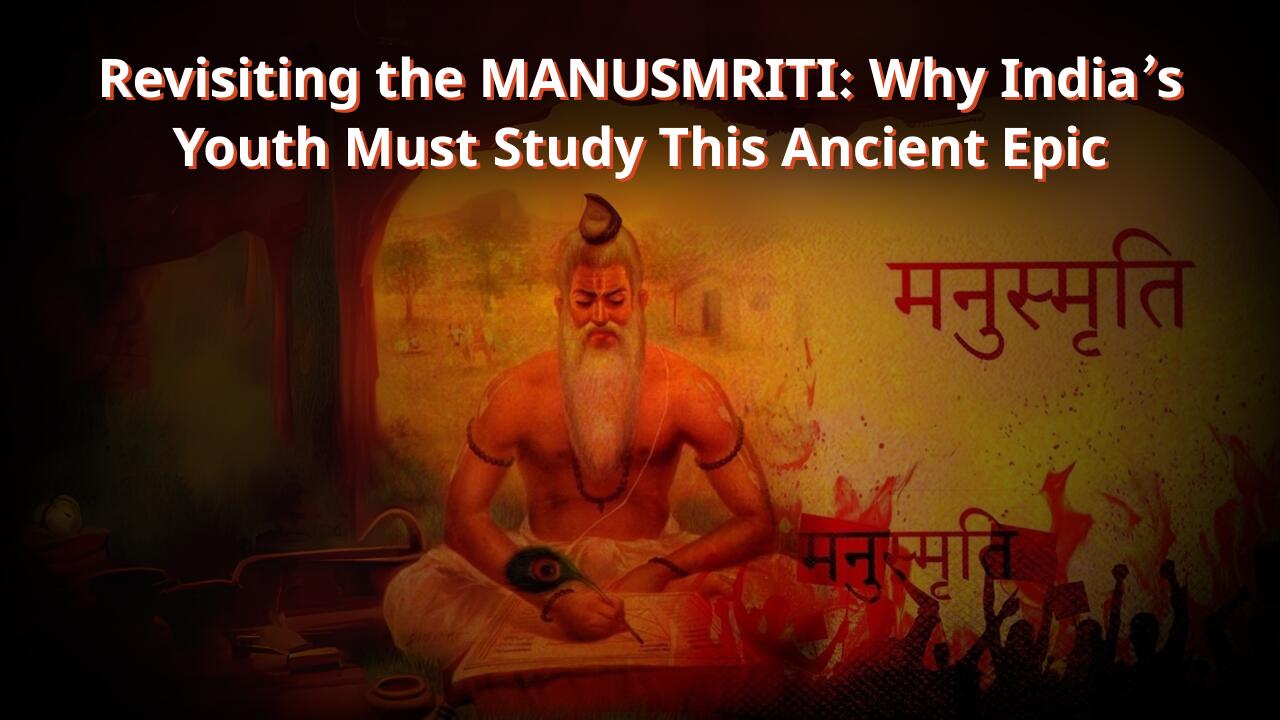
Revisiting the MANUSMRITI: Why India’s Youth Must Study This Ancient Epic

The need of the time is that India’s youth should approach this text not with blind reverence, nor with inherited prejudice, but with the critical curiosity that any ancient source of knowledge deserves.

Prof Vivek Misra by Prof Vivek Misra
14 July 2025
in Books, Culture, Education, History, Opinions
Revisiting the MANUSMRITI: Why India’s Youth Must Study This Ancient Epic

Manusmriti

Share on FacebookShare on X

In the vast ocean of India’s civilizational treasures, few texts evoke as much passion, controversy, and confusion as the Manusmriti. Also known as the Manava Dharmashastra, this ancient text has stood for over two millennia as one of the earliest and most detailed articulations of law, morality, and social order in the Indian subcontinent. For many modern Indians, especially the youth, Manusmriti is more often heard about than read — cited in fiery debates, invoked in protests, and frequently condemned outright as the fountainhead of oppressive social practices, especially the rigid caste hierarchy.

Yet, what is often forgotten is that the Manusmriti is a mirror to an ancient society, a codification of norms, anxieties, aspirations, and contradictions that shaped the Indian civilization for centuries. To dismiss it outright is to reject an opportunity to understand India’s civilizational DNA, to trace the evolution of its institutions, and to sharpen one’s own sense of social justice and reform.

RelatedPosts

Ambedkar Jayanti Clash Rocks Lakhimpur Kheri as Statue Dispute Triggers Violence, Arrests and Fresh Tension

A saga of Congress humilitating BR Ambedkar

Revisiting the Constitutional Spirit: Language, Identity and the Framers’ Vision

Load More

The need of the time is that India’s youth should approach this text not with blind reverence, nor with inherited prejudice, but with the critical curiosity that any ancient source of knowledge deserves. Studying the Manusmriti is vital for an informed citizenry, how to read it critically is important, and there are lessons — both cautionary and illuminating for today’s generation.

Understanding the Manusmriti: More Than a Rule Book

First, it is important to clarify what the Manusmriti is, and what it is not. Attributed to the sage Manu, the text is essentially a dharmashastra — a treatise on dharma, which in ancient Indian context encompassed law, morality, duty, and social order. Composed in Sanskrit, likely between 200 BCE and 200 CE, it contains 2,684 verses covering a vast array of topics: from the duties of kings and the regulation of family life to the administration of justice and guidelines for personal conduct.

To reduce the Manusmriti to simply a manual for caste oppression is to flatten its complexity. It certainly codifies a stratified society and sanctions practices that modern sensibilities rightly reject, but it also grapples with issues of governance, crime and punishment, property rights, gender roles, penance, and moral philosophy.

Like Hammurabi’s Code or Justinian’s Corpus Juris Civilis, the Manusmriti must be read as a product of its time — an attempt by an ancient society to articulate order amidst the flux of life. Its value today lies not in following its injunctions verbatim but in studying it as a historical document that illuminates how Indians thought about law, authority, and social cohesion.

Shedding Prejudice: Why Manusmriti is NOT a Sacred Monolith

One major reason young Indians shy away from the Manusmriti is the impression that it is a “holy book” for Hindus. This is misleading. Unlike the Vedas, which are shruti (that which is heard, or revealed), the Manusmriti is smriti (that which is remembered, or authored). In the Hindu epistemological framework, shruti holds greater authority. Smritis — of which Manusmriti is one — were composed by human sages and are open to interpretation, debate, and even rejection.

Throughout Indian history, the Manusmriti has been criticized, amended, and even defied. Buddhist and Jain traditions outright rejected its social stratification. In medieval India, thinkers like Basava and saints of the Bhakti movement denounced caste hierarchies. Even within Hindu jurisprudence, multiple smritis existed and were consulted alongside or instead of the Manusmriti. In modern times, reformers like Raja Ram Mohan Roy and Swami Dayanand Saraswati called for re-examining these codes in light of rationality and ethics.

This living tradition of debate should embolden today’s youth to read the Manusmriti critically, not fearfully. To understand it is not to endorse it; to critique it, one must first know it.

The Roots of Misunderstanding

One must also ask: Why does the Manusmriti carry such notoriety today? Part of the answer lies in colonial historiography and nationalist politics. When British administrators and Orientalists encountered India’s bewildering diversity, they sought an anchor — a single text that could represent “Hindu law.” The Manusmriti, with its extensive legal codes, was convenient. It was translated by Sir William Jones in 1794 and used as a basis for Anglo-Hindu law.

Yet, in doing so, the British froze a fluid tradition into a rigid code. Practices that had evolved over centuries were suddenly interpreted through the lens of an ancient text that few communities actually consulted in daily life. In parallel, Indian social reformers seeking to dismantle caste injustices targeted the Manusmriti as the symbolic villain. Dr. B.R. Ambedkar’s public burning of the Manusmriti in 1927 remains an iconic moment of protest against caste discrimination. It is critical to appreciate Ambedkar’s brilliance here: he was not afraid of the text — he had studied it thoroughly and used it as evidence to indict an oppressive social system. He did not reject knowledge; he challenged misuse. The lesson for today’s youth is clear: know your sources before you denounce them.

How to Read Manusmriti? A Roadmap for Young Minds

So, how should young Indians approach the Manusmriti today? A tentative roadmap could be read, compare, analyse and relate. Do not read the Manusmriti in isolation. Pair it with other dharmashastras — like the Yajnavalkya Smriti — and contemporary works by Kautilya (Arthashastra). Read commentaries by ancient scholars like Medhatithi. Notice the diversity of interpretations and the debates within Indian jurisprudence.

At the same time, compare the Manusmriti with other ancient law codes: Hammurabi’s Code, the Mosaic Law, or Roman legal traditions. This comparative lens shows that moral codes have always reflected the needs and contradictions of their societies.

Subsequently, try to identify passages that are unjust by modern standards — discriminatory laws, punishments, and social restrictions. Ask why these rules emerged. What anxieties were they trying to address? How did power operate? Which sections were ignored or evolved over time? While doing so, constructive dialogues may also be undertaken, the goal is not just to know what the Manusmriti says but to understand what it reveals about power, authority, social control, and human behavior.

Surprisingly, the Manusmriti has much to teach about governance. Its sections on the duties of rulers, the importance of impartial justice, and the checks on kingly power are valuable for students of political science. These ideas invite reflection on corruption, state power, and rule of law today.

A genuine study of the Manusmriti will undoubtedly reveal disturbing ideas: the endorsement of untouchability, gender inequality, and severe punishments. These are not to be glossed over — they must be confronted.

This confrontation has two merits. First, it inoculates us against romanticizing the past. No civilization is flawless, and no tradition immune to critique. Second, it helps us appreciate the remarkable journey of Indian society — how it produced both texts like the Manusmriti and visionaries like Buddha, Kabir, and Ambedkar who challenged orthodoxy.

When the youth see this dialectic, they gain confidence in their ability to reform the present. If ancient societies could evolve, so can we.

Youth Must Lead This Inquiry

India today is a youthful nation — nearly 65% of its population is under 35. This demographic dividend will only bear fruit if the youth cultivate intellectual honesty and historical curiosity. In an age of viral misinformation, it is tempting to echo slogans without checking sources. The Manusmriti invites you to reject easy binaries — blind reverence or blind rejection — and choose the harder path of informed critique.

Studying ancient texts like the Manusmriti sharpens your analytical mind. It exposes you to the evolution of ideas about governance, social hierarchy, and justice. It teaches you how societies justify power, how religion and politics intertwine, and how moral norms are constructed and contested.

For students of political science, sociology, history, and law, this is invaluable. But its relevance is not limited to academics. Entrepreneurs, artists, policymakers, and activists all benefit from understanding the roots of India’s social fabric.

The Manusmriti as a Catalyst for Social Reform

One might ask: if at all, the Manusmriti contains ideas we reject, why keep it alive? The answer is simple — because it keeps us vigilant. Historical memory is a safeguard against regression. Studying oppressive codes helps us recognize their modern avatars. Caste discrimination, gender bias, and social exclusion persist, though often in subtler forms. Knowing their historical justifications helps dismantle them more effectively.

Moreover, the Manusmriti is not just a relic of injustice; it also demonstrates how societies adapt. Later dharmashastras, commentaries, and local customs often modified or ignored its harshest injunctions. This fluidity shows that reform is possible — and often inevitable — when people challenge dogma with knowledge.

Conclusion: Towards an Informed, Just Future

To reject the Manusmriti without reading it is to surrender to ignorance. To accept it uncritically is to surrender to dogma. But to study it fearlessly is to arm oneself with knowledge — the most potent tool for change.

India’s youth stand at a crossroads where they must balance tradition and modernity, faith and reason, continuity and change. The Manusmriti is not the answer to today’s questions — but understanding it is part of asking better questions. It shows how far we have come and how far we must still go.

The youth must pick up the Manusmriti. Read its verses. Critique its injustices. Learn its lessons. And in doing so, honor not just the past but the future — a future shaped by informed, courageous minds unafraid to question and reform.

After all, the story of India has always been one of dialogue, dissent, and discovery. Let us continue that story — with knowledge as our guide and justice as our goal.
Tags: AmbedkarDebate on ManusmritiHindu scripturesManusmritiProf Vivek MisraSage ManuSanatan Dhrama
ShareTweetSend
Previous Post

Love Jihad in Shahjahanpur: ‘Shiv Verma’ Turns Out to Be Naved Pathan; Tilak, Kalawa Were a Lie

Next Post

Hindu Faith Under Siege: Mass Religious Conversions Rock Tamil Nadu

Related Posts

CBSE OSM Fallout Deepens as 4 Lakh Students Rush for Re-evaluation, Raising Serious Questions on Digital Checking System
Education

CBSE OSM Fallout Deepens as 4 Lakh Students Rush for Re-evaluation, Raising Serious Questions on Digital Checking System

29 May 2026

The Central Board of Secondary Education opened the Class 12 re-evaluation window amid growing backlash over its On-Screen Marking...

Veer Savarkar
History

When Nehru Government Imprisoned Veer Savarkar for the Pakistani Prime Minister

28 May 2026

When Vinayak Damodar Savarkar, popularly known as Veer Savarkar, was imprisoned by the British in the Cellular Jail of...

Career Outcomes After Completing an Executive MBA in India
Education

Career Outcomes After Completing an Executive MBA in India

21 May 2026

Why Professionals Choose an Executive MBA Mid career professionals often reach a stage where growth begins to plateau. While...

Load More

Leave a Reply Cancel reply

Your email address will not be published. Required fields are marked *

I agree to the Terms of use and Privacy Policy.
This site is protected by reCAPTCHA and the Google Privacy Policy and Terms of Service apply.

Currently Playing

From Runways to Warships: India’s Firefighting Warrior Built for Bases & Battles| IAF | VayuShakti

From Runways to Warships: India’s Firefighting Warrior Built for Bases & Battles| IAF | VayuShakti

00:05:40

Ethanol, EVs and Solar- How India’s Energy Game Is Changing | Modi on LPG & Crude Oil | war| Hormuz

00:05:21

Truth of IRIS Dena: 8 Days That Changed Narrative | War zone Reality, Not an Indian Navy Exercise

00:08:02

300 Million Euros for SCALP: Strategic Necessity or Costly Dependency on France300

00:04:06

Tejas Mk1A: 19th aircraft coupled but Not Delivered: What Is Holding Back the IAF Induction?

00:07:21
Facebook Twitter Instagram Youtube
tfipostTfipost.com
Right Wing | News Analysis | Indian Opinion
  • About us
  • Contact Us
  • Careers
  • Brand Partnerships
  • Terms of use
  • Privacy Policy
  • Sitemap

©2026 TFI Media Private Limited

No Result
View All Result
  • Premium
  • Politics
    • Analysis
    • Opinions
    • Trending
  • Economy
    • Business
    • Finance
  • Defense
    • Defence
    • Strategy
    • Weaponry
  • Geopolitics
    • Africa
    • Americas
    • Asia Pacific
    • Europe
    • South Asia
    • West Asia
  • Knowledge
    • Culture
    • History
    • Indology
  • Law
  • Lounge
    • Books
    • Cinema
    • Food
    • Health
    • Sports
    • technology
    • Travel
    • Satire
TFIPOST हिन्दी
TFIPOST Global

©2026 TFI Media Private Limited