















TFIPOST हिन्दी
TFIPOST Global
Tfipost.com
Tfipost.com
No Result
View All Result
  • Premium
  • Politics
    • All
    • Analysis
    • Opinions
    • Trending
    New address, old controversy as “Sheesh Mahal 2”

    From Flagstaff Road To Lodhi Estate: Kejriwal’s New Bungalow Triggers Fresh “Sheesh Mahal 2” Political Controversy

    The Bengal campaign takes a more aggressive turn.

    “Bengal Under Mafia Grip”: Yogi Adityanath Escalates Attack On TMC, Flags ‘Identity Crisis’ In Rally

    From AAP dissenter to BJP rebel, Swati Maliwal sharpens her attack on Kejriwal

    Did Swati Maliwal Just Puncture AAP’s Politics of Virtue?

    Ahmadis in Pakistan: From Faith to Marginalisation Under Law and Society

    Ahmadis in Pakistan: From Faith to Marginalisation Under Law and Society

    • Analysis
    • Opinions
    • Trending
  • Economy
    • All
    • Business
    • Economy1
    • Finance
    Ahmadis in Pakistan: From Faith to Marginalisation Under Law and Society

    Ahmadis in Pakistan: From Faith to Marginalisation Under Law and Society

    Open Demat Account with Zero Annual Maintenance Charges What to Look For

    Open Demat Account with Zero Annual Maintenance Charges What to Look For

    Blood in the Meadows: How the Pahalgam Terror Attack Exposed Calculated Targeting of Civilians in Kashmir

    Blood in the Meadows: How the Pahalgam Terror Attack Exposed Calculated Targeting of Civilians in Kashmir

    Indian economy is stronger than the ranking.

    IMF Ranking Jolt Misread: India’s Economy Strong, Sixth Spot Just a Statistical Glitch

    • Business
    • Finance
  • Defense
    • All
    • Defence
    • Strategy
    • Weaponry
    The scars of Pahalgam endure, even as the nation moves forward

    Pahalgam Anniversary: Modi Signals Firm National Stand as India Reasserts Anti-Terror Resolve

    Precision Strike: Indian Army Approves Procurement of Indigenous MPATGM to Modernise Infantry Wings

    Precision Strike: Indian Army Approves Procurement of Indigenous MPATGM to Modernise Infantry Wings

    Amit Shah on sensitive Gorkha land issue

    Shah Assures Constitutional Path for Gorkha Issue, Intensifies Attack on TMC at Bengal Rally

    Historic Leap for ‘Aatmanirbhar Bharat’ as First India-Made BrahMos Missiles from Lucknow Join Indian Army

    Historic Leap for ‘Aatmanirbhar Bharat’ as First India-Made BrahMos Missiles from Lucknow Join Indian Army

    • Defence
    • Strategy
    • Weaponry
  • Geopolitics
    • All
    • Africa
    • Americas
    • Asia Pacific
    • Europe
    • South Asia
    • West Asia
    Pakistan Tried to Bury an NYT Report. It Only Exposed Asim Munir’s Panic

    Pakistan Tried to Bury an NYT Report. It Only Exposed Asim Munir’s Panic

    The Strategic Double-Game: Pakistan’s Fatal Gambit in the US-Iran War

    The Strategic Double-Game: Pakistan’s Fatal Gambit in the US-Iran War

    When a repost became a foreign policy problem

    Trump’s India ‘Hellhole’ Insult Triggers Backlash as New Delhi Hits Back, US Scrambles for Damage Control

    PLA Navy Day Spectacle vs South China Sea Reality: How Beijing’s Naval Pageantry Masks Maritime Coercion

    PLA Navy Day Spectacle vs South China Sea Reality: How Beijing’s Naval Pageantry Masks Maritime Coercion

    • Africa
    • Americas
    • Asia Pacific
    • Europe
    • South Asia
    • West Asia
  • Knowledge
    • All
    • Culture
    • Education
    • History
    • Indology
    Chants of ‘Jai Badri Vishal’ Echo as Badrinath Portals Open; All Four Dhams Now Accessible to Pilgrims

    Chants of ‘Jai Badri Vishal’ Echo as Badrinath Portals Open; All Four Dhams Now Accessible to Pilgrims

    Kedarnath Dham Portals Open for Devotees After 181 Days Amid Vedic Chants, Traditional Rituals

    Kedarnath Dham Portals Open for Devotees After 181 Days Amid Vedic Chants, Traditional Rituals

    Sardar Patel and Amit Shah

    Sardar Patel’s 1947 Blueprint on Minority Quotas Resurfaces as Reservation Debate Returns to Centre Stage

    The 1973 Constitution and ‘Bhutto’ the Man Who Made It: What Pakistan Owes and What It Destroyed

    The 1973 Constitution and ‘Bhutto’ the Man Who Made It: What Pakistan Owes and What It Destroyed

    • Culture
    • History
    • Indology
  • Law
  • Lounge
    • All
    • Books
    • Cinema
    • Entertainment
    • Food
    • Games
    • Health
    • Lifestyle
    • Satire
    • Sports
    • technology
    • Travel
    Digital Data Collection In India

    India’s Data Reset Begins: Census 2027 to Become First Fully Digital Population Count

    5 Facilities in Bengaluru Specializing in Mental Health Treatment for Those with Cancer

    5 Facilities in Bengaluru Specializing in Mental Health Treatment for Those with Cancer

    UNESCO World Book Day and Copyright Day

    World Book Day 2026: UNESCO’s Multilingual Push Aligns with India’s Deep Literary Continuum

    Fashion Fusion Accessory Pairings That Modernize Your Look

    Fashion Fusion Accessory Pairings That Modernize Your Look

    • Books
    • Cinema
    • Food
    • Health
    • Sports
    • technology
    • Travel
    • Satire
Tfipost.com
  • Premium
  • Politics
    • All
    • Analysis
    • Opinions
    • Trending
    New address, old controversy as “Sheesh Mahal 2”

    From Flagstaff Road To Lodhi Estate: Kejriwal’s New Bungalow Triggers Fresh “Sheesh Mahal 2” Political Controversy

    The Bengal campaign takes a more aggressive turn.

    “Bengal Under Mafia Grip”: Yogi Adityanath Escalates Attack On TMC, Flags ‘Identity Crisis’ In Rally

    From AAP dissenter to BJP rebel, Swati Maliwal sharpens her attack on Kejriwal

    Did Swati Maliwal Just Puncture AAP’s Politics of Virtue?

    Ahmadis in Pakistan: From Faith to Marginalisation Under Law and Society

    Ahmadis in Pakistan: From Faith to Marginalisation Under Law and Society

    • Analysis
    • Opinions
    • Trending
  • Economy
    • All
    • Business
    • Economy1
    • Finance
    Ahmadis in Pakistan: From Faith to Marginalisation Under Law and Society

    Ahmadis in Pakistan: From Faith to Marginalisation Under Law and Society

    Open Demat Account with Zero Annual Maintenance Charges What to Look For

    Open Demat Account with Zero Annual Maintenance Charges What to Look For

    Blood in the Meadows: How the Pahalgam Terror Attack Exposed Calculated Targeting of Civilians in Kashmir

    Blood in the Meadows: How the Pahalgam Terror Attack Exposed Calculated Targeting of Civilians in Kashmir

    Indian economy is stronger than the ranking.

    IMF Ranking Jolt Misread: India’s Economy Strong, Sixth Spot Just a Statistical Glitch

    • Business
    • Finance
  • Defense
    • All
    • Defence
    • Strategy
    • Weaponry
    The scars of Pahalgam endure, even as the nation moves forward

    Pahalgam Anniversary: Modi Signals Firm National Stand as India Reasserts Anti-Terror Resolve

    Precision Strike: Indian Army Approves Procurement of Indigenous MPATGM to Modernise Infantry Wings

    Precision Strike: Indian Army Approves Procurement of Indigenous MPATGM to Modernise Infantry Wings

    Amit Shah on sensitive Gorkha land issue

    Shah Assures Constitutional Path for Gorkha Issue, Intensifies Attack on TMC at Bengal Rally

    Historic Leap for ‘Aatmanirbhar Bharat’ as First India-Made BrahMos Missiles from Lucknow Join Indian Army

    Historic Leap for ‘Aatmanirbhar Bharat’ as First India-Made BrahMos Missiles from Lucknow Join Indian Army

    • Defence
    • Strategy
    • Weaponry
  • Geopolitics
    • All
    • Africa
    • Americas
    • Asia Pacific
    • Europe
    • South Asia
    • West Asia
    Pakistan Tried to Bury an NYT Report. It Only Exposed Asim Munir’s Panic

    Pakistan Tried to Bury an NYT Report. It Only Exposed Asim Munir’s Panic

    The Strategic Double-Game: Pakistan’s Fatal Gambit in the US-Iran War

    The Strategic Double-Game: Pakistan’s Fatal Gambit in the US-Iran War

    When a repost became a foreign policy problem

    Trump’s India ‘Hellhole’ Insult Triggers Backlash as New Delhi Hits Back, US Scrambles for Damage Control

    PLA Navy Day Spectacle vs South China Sea Reality: How Beijing’s Naval Pageantry Masks Maritime Coercion

    PLA Navy Day Spectacle vs South China Sea Reality: How Beijing’s Naval Pageantry Masks Maritime Coercion

    • Africa
    • Americas
    • Asia Pacific
    • Europe
    • South Asia
    • West Asia
  • Knowledge
    • All
    • Culture
    • Education
    • History
    • Indology
    Chants of ‘Jai Badri Vishal’ Echo as Badrinath Portals Open; All Four Dhams Now Accessible to Pilgrims

    Chants of ‘Jai Badri Vishal’ Echo as Badrinath Portals Open; All Four Dhams Now Accessible to Pilgrims

    Kedarnath Dham Portals Open for Devotees After 181 Days Amid Vedic Chants, Traditional Rituals

    Kedarnath Dham Portals Open for Devotees After 181 Days Amid Vedic Chants, Traditional Rituals

    Sardar Patel and Amit Shah

    Sardar Patel’s 1947 Blueprint on Minority Quotas Resurfaces as Reservation Debate Returns to Centre Stage

    The 1973 Constitution and ‘Bhutto’ the Man Who Made It: What Pakistan Owes and What It Destroyed

    The 1973 Constitution and ‘Bhutto’ the Man Who Made It: What Pakistan Owes and What It Destroyed

    • Culture
    • History
    • Indology
  • Law
  • Lounge
    • All
    • Books
    • Cinema
    • Entertainment
    • Food
    • Games
    • Health
    • Lifestyle
    • Satire
    • Sports
    • technology
    • Travel
    Digital Data Collection In India

    India’s Data Reset Begins: Census 2027 to Become First Fully Digital Population Count

    5 Facilities in Bengaluru Specializing in Mental Health Treatment for Those with Cancer

    5 Facilities in Bengaluru Specializing in Mental Health Treatment for Those with Cancer

    UNESCO World Book Day and Copyright Day

    World Book Day 2026: UNESCO’s Multilingual Push Aligns with India’s Deep Literary Continuum

    Fashion Fusion Accessory Pairings That Modernize Your Look

    Fashion Fusion Accessory Pairings That Modernize Your Look

    • Books
    • Cinema
    • Food
    • Health
    • Sports
    • technology
    • Travel
    • Satire
No Result
View All Result
Tfipost.com
Tfipost.com
No Result
View All Result
  • Premium
  • Politics
  • Economy
  • Defense
  • Geopolitics
  • Knowledge
  • Law
  • Lounge

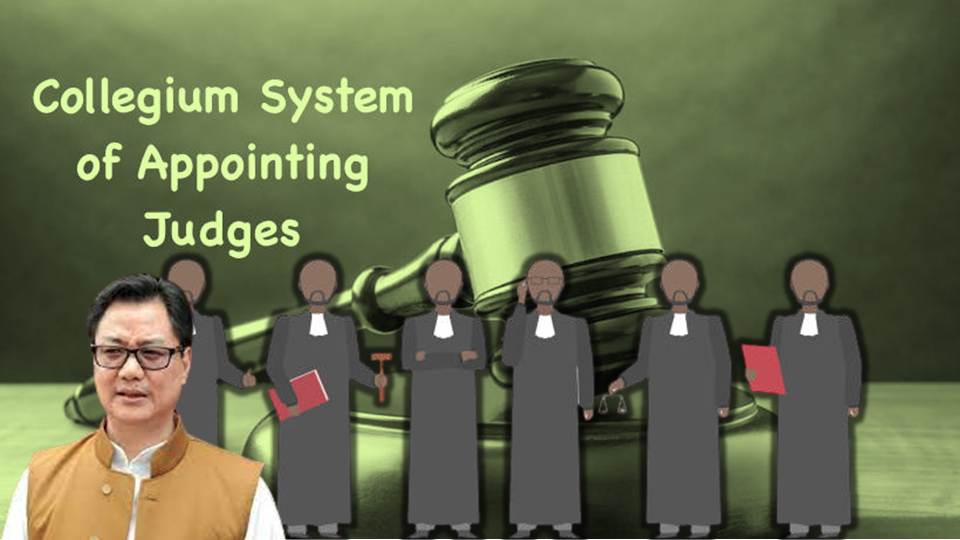
Kiren Rijiju talks about doing away with the collegium system in the Judiciary

Rahul Gupta by Rahul Gupta
19 September 2022
in Opinions
collegium system
Share on FacebookShare on X

French political thinker Charles Montesquieu in his theory of separation of power, states that power shall stop power in a system based on the rule of law. It was based on the fact that three organs of a government – legislative, executive and judiciary possess unlimited independent powers. Without any checks and balances, they would transgress each other’s power and would dismantle the very foundation of government based on the rule of law.

Thus, the Indian Constitution adopted a practical approach to limit the power dominance by making the executive part of the legislature. It also provided for the appointment of judges by the President of India, after the consultation with the judges of the Supreme Court and of the High Court, as the President may deem necessary.

RelatedPosts

Gauhati HC Dismantles Pawan Khera’s Defence, Backs Custodial Probe

SC Denies Pawan Khera Relief, Flags ‘Forum Shopping’ and Aadhaar Row, Sends Him to Assam Court

Sardar Patel’s 1947 Blueprint on Minority Quotas Resurfaces as Reservation Debate Returns to Centre Stage

Load More

But, with subsequent interpretation and judicial cases, the Supreme Court transgressed the power and manufactured a collegium body to appoint itself, which resulted in making the judiciary a self-serving and self-regulatory body. It has also promoted favouritism, nepotism, and cronyism in the judicial system.

For the smooth functioning of a democracy, it is very important that its different organs of administration work in consonance with the doctrine of separation of powers, and at the same time, there must be checks and balances for the given power.

India’s constitutional polity has been effective in controlling the powers of the executive as well as the legislature. The executive is the part of the legislature that has interdependence checks and both are being controlled by the people through the Universal Adult Franchise voting system. But, since the adoption of the constitution, the key points of talk have been the insufficient checks on the functioning and appointments of the judiciary.

Collegium System Affects Functioning of Judiciary

Once again igniting the debate of the collegium system in the judiciary, Union Law and Justice Minister Kiren Rijiju suggested that there is a need to rethink the collegium system to expedite the process of appointment in the higher judiciary.

Speaking at the inauguration of two-day Union of India Counsel (West Zone) Conference on ‘Emerging Legal Issues-2022’ at Udaipur, Rajasthan, the Ministers said that the appointments are pending not due to the law minister but due to the system.

Talking about the future course of action on the collegium system, he further stated that, “the system which is in place is causing trouble and everyone knows it. Further discussion will be held about what and how it has to be done. I put my views in front of everyone where judges, law officers and invitees were there”.

Collegium System

The Union Minister’s statement has once again ignited the debate over the process of appointments of judges in the higher judiciary. Since the adoption of the Constitution, an underlying legal war is being played between executive and judiciary over the appointments of judges.

According to Article 124 (2), every Judge of the Supreme Court shall be appointed by the President by warrant under his hand and seal after consultation with such of the Judges of the Supreme Court and of the High Courts in the States, as the President may deem necessary for the purpose. Further, the proviso of the Article states that in the case of appointment of a Judge other than the Chief Justice, the Chief Justice of India shall always be consulted.

For the Appointment of High Court Judges, Article 217 states that every Judge of a High Court shall be appointed by the President by warrant under his hand and seal after consultation with the Chief Justice of India, the Governor of the State, and, in the case of appointment of a Judge other than the Chief Justice, the Chief Justice of the High court.

Interpreting the word ‘consultation’ as ‘concurrence’ of the Chief Justice of India, the Court has opined in various cases that Primacy should be given to CJI’s opinion. In a way, the word consultation of the President’s power to appoint judges means the concurrent powers of CJI on the list of appointments. The President would comply with the CJI’s opinion on the appointment of judges.

Furthermore, in the Second Judges’ Case, the Supreme Court stated that the CJI’s position on the nomination of judges will be based on his senior colleagues’ views. Taking the advice of senior colleagues created a Collegium mechanism for recommending the nomination of judges.

In the Third judge’s case, the Supreme Court clarified that the collegium for the appointment of Supreme Court justices should comprise of the CJI and four senior most puisne judges of the Supreme Court. The collegium for High Court justices should be composed of the CJI and two of the SC’s most senior puisne judges.

The Court in its judgment stated that the appointment recommendation made according to the set norms shall be binding upon the President of India. In a way, interpreting the ‘consultation’ powers of the president with CJI was made concurrent and the collegium system was made supreme in the judicial appointments.

Collegium Is Nothing But A Family System

The collegium appointment method, in which judges choose judges, has frequently resulted in the appointment of some near and dear ones. In the judiciary, this collegium structure generated favouritism, nepotism, and cronyism.
Judges frequently choose their dear ones from the bar, and the succession cycle operates similarly to a family monarchy system. That is why most of the judges in the Supreme Court and High Courts of the different states are the relatives or family members of their own peers.

The system also had affected the independence and impartial functioning of the judiciary. It is important to understand that the judiciary is the single most powerful body in India. The Supreme Court of India is the final authority when it comes to determining the legal validity of any case, law, regulation, or decision. Their interpretation of the law is binding on every authority, people and organisation.

They are India’s supreme protectors and guardians of the rule of law. The Supreme Court’s legal interpretation shapes India’s social, economic, political, and even diplomatic policy. As a result, it is critical that this prestigious institution works efficiently and fulfills the aspirations of 1.4 billion Indians. Making a democratic constitutional authority into a private limited company is dangerous for the health of the democracy.

National Judicial Appointment Commission Is Cure To Collegium System

Since independence, the self-serving and self-regulating nature has blocked every attempt at judicial reform.
The most recent attempt to overhaul the court was the Ninety-Ninth Constitutional Amendment Act of 2014. The Act of 2014, provided for the National Judicial Appointment Commission (NJAC) under Article 124A of the Constitution for the appointments of the judges in the Supreme Court. The amendment effectively stated that all Supreme Court appointments will be based on the NJAC’s recommendation.

The member of NJAC includes:

  • (a) the Chief Justice of India, Chairperson, ex officio;
  • (b) two other senior Judges of the Supreme Court next to the Chief Justice of India––Members, ex officio;
  • (c) the Union Minister in charge of Law and Justice––Member, ex officio;
  • (d) two eminent persons to be nominated by the committee consisting of the Prime Minister, the Chief Justice of India, and the Leader of Opposition (LoO) in the House of the People ––Members

The involvement of three judges in a six-member commission and two eminent personalities through the committee of PM, CJI, and LoO was, in a way, an effort to bring transparency and checks to the appointment of judges. But, citing Article 50 (Separation of judiciary from executive) of the Indian Constitution and doctrine of Separation of Powers, the Supreme Court, in the Supreme Court Advocate on Record Association vs Union of India case, said that the 99th Constitutional Amendment Act, 2014 “do not provide adequate representation of judiciary to ensure PRIMACY of the judiciary” and termed the amendment is the violation of the ‘basic structure’ of the Constitution. The judgement also reinstated the older collegium system.

Also Read: “Lakshman Rekha must not be crossed,” Kiren Rijiju’s subtle message to the Judiciary

In a way, neither the executive nor legislature carry any significant say in the appointment of judges. Judges themselves appoint judges and carry forward the ‘inter-generational’ family business of being judges. The Collegium system’s sent list of judges are binding on the President. In case of any disagreement with the list, the President can’t do anything. These pending appointments delay the process and result in conflict between judiciary and executive.

Kiren Rijiju’s statement that “there is a need to think about the collegium system so that appointments in higher judiciary can be accelerated” is consonant with the same delay. Until and unless, the appointment of judges is not made transparent, the conflict would continue to persist. The separation of powers and the theory of checks and balances runs parallelly in a democratic system. In fact, separation of powers itself subscribes to the checks.

However, the Collegium system, in which judges appoint judges, is a blatant violation of the principle of separation of powers. Unlike legislative and executive members, judicial members are not elected by the general public or by any other organisation.

They are chosen by their own bodies and governed by their own people. As a result, it is critical to create a transparent organisation that, in accordance with constitutional principles, ensures the independence of the court.

Support TFI:

Support us to strengthen the ‘Right’ ideology of cultural nationalism by purchasing the best quality garments from TFI-STORE.COM
Also Watch:

Tags: Collegium systemConstitutioncourtExecutiveHigh CourtKiren RijijuLegistaiveSupreme Court
ShareTweetSend
Previous Post

The rise of India’s clout: Azerbaijan conflict, Pope’s Committee and SCO

Next Post

23 Happy good evening quotes and captions

Related Posts

Resolve of a Changing Bengal: Youth, Potential, and Call for Transformation
Opinions

Resolve of a Changing Bengal: Youth, Potential, and Call for Transformation

21 April 2026

The yearning for change in the soil of Bengal is not a sudden wave, it is a convergence of...

Redefining Terms of Truly Mutual Trade Deal: Sovereignty and Strategy in the US–Bangladesh Framework
Economy

Redefining Terms of Truly Mutual Trade Deal: Sovereignty and Strategy in the US–Bangladesh Framework

15 April 2026

The debate around Bangladesh’s emerging trade framework with the United States cannot be reduced to a binary choice of...

Race Against Iran Deadline: Was Pakistan’s Ceasefire Bid Driven by the White House?
Geopolitics

Race Against Iran Deadline: Was Pakistan’s Ceasefire Bid Driven by the White House?

9 April 2026

Pakistan attempted to position itself as a peacemaker in the escalating tensions involving Iran, but the reality behind the...

Load More

Leave a Reply Cancel reply

Your email address will not be published. Required fields are marked *

I agree to the Terms of use and Privacy Policy.
This site is protected by reCAPTCHA and the Google Privacy Policy and Terms of Service apply.

Currently Playing

From Runways to Warships: India’s Firefighting Warrior Built for Bases & Battles| IAF | VayuShakti

From Runways to Warships: India’s Firefighting Warrior Built for Bases & Battles| IAF | VayuShakti

00:05:40

Ethanol, EVs and Solar- How India’s Energy Game Is Changing | Modi on LPG & Crude Oil | war| Hormuz

00:05:21

Truth of IRIS Dena: 8 Days That Changed Narrative | War zone Reality, Not an Indian Navy Exercise

00:08:02

300 Million Euros for SCALP: Strategic Necessity or Costly Dependency on France300

00:04:06

Tejas Mk1A: 19th aircraft coupled but Not Delivered: What Is Holding Back the IAF Induction?

00:07:21
Facebook Twitter Instagram Youtube
tfipostTfipost.com
Right Wing | News Analysis | Indian Opinion
  • About us
  • Contact Us
  • Careers
  • Brand Partnerships
  • Terms of use
  • Privacy Policy
  • Sitemap

©2026 TFI Media Private Limited

No Result
View All Result
  • Premium
  • Politics
    • Analysis
    • Opinions
    • Trending
  • Economy
    • Business
    • Finance
  • Defense
    • Defence
    • Strategy
    • Weaponry
  • Geopolitics
    • Africa
    • Americas
    • Asia Pacific
    • Europe
    • South Asia
    • West Asia
  • Knowledge
    • Culture
    • History
    • Indology
  • Law
  • Lounge
    • Books
    • Cinema
    • Food
    • Health
    • Sports
    • technology
    • Travel
    • Satire
TFIPOST हिन्दी
TFIPOST Global

©2026 TFI Media Private Limited