



















TFIPOST हिन्दी
TFIPOST Global
Tfipost.com
Tfipost.com
No Result
View All Result
  • Premium
  • Politics
    • All
    • Analysis
    • Opinions
    • Trending
    GANDHI’S WAR 1918: WHEN AHIMSA BACKED THE EMPIRE

    The Collaborationist Apostle: Gandhi’s 1918 Betrayal of Ahinsa

    Mahatma Gandhi’s views on Cows, Cow Vigilantism and Cow-Slaughter

    Beyond the G2 Mirage: Why Great-Power Bargains Cannot Dictate India’s Ascent

    Beyond the G2 Mirage: Why Great-Power Bargains Cannot Dictate India’s Ascent

    PM Modi Speaks to Captain Smit Machchhar: “India Is Waiting to Welcome You”

    PM Modi Speaks to Captain Smit Machchhar: “India Is Waiting to Welcome You”

    • Analysis
    • Opinions
    • Trending
  • Economy
    • All
    • Business
    • Economy1
    • Finance
    Why More Vehicle Owners Are Choosing Online Car Insurance for Their Coverage Needs

    Why More Vehicle Owners Are Choosing Online Car Insurance for Their Coverage Needs

    Best Stripe Alternatives for Receiving Money in India (2026)

    Best Stripe Alternatives for Receiving Money in India (2026)

    Essar Group’s $18 billion Iowa steel plant — a “true homecoming” for Rewant Ruia, and the largest plant in US history

    Essar Group’s $18 billion Iowa steel plant — a “true homecoming” for Rewant Ruia, and the largest plant in US history

    What Makes an Online Slots Platform Safer for UK Players?

    What Makes an Online Slots Platform Safer for UK Players?

    • Business
    • Finance
  • Defense
    • All
    • Defence
    • Strategy
    • Weaponry
    INS Trishul Reaches Valencia as Indian Navy’s Mediterranean Deployment Continues

    INS Trishul Reaches Valencia as Indian Navy’s Mediterranean Deployment Continues

    114 Rafales by Financial Year-End? What India Could Get, and Where Tejas Mk1A, Mk2 and AMCA Fit

    114 Rafales by Financial Year-End? What India Could Get, and Where Tejas Mk1A, Mk2 and AMCA Fit

    Six BRICS Leaders, One Navy-Backed Indian Underwater Robot: What the EyeROV Moment Means

    Six BRICS Leaders, One Navy-Backed Indian Underwater Robot: What the EyeROV Moment Means

    Indian Navy Deepens Maritime Partnerships from the Mediterranean to the South China Sea

    Indian Navy Deepens Maritime Partnerships from the Mediterranean to the South China Sea

    • Defence
    • Strategy
    • Weaponry
  • Geopolitics
    • All
    • Africa
    • Americas
    • Asia Pacific
    • Europe
    • South Asia
    • West Asia
    Pakistan defence minister’s throat gesture at Afghan woman journalist draws condemnation

    Pakistan defence minister’s throat gesture at Afghan woman journalist draws condemnation

    When Solidarity Backfires: Wangchuk’s Tibet Remark and the CTA’s Sharp Rejection

    When Solidarity Backfires: Wangchuk’s Tibet Remark and the CTA’s Sharp Rejection

    The Jugular Vein That Bleeds Itself

    The Jugular Vein That Bleeds Itself

    US Ambassador Sergio Gor Hails Indo-US Troops Training Together at Mahajan Range, Calls Yudh Abhyas a Sign of Deepening Defence Ties

    US Ambassador Sergio Gor Hails Indo-US Troops Training Together at Mahajan Range, Calls Yudh Abhyas a Sign of Deepening Defence Ties

    • Africa
    • Americas
    • Asia Pacific
    • Europe
    • South Asia
    • West Asia
  • Knowledge
    • All
    • Culture
    • Education
    • History
    • Indology
    How to Choose the Right Online Degree at Apna Advantage for Your Career Goals

    How to Choose the Right Online Degree at Apna Advantage for Your Career Goals

    What Skills Will You Gain from a Strategic Leadership Course

    What Skills Will You Gain from a Strategic Leadership Course

    Young Indian Gen Z exploring Sanatan Dharma through smartphones, social media and the Bhagavad Gita

    Ancient Roots, Digital Minds: The Rise of Sanatani Gen Z

    Break into QA Jobs Faster with Automation Testing Course from StarAgile

    Break into QA Jobs Faster with Automation Testing Course from StarAgile

    • Culture
    • History
    • Indology
  • Law
  • Lounge
    • All
    • Books
    • Cinema
    • Entertainment
    • Food
    • Games
    • Health
    • Lifestyle
    • Satire
    • Sports
    • technology
    • Travel
    From “Nepotism” to the Pandya-Rahul Row: 7 Koffee With Karan Moments That Shook Bollywood

    From “Nepotism” to the Pandya-Rahul Row: 7 Koffee With Karan Moments That Shook Bollywood

    What Jaishankar’s food crisis warning reveals about India’s fertiliser weakness and its rice-export power

    What Jaishankar’s food crisis warning reveals about India’s fertiliser weakness and its rice-export power

    The Engagement Gap: Why Two TikTok Videos With the Same Views Can Perform Completely Differently

    The Engagement Gap: Why Two TikTok Videos With the Same Views Can Perform Completely Differently

    Mangal Dosha and Marriage Compatibility: What Does Astrology Say?

    Mangal Dosha and Marriage Compatibility: What Does Astrology Say?

    • Books
    • Cinema
    • Food
    • Health
    • Sports
    • technology
    • Travel
    • Satire
Tfipost.com
  • Premium
  • Politics
    • All
    • Analysis
    • Opinions
    • Trending
    GANDHI’S WAR 1918: WHEN AHIMSA BACKED THE EMPIRE

    The Collaborationist Apostle: Gandhi’s 1918 Betrayal of Ahinsa

    Mahatma Gandhi’s views on Cows, Cow Vigilantism and Cow-Slaughter

    Beyond the G2 Mirage: Why Great-Power Bargains Cannot Dictate India’s Ascent

    Beyond the G2 Mirage: Why Great-Power Bargains Cannot Dictate India’s Ascent

    PM Modi Speaks to Captain Smit Machchhar: “India Is Waiting to Welcome You”

    PM Modi Speaks to Captain Smit Machchhar: “India Is Waiting to Welcome You”

    • Analysis
    • Opinions
    • Trending
  • Economy
    • All
    • Business
    • Economy1
    • Finance
    Why More Vehicle Owners Are Choosing Online Car Insurance for Their Coverage Needs

    Why More Vehicle Owners Are Choosing Online Car Insurance for Their Coverage Needs

    Best Stripe Alternatives for Receiving Money in India (2026)

    Best Stripe Alternatives for Receiving Money in India (2026)

    Essar Group’s $18 billion Iowa steel plant — a “true homecoming” for Rewant Ruia, and the largest plant in US history

    Essar Group’s $18 billion Iowa steel plant — a “true homecoming” for Rewant Ruia, and the largest plant in US history

    What Makes an Online Slots Platform Safer for UK Players?

    What Makes an Online Slots Platform Safer for UK Players?

    • Business
    • Finance
  • Defense
    • All
    • Defence
    • Strategy
    • Weaponry
    INS Trishul Reaches Valencia as Indian Navy’s Mediterranean Deployment Continues

    INS Trishul Reaches Valencia as Indian Navy’s Mediterranean Deployment Continues

    114 Rafales by Financial Year-End? What India Could Get, and Where Tejas Mk1A, Mk2 and AMCA Fit

    114 Rafales by Financial Year-End? What India Could Get, and Where Tejas Mk1A, Mk2 and AMCA Fit

    Six BRICS Leaders, One Navy-Backed Indian Underwater Robot: What the EyeROV Moment Means

    Six BRICS Leaders, One Navy-Backed Indian Underwater Robot: What the EyeROV Moment Means

    Indian Navy Deepens Maritime Partnerships from the Mediterranean to the South China Sea

    Indian Navy Deepens Maritime Partnerships from the Mediterranean to the South China Sea

    • Defence
    • Strategy
    • Weaponry
  • Geopolitics
    • All
    • Africa
    • Americas
    • Asia Pacific
    • Europe
    • South Asia
    • West Asia
    Pakistan defence minister’s throat gesture at Afghan woman journalist draws condemnation

    Pakistan defence minister’s throat gesture at Afghan woman journalist draws condemnation

    When Solidarity Backfires: Wangchuk’s Tibet Remark and the CTA’s Sharp Rejection

    When Solidarity Backfires: Wangchuk’s Tibet Remark and the CTA’s Sharp Rejection

    The Jugular Vein That Bleeds Itself

    The Jugular Vein That Bleeds Itself

    US Ambassador Sergio Gor Hails Indo-US Troops Training Together at Mahajan Range, Calls Yudh Abhyas a Sign of Deepening Defence Ties

    US Ambassador Sergio Gor Hails Indo-US Troops Training Together at Mahajan Range, Calls Yudh Abhyas a Sign of Deepening Defence Ties

    • Africa
    • Americas
    • Asia Pacific
    • Europe
    • South Asia
    • West Asia
  • Knowledge
    • All
    • Culture
    • Education
    • History
    • Indology
    How to Choose the Right Online Degree at Apna Advantage for Your Career Goals

    How to Choose the Right Online Degree at Apna Advantage for Your Career Goals

    What Skills Will You Gain from a Strategic Leadership Course

    What Skills Will You Gain from a Strategic Leadership Course

    Young Indian Gen Z exploring Sanatan Dharma through smartphones, social media and the Bhagavad Gita

    Ancient Roots, Digital Minds: The Rise of Sanatani Gen Z

    Break into QA Jobs Faster with Automation Testing Course from StarAgile

    Break into QA Jobs Faster with Automation Testing Course from StarAgile

    • Culture
    • History
    • Indology
  • Law
  • Lounge
    • All
    • Books
    • Cinema
    • Entertainment
    • Food
    • Games
    • Health
    • Lifestyle
    • Satire
    • Sports
    • technology
    • Travel
    From “Nepotism” to the Pandya-Rahul Row: 7 Koffee With Karan Moments That Shook Bollywood

    From “Nepotism” to the Pandya-Rahul Row: 7 Koffee With Karan Moments That Shook Bollywood

    What Jaishankar’s food crisis warning reveals about India’s fertiliser weakness and its rice-export power

    What Jaishankar’s food crisis warning reveals about India’s fertiliser weakness and its rice-export power

    The Engagement Gap: Why Two TikTok Videos With the Same Views Can Perform Completely Differently

    The Engagement Gap: Why Two TikTok Videos With the Same Views Can Perform Completely Differently

    Mangal Dosha and Marriage Compatibility: What Does Astrology Say?

    Mangal Dosha and Marriage Compatibility: What Does Astrology Say?

    • Books
    • Cinema
    • Food
    • Health
    • Sports
    • technology
    • Travel
    • Satire
No Result
View All Result
Tfipost.com
Tfipost.com
No Result
View All Result
  • Premium
  • Politics
  • Economy
  • Defense
  • Geopolitics
  • Knowledge
  • Law
  • Lounge

Does India have a foodgrain problem? No, no and yes.

Abhishek Kumar Singh by Abhishek Kumar Singh
19 July 2022
in Premium
Foodgrains
Share on FacebookShare on X

India’s diversity has the capacity to shake anyone’s conscience. But this phenomenon is not limited to only population distribution. The whole polity and henceforth by extension the system dependent on it also reflects what could be easily classified as “cognitive dissonance”.

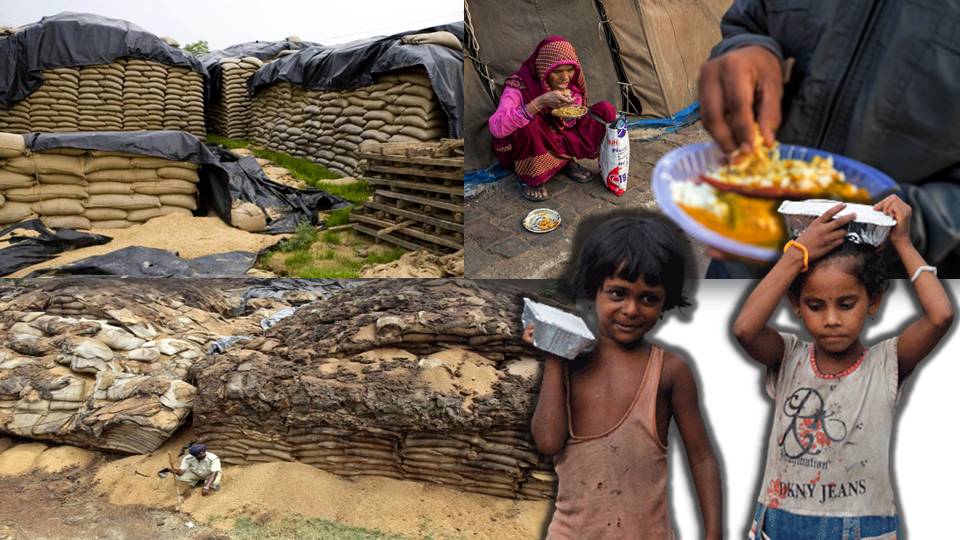
On one hand, we see reports of India fighting tooth and nail with WTO to enable seamless exports of Indian foodgrains, while on the other hand news reports time and again point towards people dying from hunger. Those basing their opinions on emotions (it reflects the majority) often ask if India has a foodgrain problem. The answer is a big ‘No’, but in a way, the problem is there. The presence of 33 lakh malnourished children substantiate it.

RelatedPosts

Why India is eyeing a route over China’s Xinjiang to get around Pakistan’s airspace ban. Here’s why it isn’t simple

Ten years on: how political resolve and military execution came together for the 2016 surgical strikes

Fifth-gen in the sky, fourth-gen on the ground: how the Tarang Shakti jets stack up against Pakistan’s and China’s frontline fighters

Load More

Foodgrain glut and hunger crisis

In the Financial year 2021, India produced nearly 308 million metric tonnes of foodgrains. Apparently, Covid-19 hurdles turned out net positive for agriculture sector and output registered nearly 4 per cent increase over 297 million metric tonnes of the financial year 2020.

Calculations tell us that India’s food production is good enough to provide 491 grams of grains to every Indian and that too on a daily basis. Moreover, our capacity is also strong with each hectare giving the output of nearly 2,400 kg.

In spite of such good numbers, hunger death in India has not disappeared. According to a January 2022 report by The Hindu, nearly 3 lakh children lose their lives due to hunger every year. Talking about adults, 5 years ago, a National Health Survey revealed that nearly 15 per cent of Indians slept on empty stomach. Though, through Direct Benefit Transfer, the numbers have declined, and according to The Global Food Policy Report 2022 released by the International Food Policy Research Institute, nearly 7.4 crore Indians are still facing hunger crisis. How much is it? Well, for the context, this number is equivalent to the population of nearly 3 times of Australia.

Crops are well diversified

Certainly, the problem is not in the production. Even the crop distribution pattern is not an issue in India. In fact, our crops are heavily tilted towards securing the nutrient requirement of average population. In the FY 2021, we produced 122 million metric tonnes of rice and more than 110 million metric tonnes of wheat.

Even the production of coarse cereals was more than 50 million metric tonnes. We do not need to import in order to fill everyone’s belly. So, the only problem one can point out to is the allotment and henceforth the availability of these crops to folks like you and me.

History of Public distribution system

While a lot of Indians buy their food, astonishingly over 50 per cent of them still rely on government for their nutritional requirements. Government makes the food available to them through Public Dustribution System (PDS). However, the system is not new and dates back to the British Raj. The system was brought into public policy for rationing food items during the World War II.

Given that the idea of welfare state was put into the Constitution, the legacy of public distribution system continued in India. Nehru government’s copy of the Soviet model ensured that even if we have to import foodgrains, PDS would continue. By the end of 1960s, it had become a necessity, as people were now addicted to free food. There was an imminent need to streamline the system.

In 1965, the government established Agriculture Prices Commission and the FCI. The former was mandated to ensure that price of agri-products do not go haywire, and the government’s cost of procuring it for subsidised distribution remains low. FCI was mainly mandated to ensure distribution of foodgrains under PDS.

27 years later, the scheme was revamped to make it more accessible to people living in far-flung, hilly, remote and inaccessible areas. Moreover, economic liberalisation had kicked in and now the government was aiming towards directing the PDS to only the needy. 5 years later, in 1997, the government introduced Targeted Public distribution system (TDPS).

From TDPS to food as a right

Under TDPS, beneficiaries were divided into below poverty and above the poverty line. TDPS is run by the Public Distribution System (Control) Order 2001, notified under the Essential Commodities Act, 1955 (ECA). Additionally, to ensure food security for the poorest 1 crore  Indians, Antyodaya Anna Yojana (AAY) was also launched by Vajpayee government. 8 years later, the Supreme Court ordered that BPL families are entitled to 35 kg of food grains per month at subsidised rates.

In 2011, India’s poverty rate had declined to 21.9 per cent from the high of 45.3 in 1993-94. Still Congress government felt it necessary to intervene in free market distribution. In 2013, the Manmohan Singh government brought National Food Security Act, 2013, and getting food from government became a right for poor and hungry. The act made it mandatory for states and centre to ensure food security to the last mile of the population. Now, if there was any problem with the deliverance, then it would be the responsibility of both the centre and the states to create a grievance redressal mechanism.

Mechanism of Food distribution to states

Under TDPS, Government procures food at Minimum support price from farmers. MSP is generally kept above market rate in order to incentivise farmers for producing more in subsequent years. Generally, FCI handles the task of responsibility and storage. In some states and Union territories, state governments do procurements on the behalf of FCI. These states directly store and distribute to beneficiaries. In case states’ collection became surplus, FCI handles the excess of grains. FCI also intervenes in case the procurement is less than what is required.

The food grains FCI get are stored as the central pool stock. Generally, they are stored in covered godowns, silos, and Covered and Plinth (CAP). Additionally, it also hires space from state warehousing corporations, state government agencies, and private parties.

Journey from FCI Godowns to fair price shops

From FCI storage, the foodgrains are transferred to states. Allocations for AAY and BPL families are prioritised. Allocation to people above Poverty Line is subject to availability of grains. FCI takes care of every minute step involved in the process. It is FCI’s responsibility to get foodgrains to state godowns. From then on, states take over.

States distribute these grains to Fair Price Shops. These are general ration shops licensed by state governments to take care of redistribution of grains on subsidised basis. Sometimes, they are owned by co-operative societies or even the government. These shops have to compulsorily sell wheat and rice at central issue prices. Some states also distribute sugar, kerosene among other essentials.

PDS not getting to intended beneficiaries

However, the problem which is haunting PDS system is that it has high rate of pilferage. According to a 2009 study, more than 61 per cent of intended beneficiaries were not included in government database. Similarly, 25 per cent fault was found in the list of included beneficiaries, that is poor were classified as non-poor and vice-versa. To solve the problem, Modi government has taken the help of technology. Government has integrated PDS with Aadhar and bank account.

Now, most of the beneficiaries avail benefits through One Time Password. Between 2014 and 2020, the Modi government saved more than Rs 1.7 lakh crores. According to a October 2021 report by The Hindu group, out of 81.3 crore beneficiaries identified by government, 71 crore were already getting their benefits through DBT. But the government needs to do more in order to ensure that the digital divide may not end up hampering the scheme.

Read more: 4.82 Crore Bogus Ration Cards cancelled by Modi government

Transportation leakage and black-marketing is also a big concern. Planning Commission had once found out that 36 per cent of foodgrains are leaked during transport. Central government’s own estimates of 2011-12 tell that 40 per cent of grain did not even reach to the target population. Though, by November 2021, the leakage was down to 15 per cent, it is still not a number to be felt proud of. Until, ‘Babugiri’ of the ultra-socialist era is broken down from the core, it is not possible to bring it down to zero.

Storages – still a cause of concern

Other issues like open ended procurement are also a big cause of concern. On an average, governments procure more than 75 million tonnes of food grains to distribute. This is in addition to the previous years’ stocks. Moreover, even if government storage is full, the incoming grains are accepted by government. It further exacerbates the issue and sometimes government has to make arrangements for storing 90 million tonnes of grains.

Government just does not have the capacity to store all of it. According to a 2018 report, FCI could only store 88 million tonnes of foodgrains. 13 million tonnes of those were in the Cover and Plinth (CAP) storage in open sky. It leads to loss of foodgrains as well. Thousands of tonnes of foodgrains just disappear from the godowns.

The only solution which the government is left with is buying space from private sector on exacerbated price. This creates shortage in the market leading to unnecessary inflation. At the same time, due to lack of storage, extra grains are wasted. In its report, even CAG had pointed towards the phenomenon of rotting of grains due to less storage. Working on the recommendation of Shantaram Committee, the Modi government is working on creating 10 million tonnes of silo capacity to save foodgrains from wastage.

It is clear that the problem with foodgrains in India is not the production. Instead, other operational issues are hampering the accessibility of foodgrains to needy section of the population. Though, Direct Benefit Transfer through Aadhar is changing things, there is still a long way to go.


Support TFI:

Support us to strengthen the ‘Right’ ideology of cultural nationalism by purchasing the best quality garments from TFI-STORE.COM

Also Watch:
 

Tags: DistributionFoodFoodgrainsGovernmentHungerIndiaPDSsystem
ShareTweetSend
Previous Post

Yashwant Sinha has lost the elections, and the opposition has made it public

Next Post

AI now in fighter jets as well: India’s modernization strategy for the Air Force

Related Posts

Mera Ration 2.0: A Leap Towards Digital Transparency and Corruption-Free India
Business

Mera Ration 2.0: A Leap Towards Digital Transparency and Corruption-Free India

13 September 2024

How India's Latest Digital Initiative is Revolutionizing Ration Distribution India is making significant strides in the digital realm with...

The Lahore declaration that was not meant to be
History

The Lahore declaration that was not meant to be

25 February 2023

For a long time, India’s geographical region of Kashmir has been a sensitive issue between India and Pakistan. But...

Baikunth Shukla
History

Bihar’s Forgotten Sons: Yogendra Shukla and Baikunth Shukla

22 February 2023

Story of Baikunth Shukla and Yogendra Shukla: Have you been to Bihar before? Stop assuming. I'm not referring to...

Load More

Leave a Reply Cancel reply

Your email address will not be published. Required fields are marked *

I agree to the Terms of use and Privacy Policy.
This site is protected by reCAPTCHA and the Google Privacy Policy and Terms of Service apply.

Currently Playing

Hanuman Chalisa Kept Me Going': Flydubai Hero Smit

Hanuman Chalisa Kept Me Going': Flydubai Hero Smit

00:10:03

How Pakistan-Linked Drug Networks Are Targeting India | Coast Guard Deals a ₹3,000 Crore Blow

00:03:28

How SkyStriker Hunts Its Target: Inside India’s Loitering Munition

00:03:49

F-35 vs Rafale? Inside India’s Biggest Air Exercise

00:05:54

China and the Philippines Are Fighting a War With Maps, Not Missiles

00:05:55
Facebook Twitter Instagram Youtube
tfipostTfipost.com
Right Wing | News Analysis | Indian Opinion
  • About us
  • Contact Us
  • Careers
  • Brand Partnerships
  • Terms of use
  • Privacy Policy
  • Sitemap

©2026 TFI Media Private Limited

No Result
View All Result
  • Premium
  • Politics
    • Analysis
    • Opinions
    • Trending
  • Economy
    • Business
    • Finance
  • Defense
    • Defence
    • Strategy
    • Weaponry
  • Geopolitics
    • Africa
    • Americas
    • Asia Pacific
    • Europe
    • South Asia
    • West Asia
  • Knowledge
    • Culture
    • History
    • Indology
  • Law
  • Lounge
    • Books
    • Cinema
    • Food
    • Health
    • Sports
    • technology
    • Travel
    • Satire
TFIPOST हिन्दी
TFIPOST Global

©2026 TFI Media Private Limited