












TFIPOST हिन्दी
TFIPOST Global
Tfipost.com
Tfipost.com
No Result
View All Result
  • Premium
  • Politics
    • All
    • Analysis
    • Opinions
    • Trending
    Record Voter Turnout in Bengal and Tamil Nadu Redefines Electoral Mood as Poll Battle Builds Toward May 4 Verdict

    Record Voter Turnout in Bengal and Tamil Nadu Redefines Electoral Mood as Poll Battle Builds Toward May 4 Verdict

    UNESCO World Book Day and Copyright Day

    World Book Day 2026: UNESCO’s Multilingual Push Aligns with India’s Deep Literary Continuum

    Before Votes Are Cast, Blame Games Begin: Election Commission Under Fire in Bengal Election 2026

    Before Votes Are Cast, Blame Games Begin: Election Commission Under Fire in Bengal Election 2026

    Fear-Free Voting or Managed Calm? What CAPF Presence Signals in the Bengal Election

    Fear-Free Voting or Managed Calm? What CAPF Presence Signals in the Bengal Election

    • Analysis
    • Opinions
    • Trending
  • Economy
    • All
    • Business
    • Economy1
    • Finance
    Blood in the Meadows: How the Pahalgam Terror Attack Exposed Calculated Targeting of Civilians in Kashmir

    Blood in the Meadows: How the Pahalgam Terror Attack Exposed Calculated Targeting of Civilians in Kashmir

    Indian economy is stronger than the ranking.

    IMF Ranking Jolt Misread: India’s Economy Strong, Sixth Spot Just a Statistical Glitch

    The Fuel Miracle: How India Frozen Petrol Prices Amidst a Global Inferno

    The Fuel Miracle: How India Frozen Petrol Prices Amidst a Global Inferno

    From Sapta Sindhu to Statecraft: Inaugural ‘Sindhu Samvad’ Links Indus Past with Policy Present

    From Sapta Sindhu to Statecraft: Inaugural ‘Sindhu Samvad’ Links Indus Past with Policy Present

    • Business
    • Finance
  • Defense
    • All
    • Defence
    • Strategy
    • Weaponry
    The scars of Pahalgam endure, even as the nation moves forward

    Pahalgam Anniversary: Modi Signals Firm National Stand as India Reasserts Anti-Terror Resolve

    Precision Strike: Indian Army Approves Procurement of Indigenous MPATGM to Modernise Infantry Wings

    Precision Strike: Indian Army Approves Procurement of Indigenous MPATGM to Modernise Infantry Wings

    Amit Shah on sensitive Gorkha land issue

    Shah Assures Constitutional Path for Gorkha Issue, Intensifies Attack on TMC at Bengal Rally

    Historic Leap for ‘Aatmanirbhar Bharat’ as First India-Made BrahMos Missiles from Lucknow Join Indian Army

    Historic Leap for ‘Aatmanirbhar Bharat’ as First India-Made BrahMos Missiles from Lucknow Join Indian Army

    • Defence
    • Strategy
    • Weaponry
  • Geopolitics
    • All
    • Africa
    • Americas
    • Asia Pacific
    • Europe
    • South Asia
    • West Asia
    PLA Navy Day Spectacle vs South China Sea Reality: How Beijing’s Naval Pageantry Masks Maritime Coercion

    PLA Navy Day Spectacle vs South China Sea Reality: How Beijing’s Naval Pageantry Masks Maritime Coercion

    Rajnath Singh addresses the possibility of India contributing to peace efforts in West Asia amid ongoing geopolitical tensions.

    Could India Become a Diplomatic Space in the West Asia Crisis? Rajnath Singh Hints at Possibility

    The Fuel Miracle: How India Frozen Petrol Prices Amidst a Global Inferno

    The Fuel Miracle: How India Frozen Petrol Prices Amidst a Global Inferno

    Port Under Siege: Gwadar Faces Threats from All Sides

    Port Under Siege: Gwadar Faces Threats from All Sides

    • Africa
    • Americas
    • Asia Pacific
    • Europe
    • South Asia
    • West Asia
  • Knowledge
    • All
    • Culture
    • Education
    • History
    • Indology
    Chants of ‘Jai Badri Vishal’ Echo as Badrinath Portals Open; All Four Dhams Now Accessible to Pilgrims

    Chants of ‘Jai Badri Vishal’ Echo as Badrinath Portals Open; All Four Dhams Now Accessible to Pilgrims

    Kedarnath Dham Portals Open for Devotees After 181 Days Amid Vedic Chants, Traditional Rituals

    Kedarnath Dham Portals Open for Devotees After 181 Days Amid Vedic Chants, Traditional Rituals

    Sardar Patel and Amit Shah

    Sardar Patel’s 1947 Blueprint on Minority Quotas Resurfaces as Reservation Debate Returns to Centre Stage

    The 1973 Constitution and ‘Bhutto’ the Man Who Made It: What Pakistan Owes and What It Destroyed

    The 1973 Constitution and ‘Bhutto’ the Man Who Made It: What Pakistan Owes and What It Destroyed

    • Culture
    • History
    • Indology
  • Law
  • Lounge
    • All
    • Books
    • Cinema
    • Entertainment
    • Food
    • Games
    • Health
    • Lifestyle
    • Satire
    • Sports
    • technology
    • Travel
    UNESCO World Book Day and Copyright Day

    World Book Day 2026: UNESCO’s Multilingual Push Aligns with India’s Deep Literary Continuum

    Stake Betting Guide for the UEFA Champions League Semi Finals

    Stake Betting Guide for the UEFA Champions League Semi Finals

    AI in healthcare

    AI is Recasting Healthcare, Reshaping How Medicine is Practised

    Delhi-Dehradun Expressway

    Modi Launches ₹12,000-Crore Delhi–Dehradun Expressway, Cutting Journey Time to Around 2.5 Hours

    • Books
    • Cinema
    • Food
    • Health
    • Sports
    • technology
    • Travel
    • Satire
Tfipost.com
  • Premium
  • Politics
    • All
    • Analysis
    • Opinions
    • Trending
    Record Voter Turnout in Bengal and Tamil Nadu Redefines Electoral Mood as Poll Battle Builds Toward May 4 Verdict

    Record Voter Turnout in Bengal and Tamil Nadu Redefines Electoral Mood as Poll Battle Builds Toward May 4 Verdict

    UNESCO World Book Day and Copyright Day

    World Book Day 2026: UNESCO’s Multilingual Push Aligns with India’s Deep Literary Continuum

    Before Votes Are Cast, Blame Games Begin: Election Commission Under Fire in Bengal Election 2026

    Before Votes Are Cast, Blame Games Begin: Election Commission Under Fire in Bengal Election 2026

    Fear-Free Voting or Managed Calm? What CAPF Presence Signals in the Bengal Election

    Fear-Free Voting or Managed Calm? What CAPF Presence Signals in the Bengal Election

    • Analysis
    • Opinions
    • Trending
  • Economy
    • All
    • Business
    • Economy1
    • Finance
    Blood in the Meadows: How the Pahalgam Terror Attack Exposed Calculated Targeting of Civilians in Kashmir

    Blood in the Meadows: How the Pahalgam Terror Attack Exposed Calculated Targeting of Civilians in Kashmir

    Indian economy is stronger than the ranking.

    IMF Ranking Jolt Misread: India’s Economy Strong, Sixth Spot Just a Statistical Glitch

    The Fuel Miracle: How India Frozen Petrol Prices Amidst a Global Inferno

    The Fuel Miracle: How India Frozen Petrol Prices Amidst a Global Inferno

    From Sapta Sindhu to Statecraft: Inaugural ‘Sindhu Samvad’ Links Indus Past with Policy Present

    From Sapta Sindhu to Statecraft: Inaugural ‘Sindhu Samvad’ Links Indus Past with Policy Present

    • Business
    • Finance
  • Defense
    • All
    • Defence
    • Strategy
    • Weaponry
    The scars of Pahalgam endure, even as the nation moves forward

    Pahalgam Anniversary: Modi Signals Firm National Stand as India Reasserts Anti-Terror Resolve

    Precision Strike: Indian Army Approves Procurement of Indigenous MPATGM to Modernise Infantry Wings

    Precision Strike: Indian Army Approves Procurement of Indigenous MPATGM to Modernise Infantry Wings

    Amit Shah on sensitive Gorkha land issue

    Shah Assures Constitutional Path for Gorkha Issue, Intensifies Attack on TMC at Bengal Rally

    Historic Leap for ‘Aatmanirbhar Bharat’ as First India-Made BrahMos Missiles from Lucknow Join Indian Army

    Historic Leap for ‘Aatmanirbhar Bharat’ as First India-Made BrahMos Missiles from Lucknow Join Indian Army

    • Defence
    • Strategy
    • Weaponry
  • Geopolitics
    • All
    • Africa
    • Americas
    • Asia Pacific
    • Europe
    • South Asia
    • West Asia
    PLA Navy Day Spectacle vs South China Sea Reality: How Beijing’s Naval Pageantry Masks Maritime Coercion

    PLA Navy Day Spectacle vs South China Sea Reality: How Beijing’s Naval Pageantry Masks Maritime Coercion

    Rajnath Singh addresses the possibility of India contributing to peace efforts in West Asia amid ongoing geopolitical tensions.

    Could India Become a Diplomatic Space in the West Asia Crisis? Rajnath Singh Hints at Possibility

    The Fuel Miracle: How India Frozen Petrol Prices Amidst a Global Inferno

    The Fuel Miracle: How India Frozen Petrol Prices Amidst a Global Inferno

    Port Under Siege: Gwadar Faces Threats from All Sides

    Port Under Siege: Gwadar Faces Threats from All Sides

    • Africa
    • Americas
    • Asia Pacific
    • Europe
    • South Asia
    • West Asia
  • Knowledge
    • All
    • Culture
    • Education
    • History
    • Indology
    Chants of ‘Jai Badri Vishal’ Echo as Badrinath Portals Open; All Four Dhams Now Accessible to Pilgrims

    Chants of ‘Jai Badri Vishal’ Echo as Badrinath Portals Open; All Four Dhams Now Accessible to Pilgrims

    Kedarnath Dham Portals Open for Devotees After 181 Days Amid Vedic Chants, Traditional Rituals

    Kedarnath Dham Portals Open for Devotees After 181 Days Amid Vedic Chants, Traditional Rituals

    Sardar Patel and Amit Shah

    Sardar Patel’s 1947 Blueprint on Minority Quotas Resurfaces as Reservation Debate Returns to Centre Stage

    The 1973 Constitution and ‘Bhutto’ the Man Who Made It: What Pakistan Owes and What It Destroyed

    The 1973 Constitution and ‘Bhutto’ the Man Who Made It: What Pakistan Owes and What It Destroyed

    • Culture
    • History
    • Indology
  • Law
  • Lounge
    • All
    • Books
    • Cinema
    • Entertainment
    • Food
    • Games
    • Health
    • Lifestyle
    • Satire
    • Sports
    • technology
    • Travel
    UNESCO World Book Day and Copyright Day

    World Book Day 2026: UNESCO’s Multilingual Push Aligns with India’s Deep Literary Continuum

    Stake Betting Guide for the UEFA Champions League Semi Finals

    Stake Betting Guide for the UEFA Champions League Semi Finals

    AI in healthcare

    AI is Recasting Healthcare, Reshaping How Medicine is Practised

    Delhi-Dehradun Expressway

    Modi Launches ₹12,000-Crore Delhi–Dehradun Expressway, Cutting Journey Time to Around 2.5 Hours

    • Books
    • Cinema
    • Food
    • Health
    • Sports
    • technology
    • Travel
    • Satire
No Result
View All Result
Tfipost.com
Tfipost.com
No Result
View All Result
  • Premium
  • Politics
  • Economy
  • Defense
  • Geopolitics
  • Knowledge
  • Law
  • Lounge

Are Hindus inherently communal?- Part 1

Frustmanoos by Frustmanoos
16 October 2015
in History
Hindu communal
Share on FacebookShare on X


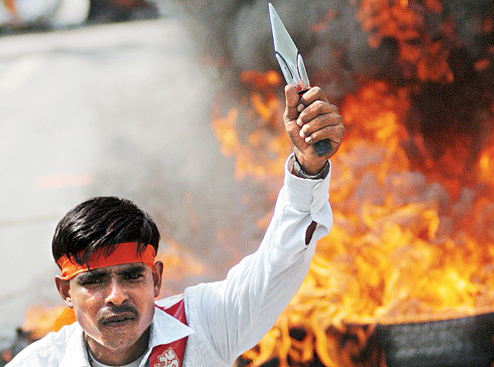
In the past couple of decades, India has been rocked by communal disturbances which have claimed the lives of people from different religious communities. While disturbances between religious minorities are not unknown, most of such communal incidents take place between Hindus and one of the religious minorities in the country. How is it that even 7 decades after independence and even after rapid political, social and economic strides that the nation has made, India continues to grapple with the threat of communal violence. How is it that Sikh pogrom, Bombay riots, Gujarat riots, Muzaffarnagar riots and countless other communal flare ups still happen unabated. Is it that the Hindu majority of India is inherently communal and it is this intolerance that exhibits itself from time to time, most recently in the savage attack in Bisada village?
This multi-part series will track the history behind Hindu communalism. Part 1 of this series talks about Hindu Communalism in ancient India i.e. from its inception till about 1000 CE.

1. The Rise of Hinduism
Ancient India had no concept of Hinduism in the sense that we know today. Indus Valley civilization, in some ways may be considered as the bedrock from which Hinduism emerged. The traditions of Indus valley culture, were fused with the existing Dravidian, tribal and animist cultures that were present in the subcontinent, to which the migrant Aryans added their own cultural thoughts. Over a period of several millennia, authoritative works such as the four vedas (Rig, Yajur, Atharv and Sam), Upanishads, commentary in the form of Brahmanas etc. came to be written. The caste system, initially created for the sake of economic expediency was also born sometime during this era. Over a period of time, Hinduism became more formalized with specific rituals, modes and methods of propitiating the deities. This period also saw increasing urbanization of India. Thus emerged the first challenges to Hinduism

RelatedPosts

Monasteries Beneath Temples? The Truth Behind Leftist propaganda of Hindu-Buddhist Divide

How India, largest economy of the world once, got sudden decline and rise?

Maharaja Kharavela: Perhaps the greatest Indian King ever

Load More

2. The Emergence of Buddhism and Jainism
The urbanization of India resulted the first challenges to the Hindu orthodoxy in the form of Jainism and Buddhism. Both had several common features with Hinduism, but varied vastly in several ways. For starters, both despised the intricate rituals followed in Hinduism. Both Buddhism and Jainism were also opposed to the system of Vedic sacrifices. They also differed with Hinduism in their approach to salvation. Lastly, both repudiated the concept of castes, which by then was well entrenched in Hinduism. While Jainism had a significant impact on Indian thought, it remained a minor player in terms of its outreach. Buddhism on the other hand, became the religion of the Kings, starting from Ashoka and spread out far and wide. This was also a time, when several schools of thought emerged within Hinduism, at times, vastly at odds with each other.

3. Hindu philosophy
By the beginning of the common era, broadly two schools of thought were already in place. One school of thought recognized the primacy of Vedas and was hence called Astika, the other rejected Vedas as the source of knowledge and was hence called Nastika. Buddhism and Jainism came under the Nastika school. The Astika school was sub divided into Samkhya (rationalist), Yoga (believed in the concept of personal God), Vaisheshika (Atomist), Nyaya (realist), Mimansa (orthopraxy) and Vedanta (Knowledge based). These schools were sub divided into several sub-groups. Each of these schools had their own set of adherents, their own set of practices and their unique belief in God, often at variance with each other. The rise of Puranic Hinduism 500CE onwards which replaced rituals with devotion, saw the rise of Shaivaite and Vaishnavite schools, whose adherents worshipped Shiv/Vishnu as their prime deities.

To put it succinctly, the scope for communal conflict in Ancient India, existed between Hindus, Jains and Buddhists and among various schools of Hindu thoughts. We will now examine historical incidents highlighting this conflict.

1. Hindu-Buddhist conflict
Buddhism was never seen as an alien religion in India. Even though it enjoyed royal patronage for a substantial time, the Kings were equally favorably disposed towards both Hinduism and Buddhism. There are many examples to show how Hindu Kings built Buddhist temples and Buddhist Kings built Hindu temples. The name of Pushyamitra Sunga is often quoted to show the intolerance of Hindus towards Buddhists. Pushyamitra (185-149 BC) was a Hindu King from the Sunga dynasty, who is alleged to have destroyed Buddhist stupas and slaughtered Buddhist monks. There is considerable academic debate on this, primarily due to the lack of archaeological evidence. Modern day research points to Pushyamitra’s attack on Mauryas, reflecting merely the decline of Buddhism in Sunga imperial court. This is believed to have forced Buddhists to seek help from Pushyamitra’s enemies, which might have resulted in an attack on Buddhists to secure political power. Even if one were to accept this story, it would appear that the attack on Buddhists by Hindus was an exception rather than the norm. It seems more likely that this was a battle between political powers with Buddhists on the wrong side. Another case of persecution of Buddhists is by the Hun King Mihirakula (502-530 AD), who had become Hinduised and who severely persecuted Buddhists across Northern India. Apparently, Mihirakula’s blood lust didn’t end with the destruction of Buddhist temples. He is believed to have destroyed Hindu temples as well. Persecution of Buddhists appears to have abated after Mihirakula’s death.Kumarila Bhatta was a Hindu philosopher from the Mimamsa school who challenged and defeated Buddhists in philosophical debates. He is believed to have played a major role in hastening the decline of Buddhism in the subcontinent.

2. Hindu-Jain conflict
The conflict between Hindu and Jains in ancient India, seems to be more academic rather than physical. Jains rejected Vedas as they were anonymously written . They rejected Vedic sacrifices, questioning how killing could lead to enlightenment. For every Hindu epic, a counter Jain epic was in place. There are apocryphal tales of the massacre of Jains at the hands of Shaivites or Buddhists, however, none of these are found in Jain literature and are believed to be Hindu/Buddhist propaganda at embellishing their strength. However, it is widely believed that Jainism held sway in the Southern parts of India, before being swept aside by a resurgent Hinduism.

3. Philosophical intolerance
There is a tradition of debates between philosophers from different schools within Hinduism and also with those from the Nastika School of thought. Adi Shankara (788-820 AD) is believed to have travelled widely and participated in philosophical debates with different schools. Shastrath, which institutionalized debates between different philosophers was also prevalent. In fact, there was a free flow of ideas and principles between Astika Schools and between Astika and Nastika schools due to these debates. The level of diffusion was such that many have claimed that Adi Shankara was a crypto-Mahayana Buddhist. There was also a great deal of debate between the adherents of Shaiva and Vaishnava schools which was relatively free from violence at this time.
In light of the above, it will be difficult to believe that Hindu society in ancient India was communal in the sense we define Communalism today. Religion based violence does not seem to be prevalent in general. Isolated incidents are also of doubtful authenticity. There is no doubt that Hindu society was not perfect, that there were several glaring shortfalls (e.g. caste system) that made it difficult from realizing its full potential, but on the whole, ancient India seems to be a place of Communal harmony, in part due to the fact that Hinduism, Buddhism and Jainism were all native religions that had sprouted from the same source. Hindus looked at Buddhists and Jains, not as enemies but as people with a different approach to God. It was this tolerance that made diffusion of ideas between them possible.

The next part of the series will cover the period between 1000 AD- 1500 AD.

References:

http://autarmota.blogspot.in/2012/09/huns-mihirkula-and-kashmir.html

Were Buddhists Persecuted By Hindus?


Wendy Doniger- The Hindus- An alternative history
https://en.wikipedia.org/wiki/Madurai_massacre
http://koenraadelst.bharatvani.org/articles/ayodhya/pushyamitra.html
Tags: Ancient IndiaBuddhismHindu CommunalismJainism
ShareTweetSend
Previous Post

National Media – Aren’t Sanjiv Bhatt and CoffinGate news worthy? Why the stoic silence then?

Next Post

Story of Last honorary doctorate degree of Dr. Abdul Kalam

Related Posts

Sardar Patel and Amit Shah
History

Sardar Patel’s 1947 Blueprint on Minority Quotas Resurfaces as Reservation Debate Returns to Centre Stage

17 April 2026

Sardar Vallabhbhai Patel’s 1947 intervention on minority representation in India’s Constituent Assembly has returned to the centre of political...

The 1973 Constitution and ‘Bhutto’ the Man Who Made It: What Pakistan Owes and What It Destroyed
Analysis

The 1973 Constitution and ‘Bhutto’ the Man Who Made It: What Pakistan Owes and What It Destroyed

6 April 2026

Pakistan’s constitutional story is built on a contradiction so stark that it still indicts the state nearly half a...

The Fall of Lhasa: How Nine Days in 1959 Changed Tibet Forever
History

The Fall of Lhasa: How Nine Days in 1959 Changed Tibet Forever

26 March 2026

There is a photograph that has never left the minds of those who have seen it. Lhasa, March 1959,...

Load More

Leave a Reply Cancel reply

Your email address will not be published. Required fields are marked *

I agree to the Terms of use and Privacy Policy.
This site is protected by reCAPTCHA and the Google Privacy Policy and Terms of Service apply.

Currently Playing

From Runways to Warships: India’s Firefighting Warrior Built for Bases & Battles| IAF | VayuShakti

From Runways to Warships: India’s Firefighting Warrior Built for Bases & Battles| IAF | VayuShakti

00:05:40

Ethanol, EVs and Solar- How India’s Energy Game Is Changing | Modi on LPG & Crude Oil | war| Hormuz

00:05:21

Truth of IRIS Dena: 8 Days That Changed Narrative | War zone Reality, Not an Indian Navy Exercise

00:08:02

300 Million Euros for SCALP: Strategic Necessity or Costly Dependency on France300

00:04:06

Tejas Mk1A: 19th aircraft coupled but Not Delivered: What Is Holding Back the IAF Induction?

00:07:21
Facebook Twitter Instagram Youtube
tfipostTfipost.com
Right Wing | News Analysis | Indian Opinion
  • About us
  • Contact Us
  • Careers
  • Brand Partnerships
  • Terms of use
  • Privacy Policy
  • Sitemap

©2026 TFI Media Private Limited

No Result
View All Result
  • Premium
  • Politics
    • Analysis
    • Opinions
    • Trending
  • Economy
    • Business
    • Finance
  • Defense
    • Defence
    • Strategy
    • Weaponry
  • Geopolitics
    • Africa
    • Americas
    • Asia Pacific
    • Europe
    • South Asia
    • West Asia
  • Knowledge
    • Culture
    • History
    • Indology
  • Law
  • Lounge
    • Books
    • Cinema
    • Food
    • Health
    • Sports
    • technology
    • Travel
    • Satire
TFIPOST हिन्दी
TFIPOST Global

©2026 TFI Media Private Limited