
























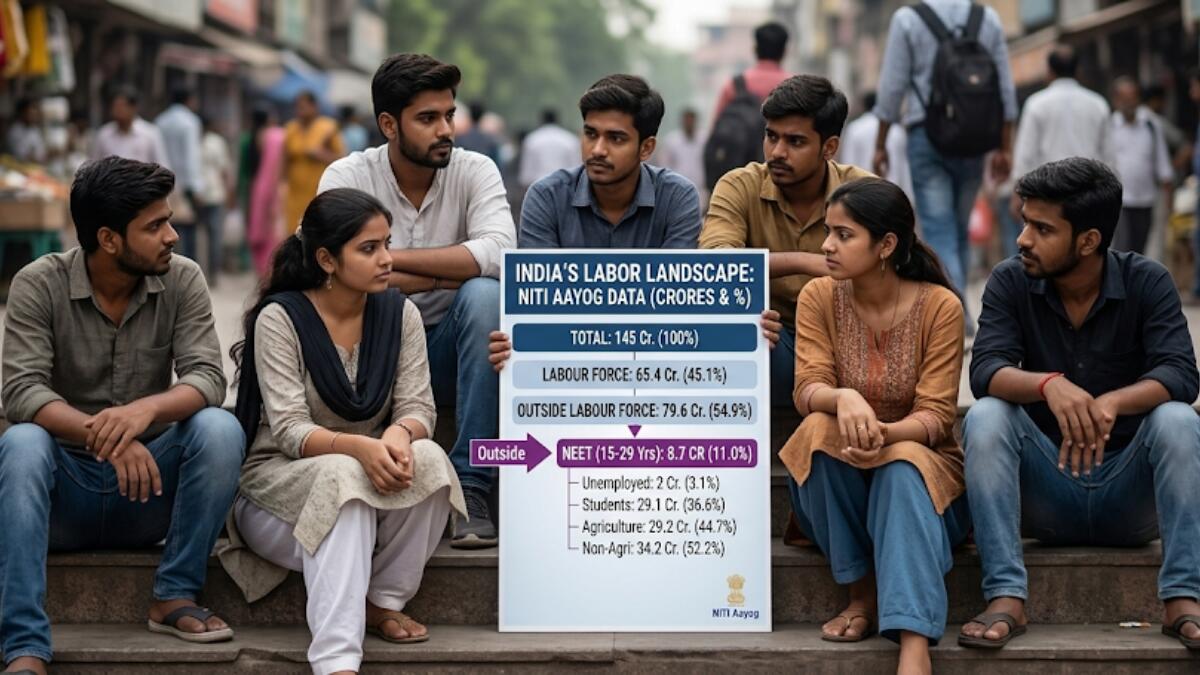
While India’s economic growth narratives often showcase its demographic dividend, fresh data released by NITI Aayog exposes a glaring structural shadow: 8.7 crore (87 million) young Indians aged 15–29 are currently Not in Employment, Education, or Training (NEET).
The figures, detailed in NITI Aayog’s workforce mapping report, draw back the curtain on a crisis far deeper than standard unemployment statistics. While 2 crore (20 million) individuals are actively looking for work but remain unemployed, the 8.7 crore NEET population represents nearly 11% of the total labor pool—a vast segment detached entirely from the economic pipeline.
The Breakdown: India’s Labor Landscape
Out of India’s overall 145 crore population baseline, the active labor force stands at 65.4 crore (45.1%), which includes 58.4% self-employed workers, 21.7% regular wage/salaried employees, and 19.8% casual laborers. Within this active workforce, the agriculture sector accounts for 29.2 crore (44.7%) workers, while the non-agriculture sector absorbs 34.2 crore (52.2%)—led largely by services (18.9 crore) and construction (7.6 crore).
Outside the active workforce, 2.0 crore (3.1%) individuals are actively unemployed and looking for jobs. The NEET youth demographic accounts for 8.7 crore (11.0%) individuals who are completely disconnected from education, training, or employment. Students across school and higher education levels account for 29.1 crore (36.6%) of the population, while dependents and non-working populations total 27.0 crore (34.0%), including 11.3 crore children under age 5 and 15.7 crore seniors aged 59 and above.
Why the NEET Group is a Ticking Clock
Unlike the active unemployed—who are seeking employment and can be absorbed as jobs open up—the NEET demographic faces complex structural barriers:
- The Domestic Duty Trap: Over 88% of this group is bound by domestic duties, predominantly impacting young women constrained by caregiving, limited mobility, and safety concerns.
- The “Sunk Cost” Dilemma: Many young people have already invested heavily in degrees or qualifications that failed to deliver jobs. Lacking income, they cannot afford further paid skilling programs.
- Transition Gaps: The transition from education to work remains broken, leaving youth stranded without flexible re-entry pathways.
Economic & Political Stakes
Leaving nearly 90 million youth outside the workforce threatens India’s target of becoming a developed nation by 2047 (Viksit Bharat). Disconnected from mainstream opportunities, this population is not only an economic loss, but also represents a volatile political constituency that risks long-term social instability if left unaddressed.
To bridge this gap, NITI Aayog calls for flexible skill vouchers, hyper-local part-time training programs, and multiple entry-exit points so young Indians can retrain without sacrificing household security.
