























The latest incident occurred in the early hours of November 9 in Uttar Dinajpur district, where Dilip Roy, the prime accused in the rape and murder of a minor girl in Raiganj, was killed in a police encounter. According to police officials, Roy had been absconding after the body of the 12-year-old victim was recovered from the Kulik Wildlife Sanctuary on November 5. The girl had reportedly gone missing two days earlier.
Following a complaint from the victim’s family, police launched an intensive search operation. Investigators eventually traced Roy to the Gauri village area, near the West Bengal-Bihar border. Police officials stated that when the team attempted to apprehend him at approximately 3 am, he allegedly opened fire. The police retaliated, critically injuring him. He was taken to Raiganj Medical College and Hospital, where doctors declared him dead. The incident has brought renewed attention to the Yogi Style approach being associated with the Adhikari administration.
This was not an isolated incident. On July 8, Prabhas Mondal, an accused in the rape and murder of a 12-year-old girl in Baruipur, South 24 Parganas, was killed during a police encounter. According to the police account, Mondal had been taken to the crime scene for reconstruction when he allegedly snatched an officer’s service weapon and fired at the police personnel. The officers returned fire, injuring him. He was subsequently taken to Baruipur Hospital, where he was declared dead.
The case had caused considerable outrage in the locality. The victim’s body had been recovered from a pond on July 5, and CCTV footage reportedly showed Mondal accompanying the girl before her disappearance. The investigation resulted in serious charges under the Bharatiya Nyaya Sanhita and the Protection of Children from Sexual Offences (POCSO) Act. The incident became an early indication of the government’s Yogi Style emphasis on a tougher response to violent crimes.
Another significant encounter took place on October 27 in Gaighata, North 24 Parganas district. Prahlad Das, aged 23, was accused of raping and murdering a 17-year-old schoolgirl. Her body had reportedly been discovered in a mutilated condition behind a neighbour’s house. Police officials stated that Das was taken to the location for crime-scene reconstruction when he allegedly snatched a service revolver, fired at the officers and attempted to escape by jumping into a nearby pond. The police retaliated, and Das was later declared dead at a hospital.
The victim’s father expressed support for the police action while acknowledging that nothing could bring his daughter back. His emotional response reflected the anguish of families confronted with such horrific crimes. For many residents, the administration’s Yogi Style approach represents a departure from what they perceive as years of inadequate deterrence against violent offenders.
The fourth encounter involved Samaul Sheikh, an accused in the murder of BJP worker Sujit Mondal, in Murshidabad district, also on October 27. Mondal, a 36-year-old bidi worker and local BJP activist, had disappeared on August 28. His family subsequently received a ransom call, while parts of his dismembered body were recovered during the investigation. Police arrested several suspects, including Sheikh. According to police officials, Sheikh was taken for crime-scene reconstruction when he allegedly attempted to snatch an officer’s firearm and flee. He was killed in the ensuing retaliatory firing.
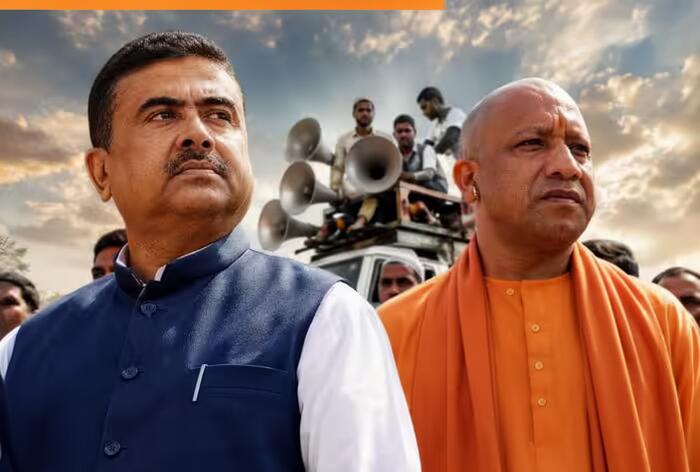
Chief Minister Suvendu Adhikari has repeatedly adopted an uncompromising public position on crimes against women. He has stated that the police have been given a free hand to act against perpetrators of sexual violence. His administration’s Yogi Style messaging draws an unmistakable comparison with Uttar Pradesh Chief Minister Yogi Adityanath, whose government has made a zero-tolerance approach to organised crime and violence against women a central feature of its governance.
Uttar Pradesh’s experience provides an important backdrop to this comparison. According to the National Crime Records Bureau’s 2024 figures, published in 2026, rape cases in the state declined from 3,516 in 2023 to 3,209 in 2024. Dowry deaths also fell from 2,122 to 1,047 during the same period. The Uttar Pradesh government has additionally reported thousands of police encounters since 2017 as part of its campaign against hardened criminals. These figures have frequently featured in the political debate surrounding the Yogi Style model of law enforcement.
For West Bengal, however, the challenge extends beyond high-profile encounters. Effective policing requires professional investigations, timely prosecution, protection of witnesses and convictions supported by credible evidence. Police encounters must also remain subject to constitutional safeguards, independent scrutiny and judicial oversight. An allegation of firing by an accused person must be investigated rather than treated as an automatic justification for lethal force.
Nevertheless, the four incidents have placed the Adhikari government’s law-and-order policy firmly in the spotlight. After years of political controversy surrounding women’s safety and policing in Bengal, the administration is attempting to establish a different public image. Whether this Yogi Style approach produces lasting improvements in public safety will ultimately depend on transparent investigations, falling crime rates and convictions through the courts, rather than encounter statistics alone.