
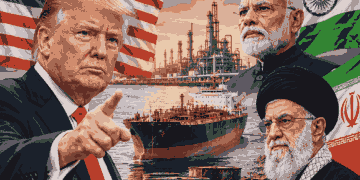






















It’s more specific than eever. US threatens Indian and Turkish businesses with sweeping sanctions over their alleged involvement in helping Iran circumvent American oil restrictions, escalating Washington’s economic confrontation with Tehran and placing international commercial networks under renewed scrutiny. The latest action by the Donald Trump administration has targeted an India-based couple, their business associates and several companies, accusing them of facilitating Iranian oil transportation through fraudulent maritime registrations and documentation.
On Wednesday, November 4, the US Department of the Treasury announced fresh sanctions against individuals and entities based in India and Turkey. The measures form part of the Trump administration’s ‘Operation Economic Outcast’, an aggressive campaign designed to cut off Iran’s ability to generate revenue through petroleum exports and use those earnings to finance its military operations.
At the centre of the allegations is India-based Suniel Kumar Sharma and his wife, Jaspreet Preeti Shahid. The Treasury Department also identified two other Indian citizens associated with the couple’s businesses, along with nine entities linked to Sharma. According to American authorities, the network allegedly supported Iran’s so-called shadow fleet by providing fraudulent maritime services that allowed sanctioned vessels to continue transporting Iranian petroleum.
The US Treasury alleges that the network supplied false vessel flags and maritime certifications to ships carrying Iranian oil, including vessels allegedly operating on behalf of the Iranian military and its affiliated groups. Such documentation can allow ships to conceal their actual ownership, registration and operational affiliations, making it harder for international authorities to monitor their movements.
The allegations go beyond ordinary commercial irregularities. The American authorities claim that Sharma and Shahid impersonated maritime authorities of several countries, including Guyana, Eswatini and Laos. They allegedly established websites offering ship registration, flagging, seafarer training and vessel classification services without the necessary authorisation from the respective governments.
The alleged operation reportedly dates back to 2014, when the couple attempted to impersonate the maritime flagging authority of Dominica. In 2023, Sharma established a Singapore-based entity called Eswatini Maritime Affairs and International Ship Registry PTE. Ltd. According to the Treasury, the organisation continued providing services to vessels carrying Iranian oil even after Eswatini authorities publicly disowned it.
The US threatens further action against individuals and companies that continue facilitating Iran’s sanctioned commercial operations. Treasury officials argue that fraudulent vessel registrations are not merely a mechanism for evading economic restrictions but also create serious maritime safety and environmental risks. Ships operating under false flags may bypass international safety requirements and operate without appropriate indemnity insurance. Any accident involving such vessels could expose coastal states and other affected economies to enormous financial and environmental liabilities.
Washington has simultaneously expanded its action against businesses operating in Turkey. The Treasury sanctioned Turkey-based Fugo Ground Services Inc., accusing the company of providing ground-handling and logistical assistance to several Iranian airlines already facing American restrictions. These included Iran Air Tour, Saha Airlines, Taban Airlines and Ata Airlines.
The action demonstrates that American enforcement is no longer confined to oil producers, shipping companies and financial intermediaries. Aviation support services, logistics providers and other businesses maintaining commercial relationships with sanctioned Iranian organisations are also facing scrutiny. The US threatens to pursue such networks across land, sea and air, leaving international companies with increasingly difficult compliance decisions.
Treasury Secretary Scott Bessent delivered an uncompromising message while announcing the measures. He stated that Washington knew where those supporting the Iranian regime were operating and would sanction anyone continuing to assist Tehran. Referring to Operation Economic Outcast, Bessent declared, “You are either with us or against us.”
He repeated the warning in a post on X, making clear that the administration intended to pursue alleged sanctions violators irrespective of their geographical location. The US threatens consequences not only for direct participants but also for businesses that facilitate restricted transactions and provide essential services to designated entities.
The timing of the announcement is politically significant. The sanctions were unveiled a day after Democrats registered major gains in the American midterm elections, winning control of both chambers of Congress amid public dissatisfaction over the Iran war and its contribution to rising fuel costs. Treasury officials have claimed that their economic pressure campaign has severely weakened Iran’s economy, with the Iranian rial falling to new lows and inflation reportedly approaching 90 per cent.
Brett Erickson, managing principal at Obsidian Risk Advisors, told Reuters that the latest measures demonstrated Washington’s determination to intensify economic pressure on Tehran despite the administration’s electoral setbacks.
For India, the development presents a complicated diplomatic and commercial challenge. New Delhi maintains important relationships with both Washington and Tehran, while its energy security and regional connectivity interests require careful engagement with West Asia. American sanctions can also create substantial difficulties for Indian companies dealing with international shipping, banking and insurance networks.
However, the allegations against the designated individuals and businesses must be distinguished from the broader interests of the Indian state. The action does not amount to sanctions against India as a country. It targets specific individuals and entities accused by Washington of facilitating prohibited Iranian activities.
Ultimately, the latest measures underline how aggressively the United States intends to enforce its sanctions regime. The US threatens to make sanctions evasion increasingly costly for international businesses, signalling that geographical distance and corporate structures will not necessarily shield those accused of supporting Tehran. For companies operating across international markets, the message is unmistakable: compliance with American restrictions has become a major consideration in conducting global business.