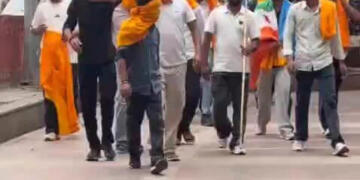





















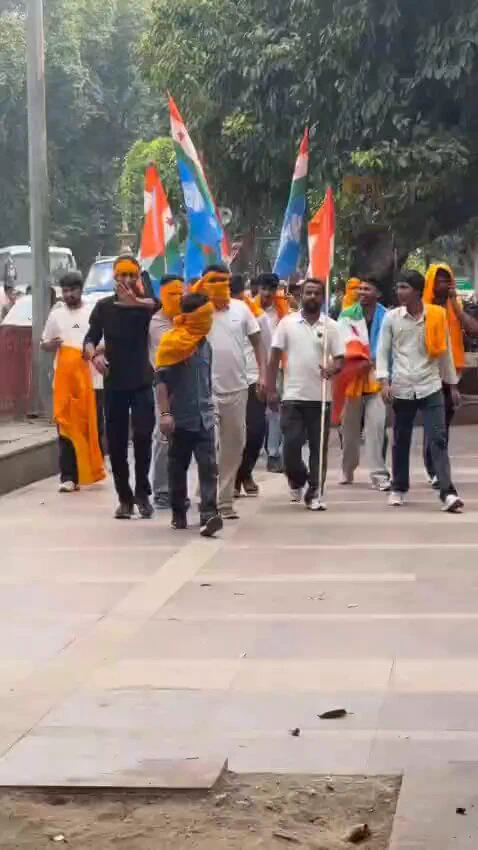
The demonstration forms part of a wider campaign by Congress-linked groups and other opposition organisations questioning the Election Commission’s handling of electoral rolls and the Special Intensive Revision (SIR) exercise. Protesters have accused the poll body of failing to address their concerns adequately, while demanding greater transparency and accountability from its leadership. These allegations remain contested and should be distinguished from established findings of electoral wrongdoing.
According to the report published by OpIndia, the NSUI workers’ saffron attire and flags became a notable feature of the demonstration. The report framed the imagery as politically striking because saffron is commonly associated with Hindu religious and cultural symbolism and is frequently used by organisations and political movements across India. The appearance of such symbols at a protest organised by a Congress student wing consequently invited questions about messaging, political identity and the visual presentation of opposition campaigns.
The immediate issue behind the protest, however, was the demand for action against Chief Election Commissioner Gyanesh Kumar. Opposition groups have raised allegations of irregularities in electoral procedures and questioned the Election Commission’s response to concerns surrounding voter rolls. Their demands reflect a broader political confrontation over the credibility and administration of elections, although accusations made by political parties do not, by themselves, establish misconduct.
The NSUI, formally known as the National Students’ Union of India, is affiliated with the Indian National Congress and has traditionally participated in student politics, demonstrations and campaigns on issues ranging from education to national political affairs. Its involvement in protests against the chief election commissioner places the organisation within the larger opposition effort to challenge the poll body publicly.
The use of saffron scarves and flags adds another dimension to that campaign. Political demonstrations rely not only on speeches and slogans but also on images that can circulate rapidly through news reports and social media. Clothing, colours and flags can become powerful symbols, sometimes drawing more attention than the specific demands being raised. In this instance, the visual contrast between the organisation’s Congress affiliation and the saffron imagery has become part of the wider conversation surrounding the protest.
At the same time, the significance of the colours should not be overstated without evidence about the organisers’ intentions. Saffron has a long history in Indian religious, cultural and political life, and its use does not automatically establish an organisation’s ideological position. Whether the scarves and flags reflected a deliberate communications strategy, a tactical choice or another consideration cannot be determined from the visuals alone.
The NSUI demonstration also highlights the increasingly confrontational atmosphere surrounding disputes over electoral administration. The Election Commission occupies a central position in India’s democratic system, and public confidence in its impartiality is essential. Opposition parties have the right to question its decisions, while the commission and its officials must be assessed on the basis of evidence, applicable law and established procedures rather than political rhetoric alone.
For the commission, the challenge is to maintain public trust through transparent explanations and credible responses to specific complaints. For political organisations, the challenge is to turn allegations into substantiated questions that can be examined through appropriate legal and institutional channels. Protest can draw attention to concerns, but lasting answers require evidence and due process.
The controversy surrounding the NSUI protest also illustrates how political messaging can take on a life of its own. A demonstration intended to focus attention on an institutional dispute may generate a parallel debate about symbolism, identity and the political choices of its organisers. That shift can broaden public discussion, but it can also distract from the underlying questions about electoral procedures.
Ultimately, the NSUI workers’ appearance with bhagwa scarves and saffron flags has added an unexpected visual element to the campaign against Gyanesh Kumar. The episode underscores the importance of separating the symbolism of a protest from the substance of the allegations being made. The demands for accountability, the commission’s response and any evidence supporting claims of irregularities remain the central issues in determining how the dispute develops.