

























A 200% casino bonus sounds better than a 50% bonus.
It may not be.
The percentage advertised at the top of a promotion tells players how much bonus credit they can receive. It does not tell them how much qualifying play may be required before bonus-related winnings can be withdrawn.
Consider two simplified offers.
Offer A
$100 deposit
200% bonus = $200
40x wagering on the bonus
Required qualifying wagering:
$200 × 40 = $8,000
Offer B
$100 deposit
50% bonus = $50
10x wagering on the bonus
Required qualifying wagering:
$50 × 10 = $500
The first promotion gives the player four times as much bonus money, but it also creates sixteen times as much required wagering.
And even that comparison is incomplete.
Game contribution, maximum bets, expiry periods, restricted games and cashout limits can all change the practical value of a casino bonus.
These examples are simplified to show how wagering calculations work. Actual bonus rules vary by casino and promotion.
The largest number in a casino advertisement is therefore often not the number that matters most.
What does a casino wagering requirement actually mean?
A wagering requirement — sometimes called playthrough, rollover or turnover — determines how much qualifying play must take place before funds associated with a bonus can become withdrawable.
A promotion might advertise:
100% bonus up to $500 — 30x wagering
The $500 is the figure designed to attract attention.
But if a player receives the full $500 bonus and the 30x requirement applies to that bonus amount, the calculation becomes:
$500 × 30 = $15,000
That means $15,000 in qualifying wagers may be required before the bonus conditions are completed.
CasinoIndex provides a more detailed explanation of how casino wagering requirements actually work, including how the calculation changes depending on which balance the multiplier applies to.
That distinction matters because 30x does not always mean the same thing.
The first question should be: 30x of what?
Players often compare two promotions by looking only at the wagering multiplier.
That can produce a misleading comparison.
A casino may calculate wagering from the bonus alone. Another promotion might apply the multiplier to the deposit and bonus combined.
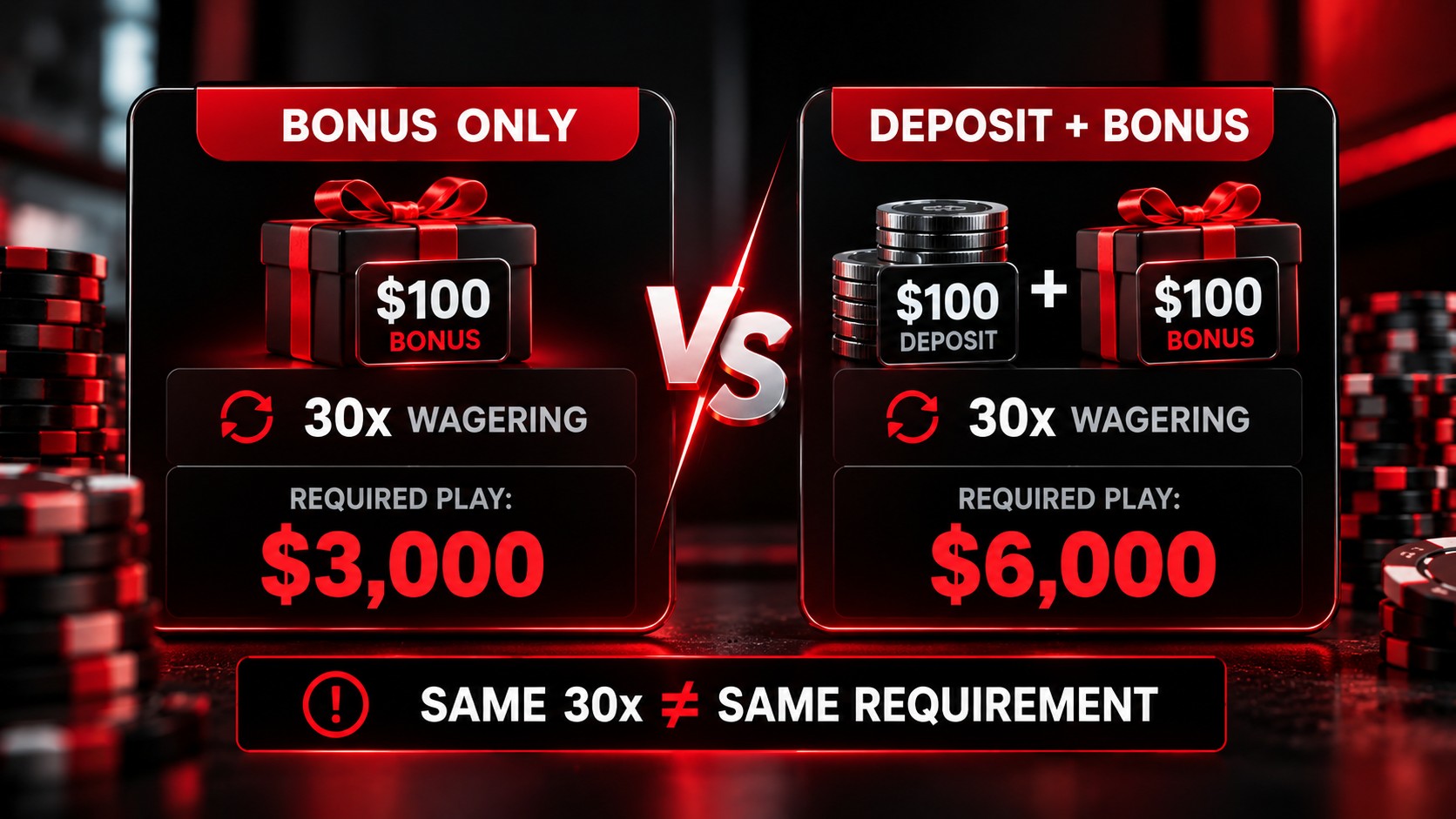
Consider a $100 deposit with a $100 bonus.
30x bonus only
$100 bonus × 30
= $3,000 required wagering
30x deposit plus bonus
($100 deposit + $100 bonus) × 30
= $6,000 required wagering
Both promotions display 30x.
One requires twice as much qualifying play.
| Offer structure | Deposit | Bonus | Wagering | Required qualifying play |
| Bonus only | $100 | $100 | 30x bonus | $3,000 |
| Deposit + bonus | $100 | $100 | 30x D+B | $6,000 |
| Bonus only | $100 | $50 | 10x bonus | $500 |
This is why casino bonus terms are better understood as a formula than as a headline.
The multiplier matters, but so does the amount being multiplied.
Game contribution can change the real requirement again
Completing $3,000 in total bets does not necessarily mean completing $3,000 of wagering progress.
Casino bonuses can assign different contribution percentages to different game categories.
A qualifying slot may contribute 100% of every wager.
A table game may contribute only part of the stake.
Some games may contribute nothing at all.
Suppose a player still needs $1,000 of wagering progress.
At 100% contribution, $1,000 in qualifying bets produces $1,000 of wagering progress.
At 20% contribution, the same $1,000 in bets produces only $200 of progress.
At 10% contribution, it produces only $100.
To generate $1,000 of qualifying progress at a 10% contribution rate would require $10,000 in total wagers.
The exact percentages vary between casinos and promotions. Broad assumptions such as “slots always count 100%” or “blackjack always counts 10%” should therefore never replace the actual promotional terms.
CasinoIndex explains why different casino games count differently toward wagering requirements and how contribution percentages can substantially change the amount of play needed to complete a bonus.
This is also why a seemingly low wagering multiplier can still become demanding if the games a player prefers receive poor contribution rates.
Maximum bet rules can change how practical a bonus is
Many casino promotions also set a maximum permitted wager while bonus funds or bonus conditions remain active.
That rule can matter almost as much as the wagering multiplier itself.
Imagine two bonuses with identical 20x wagering requirements.
One allows relatively flexible stake sizes.
The other imposes a much lower maximum bet.
The amount of required wagering may be identical on paper, but the way a player can complete it is not.
A promotion may therefore look attractive because it combines a large bonus with a reasonable multiplier, while still containing a restrictive maximum-bet condition.
The safest approach is simple: check the maximum permitted stake before starting bonus play rather than discovering the rule after placing larger wagers.
In Great Britain, the Gambling Commission treats wagering requirements, maximum stake sizes and game restrictions as significant promotional conditions that need to be communicated clearly.
Expiry changes the pressure behind the same number
A wagering target also has a time dimension.
Suppose a player must complete $8,000 in qualifying play.
With 30 days available, that requirement has one practical profile.
With only seven days available, it becomes very different.
The mathematical target may be the same, but the amount of gambling required each day rises sharply when the expiry period gets shorter.
This matters because a promotion should not be evaluated only by asking:
How much do I need to wager?
It should also ask:
How much time do I have to do it?
A moderate wagering requirement combined with a reasonable expiry period may be easier to understand and manage than a seemingly attractive bonus built around a very short deadline.
Maximum cashout can matter more than the advertised reward
Another condition that deserves attention is the maximum amount that can be withdrawn from bonus-related winnings.
This is particularly common with some free-spin, free-chip and no-deposit promotions.
Imagine that a player receives a promotional reward and eventually builds a $500 bonus-related balance.
If the promotion has a maximum cashout of $100, completing the wagering requirement does not necessarily make the full $500 withdrawable.
The promotional balance and the amount that can ultimately be withdrawn are two different things.
This creates another useful test when comparing casino bonuses:
How difficult is the reward to clear?
and
How much can actually be withdrawn after it has been cleared?
A huge promotional balance is far less meaningful if the cashout ceiling is small.
Your deposit and the casino’s bonus are not the same thing
Players should also understand the distinction between their own deposited money and promotional funds.
In regulated Great Britain, Gambling Commission rules require operators to distinguish deposit and bonus balances and not force customers to complete promotional wagering requirements before withdrawing their own deposit balance.
The UK Gambling Commission explains these rules in its guidance on restrictions on withdrawing deposits and deposit winnings.
That rule should not be assumed to apply to every casino worldwide. Gambling regulations differ considerably between jurisdictions.
The broader principle is still useful: before claiming a bonus, players should know what happens to their own money once the promotion is activated.
Can the deposit still be withdrawn?
Does cancelling the bonus affect winnings?
Which balance is used first?
What happens when cash and promotional funds are mixed?
These questions often matter more than another 25% added to the headline bonus.
Sticky and non-sticky bonuses can behave differently
The distinction becomes even clearer with sticky and non-sticky bonus structures.
A sticky bonus generally remains tied to the promotional balance until the conditions are completed or the promotion ends.
A non-sticky structure may allow greater separation between real-money funds and promotional funds.
However, terminology varies between operators.
The word “non-sticky” on its own does not tell a player everything about withdrawal priority, bonus cancellation, wagering or cashout restrictions.
The actual terms still decide how the promotion works.
This is another reason bonus comparisons should focus on mechanics rather than labels.
Britain introduced a 10x wagering cap in 2026
The treatment of wagering requirements changed significantly in Great Britain in 2026.
From 19 January 2026, UK Gambling Commission rules cap wagering requirements on promotional bonus funds at 10x.
The current rule is set out in the Gambling Commission’s Social Responsibility Code Provision 5.1.1.
The change matters because very high wagering requirements can make promotions more complicated and require substantially more gambling before bonus-related funds become withdrawable.
Consider a £10 bonus.
At 50x wagering, it can require:
£10 × 50 = £500
in qualifying wagering.
At 10x:
£10 × 10 = £100
The difference is substantial.
But the British rule should not be interpreted as a global casino standard.
A casino licensed elsewhere may operate under different promotional rules. Offshore operators and crypto casinos can also be subject to very different regulatory requirements depending on the company, licence and jurisdiction involved.
The location and regulatory framework still matter.
Lower wagering is easier — but it does not automatically mean a better bonus
If two promotions are identical except for wagering, the lower requirement is easier to complete.
A 10x bonus requires less qualifying wagering than a 40x bonus.
But casino offers are rarely identical.
A 10x bonus might still contain:
- poor game contribution;
- restrictive maximum bets;
- a short expiry period;
- a low maximum cashout;
- excluded payment methods;
- geographic restrictions;
- limited eligible games.
A higher-wagering offer could theoretically have more flexible conditions elsewhere.
That is why wagering should be treated as a major part of bonus quality, but not the only part.
Instead of asking:
Which casino gives the biggest bonus?
a more useful question is:
What needs to happen before the promotional value can become withdrawable?
That question exposes the real structure of the offer.
No-wagering bonuses remove one major layer of complexity
One way to simplify a casino promotion is to remove traditional multi-round playthrough requirements entirely.
That is the idea behind no-wagering or wager-free bonuses.
Instead of receiving a reward that must be turned over 20x, 30x or 40x before bonus-related winnings become eligible for withdrawal, the offer removes that repeated playthrough requirement.
That can make the promotion substantially easier to understand.
But no wagering does not mean no rules.
A wager-free promotion may still have:
- eligibility requirements;
- expiry dates;
- restricted games;
- maximum cashout rules;
- verification requirements;
- country restrictions;
- minimum deposit conditions.
The term should therefore be interpreted narrowly: it removes the traditional wagering multiplier, not every other promotional condition.
For crypto users, CasinoIndex compares no-wagering crypto casino offers by looking beyond the headline reward and examining the conditions surrounding the offer.
That distinction is important.
A smaller wager-free reward can sometimes be easier to understand than a much larger bonus built around multiple layers of playthrough requirements.
How to compare two casino bonuses in under a minute
A player does not need to analyse every line of a promotion before understanding its basic structure.
Seven questions reveal most of what matters:
- How much bonus money will I actually receive?
Calculate the amount based on the deposit you intend to make rather than the advertised maximum. - What does the wagering requirement apply to?
Bonus only, deposit plus bonus or another defined amount? - Which games count?
Check contribution percentages and excluded games. - Is there a maximum bet?
Know the permitted stake before wagering begins. - When does the bonus expire?
A reasonable multiplier can become much less practical when combined with a short deadline. - Is there a maximum cashout?
Check whether bonus-related winnings are capped. - What happens to the original deposit?
Understand how cash and promotional balances are treated if the bonus is cancelled or withdrawn.
These questions often reveal more about a promotion than the percentage printed across the top of the advertisement.

A 200% bonus is not automatically better than a 50% bonus
Returning to the opening example makes the difference clear.
| Factor | Offer A | Offer B |
| Deposit | $100 | $100 |
| Headline bonus | 200% | 50% |
| Bonus received | $200 | $50 |
| Wagering | 40x bonus | 10x bonus |
| Required qualifying play | $8,000 | $500 |
| Game contribution | Check terms | Check terms |
| Maximum bet | Check terms | Check terms |
| Expiry | Check terms | Check terms |
| Maximum cashout | Check terms | Check terms |
Offer A wins the advertising comparison.
Offer B wins the simplified wagering comparison by a huge margin.
Neither can be fully evaluated until the remaining terms are known.
That is the weakness of ranking casino promotions by headline percentage alone.
Bonus value starts in the terms, not the banner
Casino bonuses are not inherently good or bad.
Their value comes from the combination of promotional credit and the conditions attached to it.
A large reward can be attractive when the wagering requirement is reasonable, eligible games contribute fairly and withdrawal restrictions are clear.
The same headline can become far less valuable when it is combined with high turnover, poor contribution rates, restrictive bet limits, short expiry periods or severe cashout caps.
Players therefore do not need to reject every promotion that includes wagering.
They need to understand exactly what the requirement asks them to do.
The percentage on the banner is only the beginning of that calculation.
What matters is the amount of qualifying play required under the actual rules of the promotion — and what remains withdrawable when those rules have been satisfied.
Sometimes the smaller bonus is the better offer.
Not because it gives more.
Because it asks for less in return.