
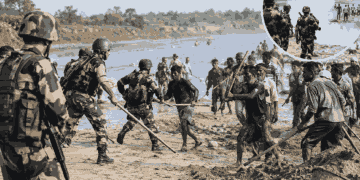























The incident occurred near Saniajan River in Bhotbari village, under the Mekhliganj block of Cooch Behar. According to reports, a group of approximately 30 to 50 people crossed into Indian territory and began digging sand and collecting stones from the riverbed. When BSF personnel attempted to prevent the activity, the group allegedly confronted the troops rather than withdrawing.
The confrontation highlights the difficulties faced by security personnel in protecting riverine stretches of the international border, where the movement of people and the extraction of natural resources can become contentious issues.
According to information cited in reports, personnel from the BSF’s 62nd Battalion, stationed at the Koshi Border Outpost, reached the location after receiving information about the suspected illegal extraction. The jawans entered the river area to stop the activity and drive the intruders back towards the Bangladesh side.
However, the situation reportedly escalated when the group outnumbered the personnel and advanced towards them carrying bamboo sticks, rods and other objects. The Bangladeshi smugglers allegedly attacked the jawans, turning an attempted enforcement operation into a tense border confrontation.
The BSF personnel responded by using smoke grenades to disperse the group. The tactic eventually forced those involved to retreat from the area, according to the reports. The available account does not establish the full extent of any injuries or provide a comprehensive official assessment of the confrontation.
Footage circulating on social media reportedly captures people shouting during the encounter. The video has brought renewed attention to the challenges of controlling unauthorised activities along the India-Bangladesh border, particularly in areas where rivers and changing terrain complicate surveillance and enforcement.
Residents have expressed concern about repeated sand and stone extraction from the Saniajan River. According to local accounts cited in the report, such activity has continued for a considerable period, with people allegedly crossing into Indian territory to collect construction materials despite previous interventions by border personnel.
The concerns extend beyond the immediate question of illegal extraction. Sand mining can alter riverbeds, affect water flow and accelerate erosion, depending on the scale and location of the activity. In a riverine border area, these changes may also threaten nearby agricultural land, homes and other infrastructure.
Prashant Kumar Roy, a local resident quoted in the report, said approximately 40 to 50 people were digging sand and collecting stones when the BSF arrived. He alleged that the group ignored the personnel’s instructions and attacked them, prompting the response with smoke grenades. Roy also stressed that the river lies within Indian territory and called for stronger action to prevent further unauthorised extraction.
For residents of Bhotbari and surrounding villages, the reported incident raises questions about the long-term protection of local resources and the safety of communities living close to the international boundary. If riverbed excavation continues without effective oversight, its environmental and economic consequences could extend well beyond the immediate site.
The episode also underlines the importance of coordination between border security personnel and local authorities. Sustained surveillance, timely intelligence and action against illegal extraction networks could help reduce the likelihood of repeated confrontations. Cooperation between the relevant agencies on both sides of the border may also be necessary to address activities that originate across the international boundary.
The presence of Bangladeshi smugglers allegedly extracting sand and stones inside Indian territory has therefore become a matter of concern for local residents, who want stronger preventive measures and consistent enforcement. At the same time, a complete understanding of the incident will depend on verified findings from the authorities.
Reports indicated that security was tightened in the area following the confrontation, with personnel remaining alert to prevent further incidents. However, the BSF had not issued an official statement on the episode at the time of publication, according to the report.
The incident involving Bangladeshi smugglers serves as a reminder that border management involves more than preventing unauthorised crossings. It also requires protecting natural resources, maintaining public safety and ensuring that enforcement operations do not escalate into repeated clashes.
For Cooch Behar’s border communities, the immediate priority is to prevent a recurrence and protect the Saniajan River from uncontrolled extraction. Whether stronger monitoring and enforcement can bring a lasting solution will depend on the steps taken by the authorities in the days ahead.