















TFIPOST हिन्दी
TFIPOST Global
Tfipost.com
Tfipost.com
No Result
View All Result
  • Premium
  • Politics
    • All
    • Analysis
    • Opinions
    • Trending
    GANDHI’S WAR 1918: WHEN AHIMSA BACKED THE EMPIRE

    The Collaborationist Apostle: Gandhi’s 1918 Betrayal of Ahinsa

    Mahatma Gandhi’s views on Cows, Cow Vigilantism and Cow-Slaughter

    Beyond the G2 Mirage: Why Great-Power Bargains Cannot Dictate India’s Ascent

    Beyond the G2 Mirage: Why Great-Power Bargains Cannot Dictate India’s Ascent

    PM Modi Speaks to Captain Smit Machchhar: “India Is Waiting to Welcome You”

    PM Modi Speaks to Captain Smit Machchhar: “India Is Waiting to Welcome You”

    • Analysis
    • Opinions
    • Trending
  • Economy
    • All
    • Business
    • Economy1
    • Finance
    Essar Group’s $18 billion Iowa steel plant — a “true homecoming” for Rewant Ruia, and the largest plant in US history

    Essar Group’s $18 billion Iowa steel plant — a “true homecoming” for Rewant Ruia, and the largest plant in US history

    What Makes an Online Slots Platform Safer for UK Players?

    What Makes an Online Slots Platform Safer for UK Players?

    Bank strike deferred: why unions called it off, and what happens next

    Bank strike deferred: why unions called it off, and what happens next

    Can a Sweep-In FD Remove Your Need to Borrow?

    Can a Sweep-In FD Remove Your Need to Borrow?

    • Business
    • Finance
  • Defense
    • All
    • Defence
    • Strategy
    • Weaponry
    INS Trishul Reaches Valencia as Indian Navy’s Mediterranean Deployment Continues

    INS Trishul Reaches Valencia as Indian Navy’s Mediterranean Deployment Continues

    114 Rafales by Financial Year-End? What India Could Get, and Where Tejas Mk1A, Mk2 and AMCA Fit

    114 Rafales by Financial Year-End? What India Could Get, and Where Tejas Mk1A, Mk2 and AMCA Fit

    Six BRICS Leaders, One Navy-Backed Indian Underwater Robot: What the EyeROV Moment Means

    Six BRICS Leaders, One Navy-Backed Indian Underwater Robot: What the EyeROV Moment Means

    Indian Navy Deepens Maritime Partnerships from the Mediterranean to the South China Sea

    Indian Navy Deepens Maritime Partnerships from the Mediterranean to the South China Sea

    • Defence
    • Strategy
    • Weaponry
  • Geopolitics
    • All
    • Africa
    • Americas
    • Asia Pacific
    • Europe
    • South Asia
    • West Asia
    Pakistan defence minister’s throat gesture at Afghan woman journalist draws condemnation

    Pakistan defence minister’s throat gesture at Afghan woman journalist draws condemnation

    When Solidarity Backfires: Wangchuk’s Tibet Remark and the CTA’s Sharp Rejection

    When Solidarity Backfires: Wangchuk’s Tibet Remark and the CTA’s Sharp Rejection

    The Jugular Vein That Bleeds Itself

    The Jugular Vein That Bleeds Itself

    US Ambassador Sergio Gor Hails Indo-US Troops Training Together at Mahajan Range, Calls Yudh Abhyas a Sign of Deepening Defence Ties

    US Ambassador Sergio Gor Hails Indo-US Troops Training Together at Mahajan Range, Calls Yudh Abhyas a Sign of Deepening Defence Ties

    • Africa
    • Americas
    • Asia Pacific
    • Europe
    • South Asia
    • West Asia
  • Knowledge
    • All
    • Culture
    • Education
    • History
    • Indology
    How to Choose the Right Online Degree at Apna Advantage for Your Career Goals

    How to Choose the Right Online Degree at Apna Advantage for Your Career Goals

    What Skills Will You Gain from a Strategic Leadership Course

    What Skills Will You Gain from a Strategic Leadership Course

    Young Indian Gen Z exploring Sanatan Dharma through smartphones, social media and the Bhagavad Gita

    Ancient Roots, Digital Minds: The Rise of Sanatani Gen Z

    Break into QA Jobs Faster with Automation Testing Course from StarAgile

    Break into QA Jobs Faster with Automation Testing Course from StarAgile

    • Culture
    • History
    • Indology
  • Law
  • Lounge
    • All
    • Books
    • Cinema
    • Entertainment
    • Food
    • Games
    • Health
    • Lifestyle
    • Satire
    • Sports
    • technology
    • Travel
    From “Nepotism” to the Pandya-Rahul Row: 7 Koffee With Karan Moments That Shook Bollywood

    From “Nepotism” to the Pandya-Rahul Row: 7 Koffee With Karan Moments That Shook Bollywood

    What Jaishankar’s food crisis warning reveals about India’s fertiliser weakness and its rice-export power

    What Jaishankar’s food crisis warning reveals about India’s fertiliser weakness and its rice-export power

    The Engagement Gap: Why Two TikTok Videos With the Same Views Can Perform Completely Differently

    The Engagement Gap: Why Two TikTok Videos With the Same Views Can Perform Completely Differently

    Mangal Dosha and Marriage Compatibility: What Does Astrology Say?

    Mangal Dosha and Marriage Compatibility: What Does Astrology Say?

    • Books
    • Cinema
    • Food
    • Health
    • Sports
    • technology
    • Travel
    • Satire
Tfipost.com
  • Premium
  • Politics
    • All
    • Analysis
    • Opinions
    • Trending
    GANDHI’S WAR 1918: WHEN AHIMSA BACKED THE EMPIRE

    The Collaborationist Apostle: Gandhi’s 1918 Betrayal of Ahinsa

    Mahatma Gandhi’s views on Cows, Cow Vigilantism and Cow-Slaughter

    Beyond the G2 Mirage: Why Great-Power Bargains Cannot Dictate India’s Ascent

    Beyond the G2 Mirage: Why Great-Power Bargains Cannot Dictate India’s Ascent

    PM Modi Speaks to Captain Smit Machchhar: “India Is Waiting to Welcome You”

    PM Modi Speaks to Captain Smit Machchhar: “India Is Waiting to Welcome You”

    • Analysis
    • Opinions
    • Trending
  • Economy
    • All
    • Business
    • Economy1
    • Finance
    Essar Group’s $18 billion Iowa steel plant — a “true homecoming” for Rewant Ruia, and the largest plant in US history

    Essar Group’s $18 billion Iowa steel plant — a “true homecoming” for Rewant Ruia, and the largest plant in US history

    What Makes an Online Slots Platform Safer for UK Players?

    What Makes an Online Slots Platform Safer for UK Players?

    Bank strike deferred: why unions called it off, and what happens next

    Bank strike deferred: why unions called it off, and what happens next

    Can a Sweep-In FD Remove Your Need to Borrow?

    Can a Sweep-In FD Remove Your Need to Borrow?

    • Business
    • Finance
  • Defense
    • All
    • Defence
    • Strategy
    • Weaponry
    INS Trishul Reaches Valencia as Indian Navy’s Mediterranean Deployment Continues

    INS Trishul Reaches Valencia as Indian Navy’s Mediterranean Deployment Continues

    114 Rafales by Financial Year-End? What India Could Get, and Where Tejas Mk1A, Mk2 and AMCA Fit

    114 Rafales by Financial Year-End? What India Could Get, and Where Tejas Mk1A, Mk2 and AMCA Fit

    Six BRICS Leaders, One Navy-Backed Indian Underwater Robot: What the EyeROV Moment Means

    Six BRICS Leaders, One Navy-Backed Indian Underwater Robot: What the EyeROV Moment Means

    Indian Navy Deepens Maritime Partnerships from the Mediterranean to the South China Sea

    Indian Navy Deepens Maritime Partnerships from the Mediterranean to the South China Sea

    • Defence
    • Strategy
    • Weaponry
  • Geopolitics
    • All
    • Africa
    • Americas
    • Asia Pacific
    • Europe
    • South Asia
    • West Asia
    Pakistan defence minister’s throat gesture at Afghan woman journalist draws condemnation

    Pakistan defence minister’s throat gesture at Afghan woman journalist draws condemnation

    When Solidarity Backfires: Wangchuk’s Tibet Remark and the CTA’s Sharp Rejection

    When Solidarity Backfires: Wangchuk’s Tibet Remark and the CTA’s Sharp Rejection

    The Jugular Vein That Bleeds Itself

    The Jugular Vein That Bleeds Itself

    US Ambassador Sergio Gor Hails Indo-US Troops Training Together at Mahajan Range, Calls Yudh Abhyas a Sign of Deepening Defence Ties

    US Ambassador Sergio Gor Hails Indo-US Troops Training Together at Mahajan Range, Calls Yudh Abhyas a Sign of Deepening Defence Ties

    • Africa
    • Americas
    • Asia Pacific
    • Europe
    • South Asia
    • West Asia
  • Knowledge
    • All
    • Culture
    • Education
    • History
    • Indology
    How to Choose the Right Online Degree at Apna Advantage for Your Career Goals

    How to Choose the Right Online Degree at Apna Advantage for Your Career Goals

    What Skills Will You Gain from a Strategic Leadership Course

    What Skills Will You Gain from a Strategic Leadership Course

    Young Indian Gen Z exploring Sanatan Dharma through smartphones, social media and the Bhagavad Gita

    Ancient Roots, Digital Minds: The Rise of Sanatani Gen Z

    Break into QA Jobs Faster with Automation Testing Course from StarAgile

    Break into QA Jobs Faster with Automation Testing Course from StarAgile

    • Culture
    • History
    • Indology
  • Law
  • Lounge
    • All
    • Books
    • Cinema
    • Entertainment
    • Food
    • Games
    • Health
    • Lifestyle
    • Satire
    • Sports
    • technology
    • Travel
    From “Nepotism” to the Pandya-Rahul Row: 7 Koffee With Karan Moments That Shook Bollywood

    From “Nepotism” to the Pandya-Rahul Row: 7 Koffee With Karan Moments That Shook Bollywood

    What Jaishankar’s food crisis warning reveals about India’s fertiliser weakness and its rice-export power

    What Jaishankar’s food crisis warning reveals about India’s fertiliser weakness and its rice-export power

    The Engagement Gap: Why Two TikTok Videos With the Same Views Can Perform Completely Differently

    The Engagement Gap: Why Two TikTok Videos With the Same Views Can Perform Completely Differently

    Mangal Dosha and Marriage Compatibility: What Does Astrology Say?

    Mangal Dosha and Marriage Compatibility: What Does Astrology Say?

    • Books
    • Cinema
    • Food
    • Health
    • Sports
    • technology
    • Travel
    • Satire
No Result
View All Result
Tfipost.com
Tfipost.com
No Result
View All Result
  • Premium
  • Politics
  • Economy
  • Defense
  • Geopolitics
  • Knowledge
  • Law
  • Lounge

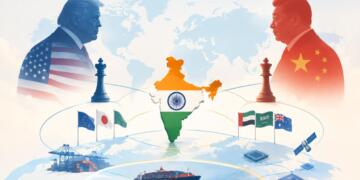
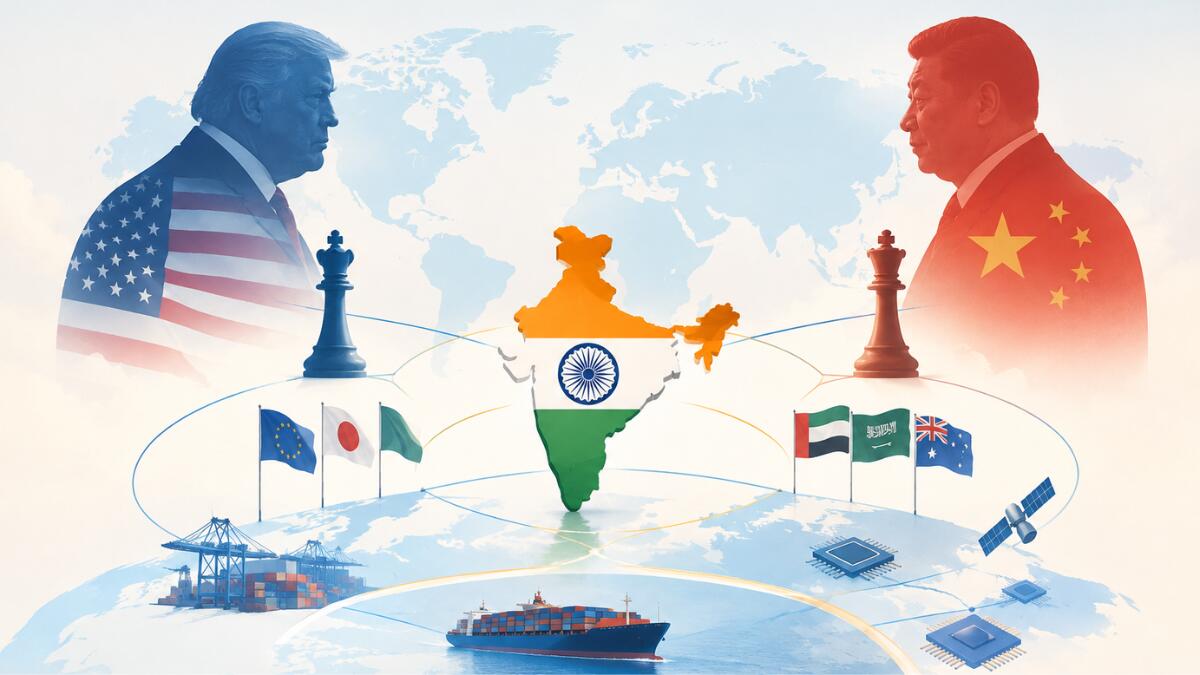
Beyond the G2 Mirage: Why Great-Power Bargains Cannot Dictate India’s Ascent

Great-power rivalry is driven by structural security dilemmas over maritime supremacy, technology standards, and regional dominance. These cannot be resolved solely through bilateral trade pacts.

Commodore (Dr.) Johnson Odakkal by Commodore (Dr.) Johnson Odakkal
2 October 2026
in Trending
Beyond the G2 Mirage: Why Great-Power Bargains Cannot Dictate India’s Ascent
Share on FacebookShare on X

High-visibility summitry between Washington and Beijing regularly triggers alarmist commentary across international policy circles, alleging that intermediate powers risk being outmaneuvered whenever the superpowers cut bilateral deals. Following encounters between U.S. President Donald Trump and Chinese President Xi Jinping in Busan and Washington, realist critics argue that New Delhi overplayed its hand as an indispensable swing state without first establishing manufacturing dominance. This fatalistic perspective warns that transactional accommodations between Washington and Beijing will inevitably relegate India to secondary status in a managed global duopoly.

However, this panic rests on a fundamental analytical flaw: mistaking tactical, cyclical trade truces for a permanent, structural G2 condominium. Short-term tariff pauses, agricultural purchasing commitments, and temporary suspensions of rare earth export controls are operational recalibrations, rather than a strategic grand bargain. Strategic analysts point out that transactional economic accommodations cannot bridge systemic friction between an established hegemon and an ascending revisionist challenger.

RelatedPosts

Defence Minister Rajnath Singh Urges Boost in Indigenous Drone Production to Strengthen India’s Strategic Autonomy

He Put On a Disguise, Walked Into the Dark, and Never Came Home: The Dalai Lama’s Escape from Tibet

Explainer: Why PM Modi broke protocol to welcome Emir of Qatar Sheikh Tamim at Airport

Load More

Great-power rivalry is driven by structural security dilemmas over maritime supremacy, technology standards, and regional dominance. These cannot be resolved solely through bilateral trade pacts. Regional assessments underscore that the anxiety over US-China G2 condominium managing global governance is a phantom monster, as neither Washington nor Beijing possesses the incentive or capacity to permanently divide global spheres of influence without provoking severe regional resistance.

The Unpredictability of Beijing and the Limits of Bilateralism

Rather than a retreat from long-term regional hegemony, Chinese diplomatic conciliation toward Washington represents a tactical operational pause designed to manage severe domestic economic headwinds. Economic evaluations show that Beijing faces a protracted property sector contraction and escalating local government debt reaching RMB 66 trillion ($9.2 trillion) by mid-2025, requiring extensive refinancing, with youth unemployment lingering at 17.3%. To absorb these domestic vulnerabilities and sustain an annualized merchandise export value of $3.38 trillion, Beijing utilizes tactical trade truces while rerouting supply chains through ASEAN hubs.

China’s behaviour across non-Western multilateral forums explicitly contradicts the notion of a compliant G2 partner. Beijing’s official national security framework active in its 15th Five-Year Plan operates on a Promote, Protect, Partner, and Punish posture to achieve total dominance in critical industries and technology. At the Shanghai Cooperation Organisation (SCO) Tianjin Summit and the BRICS Summit in New Delhi, China aggressively advanced alternative financial infrastructure, local currency settlement mechanisms, and cross-border digital payment systems to bypass Western financial architecture.

This reveals a fundamental structural paradox: a superpower cannot stably co-manage global order with Washington while actively subverting Western security alliances, weaponizing its 95% processing monopoly over rare earth elements, and pursuing unilateral territorial revisions along the Indian border and in the South China Sea. Policy studies highlight that even within BRICS, structural trade asymmetries limit the coherence of non-Western monetary blocs. Beijing’s revisionist trajectory remains volatile, non-linear, and resistant to bilateral containment, making any Western-led grand bargain inherently unstable.

Tech Statecraft, “Super Intelligence”, and the Frontier Semiconductor Race

The battleground for global primacy has shifted decisively to technology statecraft, where Washington and Beijing are engaged in an escalating race for computational supremacy. This dynamic was vividly on display when President Donald Trump convened top technology executives at the White House, including CEOs from Google, Meta, Microsoft, OpenAI, and Anthropic, to sign a voluntary accord. Intended to frame the technology as a matter of national security, the White House Accord formally seeks to rebrand artificial intelligence as Super Intelligence, despite a jarring typographical error in the official document that misspelled the United States.

During the summit, Washington explicitly rejected restrictive regulatory guardrails, portraying the artificial intelligence race as a zero-sum competition with China in which there is no second place. While the White House promotes industry self-policing, Beijing is executing a whole-of-state strategy under its 15th Five-Year Plan to build new quality productive forces and achieve total independence in basic research and advanced hardware. This frontier technology race is mirrored in the global semiconductor bottleneck, where US export curbs on advanced chips conflict with Chinese import-substitution initiatives and European efforts to nationalize strategic assets like Nexperia.

For India, this technological divide presents both a challenge and an opportunity. Rather than remaining a passive consumer of foreign technology stacks, India’s strategy centres on deploying its massive Global Capability Centre ecosystem to build sovereign capabilities in enterprise AI, software engineering, and semiconductor design. Securing a resilient position in global chip and artificial intelligence supply chains is essential to safeguarding India’s long-term strategic autonomy.

Indian Strategic Thought as a Calibrated Balance

New Delhi’s foreign policy establishment interprets great-power volatility through three distinct analytical lenses. Realist skeptics caution that Washington’s strategic posture is fundamentally transactional and warn that relying on external balancing leaves India vulnerable to sudden shifts in American domestic politics. Structural Convergence Proponents counter that shared maritime security interests across the Indo-Pacific and deep technology integration create an enduring structural alignment between Washington and New Delhi, noting that the United States requires India’s democratic scale to absorb re-routed global supply chains and balance regional power dynamics. Meanwhile, Multi-Alignment Pragmatists emphasize that active engagement in the Quad alongside simultaneous participation in BRICS, the SCO, G20, and I2U2 serves as a deliberate hedge against great-power collusion or abandonment.

This multi-alignment strategy was articulated by External Affairs Minister S. Jaishankar during a discussion at the Asia Society. Addressing the evolving dynamics between New Delhi and Beijing, Jaishankar noted that India-China relations are in a better position today than in 2024 or 2025, following the resolution of key border standoffs and high-level engagement at the BRICS Summit in New Delhi. However, Jaishankar clarified that this stabilization reflects a recovery from an off-track baseline, rather than a structural realignment, reinforcing India’s insistence that broader normalization requires sustained peace along the frontier.

Jaishankar’s statements reflect New Delhi’s calibrated dual-track diplomacy. India is maintaining a cautious, independent posture toward Washington in the face of proposed Section 301 tariffs and coercive trade pressures, while simultaneously pursuing a pragmatic, step-by-step stabilization with Beijing. Strategic evaluations explain that this posture is rooted in classical Indian statecraft, drawing from Kautilya’s Arthashastra and Thiruvalluvar’s Thirukkural, which prioritize strategic timing, self-reliance, and diplomatic flexibility over rigid alliance commitments.

India’s Irreplaceable Gravity and Strategic Synthesis

India’s geopolitical weight does not depend on catching up to global manufacturing benchmarks before asserting international agency. New Delhi possesses structural advantages across three core pillars. First, geography positions the Indian Peninsula and the Andaman and Nicobar Islands as the primary strategic chokepoint for Eurasian energy and trade flows traversing the Malacca Strait, ensuring that no bilateral arrangement can stabilize the Indo-Pacific while bypassing the Indian military’s regional footprint.

Second, India’s economic scale generates immense market gravity. With average annual real GDP growth reaching 7.9% between FY22 and FY26, India has expanded into a $4 trillion economy. Industry intelligence shows that India’s Global Capability Centre ecosystem generated $98.4 billion in annual revenue in FY26 across 2,117 centres employing 2.36 million professionals. Detailed economic reports reveal that these centers contributed $182 billion in Gross Value Added in FY25, delivering $62 billion in net service exports and owning over 6,500 global product and R&D roles end-to-end.

Third, India’s mass in Digital Public Infrastructure, software engineering, and pharmaceutical production embeds it firmly within global supply chains. Hosting more than 40% of the world’s global capability talent base, India provides an irreplaceable concentration of technical capability that international capital cannot isolate.

To translate this structural weight into permanent power, India is executing a dual mandate: accelerating internal industrial capacity while sustaining multi-vector diplomacy. Foreign policy analyses emphasize that strategic autonomy backed by domestic manufacturing, military deterrence, and Global South leadership remains a national imperative.

Strategic commentary observes that the emerging international order is moving toward a G2 + x architecture, in which India serves as one of the crucial “x” powers whose independent weight prevents any superpower duopoly from dominating global governance. By refusing binary choices and anchoring its position through continental scale, economic resilience, and multi-alignment, India ensures that the international system remains multipolar rather than a managed superpower condominium.

About the Author. Commodore (Dr.) Johnson Odakkal is a maritime scholar, strategic affairs analyst, and Indian Navy veteran. He is an expert faculty and IBDP Examiner in Global Politics and Theory of Knowledge and an Adjunct Faculty of Maritime and Strategic Studies at Naval War College, Goa.



Tags: #statecraftIndia foreign policyMulti-Alignment TechnologyStrategic AutonomyUS-China Relations
ShareTweetSend
Previous Post

PM Modi Speaks to Captain Smit Machchhar: “India Is Waiting to Welcome You”

Next Post

Mahatma Gandhi’s views on Cows, Cow Vigilantism and Cow-Slaughter

Related Posts

GANDHI’S WAR 1918: WHEN AHIMSA BACKED THE EMPIRE
Trending

The Collaborationist Apostle: Gandhi’s 1918 Betrayal of Ahinsa

2 October 2026

Mahatma Gandhi is remembered as the apostle of ahinsa and the leader who made non-violence the central weapon of...

PM Modi Speaks to Captain Smit Machchhar: “India Is Waiting to Welcome You”
Trending

PM Modi Speaks to Captain Smit Machchhar: “India Is Waiting to Welcome You”

2 October 2026

Prime Minister Narendra Modi on Friday spoke by video call to Captain Smit Machchhar, the Flydubai pilot who was...

The Mecca “Suicide Bomber” Claim: What Saudi Arabia Says, and Why the Grand Mosque Keeps Facing Threats
Trending

The Mecca “Suicide Bomber” Claim: What Saudi Arabia Says, and Why the Grand Mosque Keeps Facing Threats

2 October 2026

Reports spread on social media on Friday that a suicide bomber had tried to detonate an explosive vest near...

Load More

Leave a Reply Cancel reply

Your email address will not be published. Required fields are marked *

I agree to the Terms of use and Privacy Policy.
This site is protected by reCAPTCHA and the Google Privacy Policy and Terms of Service apply.

Currently Playing

Hanuman Chalisa Kept Me Going': Flydubai Hero Smit

Hanuman Chalisa Kept Me Going': Flydubai Hero Smit

00:10:03

How Pakistan-Linked Drug Networks Are Targeting India | Coast Guard Deals a ₹3,000 Crore Blow

00:03:28

How SkyStriker Hunts Its Target: Inside India’s Loitering Munition

00:03:49

F-35 vs Rafale? Inside India’s Biggest Air Exercise

00:05:54

China and the Philippines Are Fighting a War With Maps, Not Missiles

00:05:55
Facebook Twitter Instagram Youtube
tfipostTfipost.com
Right Wing | News Analysis | Indian Opinion
  • About us
  • Contact Us
  • Careers
  • Brand Partnerships
  • Terms of use
  • Privacy Policy
  • Sitemap

©2026 TFI Media Private Limited

No Result
View All Result
  • Premium
  • Politics
    • Analysis
    • Opinions
    • Trending
  • Economy
    • Business
    • Finance
  • Defense
    • Defence
    • Strategy
    • Weaponry
  • Geopolitics
    • Africa
    • Americas
    • Asia Pacific
    • Europe
    • South Asia
    • West Asia
  • Knowledge
    • Culture
    • History
    • Indology
  • Law
  • Lounge
    • Books
    • Cinema
    • Food
    • Health
    • Sports
    • technology
    • Travel
    • Satire
TFIPOST हिन्दी
TFIPOST Global

©2026 TFI Media Private Limited