


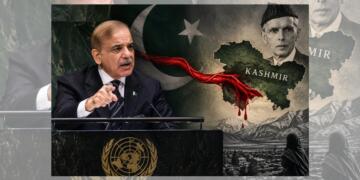
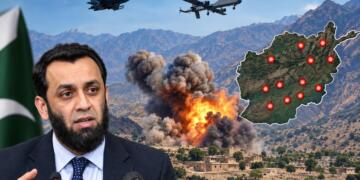









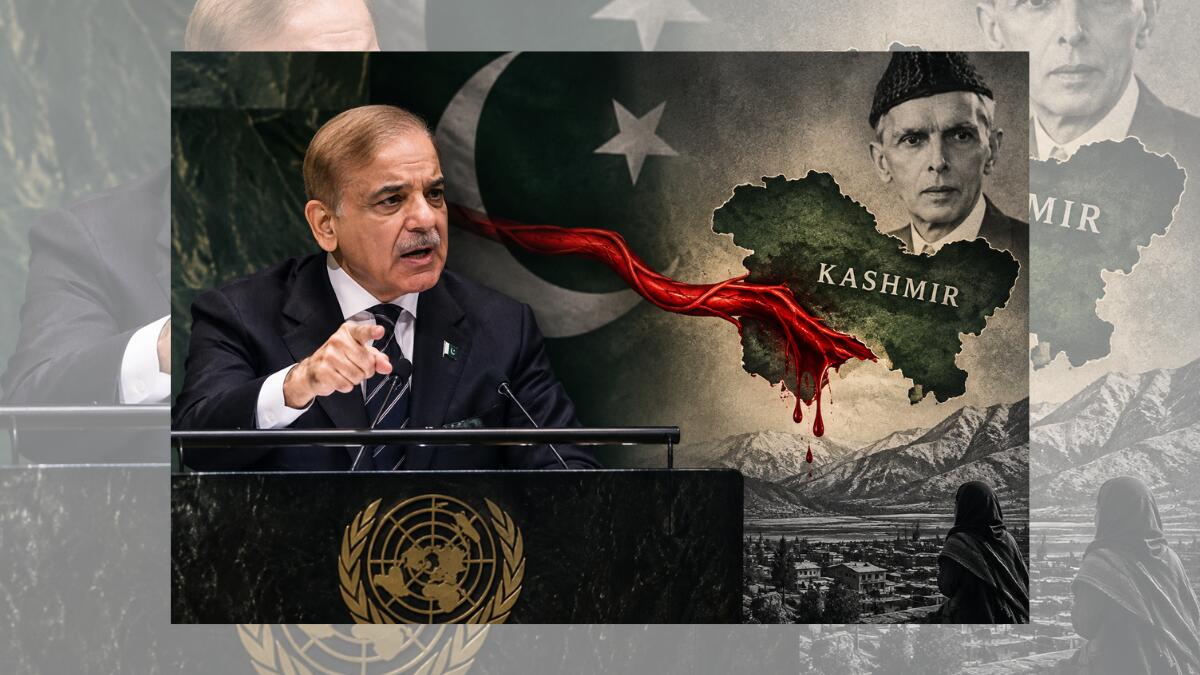
At the UN General Assembly this week, Shehbaz Sharif reached for a decades-old script. Pakistan’s prime minister warned that any attempt to stop, impede, or divert Pakistan’s share of the Indus waters would be treated as an “act of war,” while reiterating Islamabad’s position on Kashmir. He vowed that Kashmir “has, and always will be, Pakistan’s jugular vein.” He argued Kashmiris had waited eight decades for a UN-mandated plebiscite, and tied the issue to the four-day military confrontation with India in May 2025, saying the crisis had brought the Kashmir dispute “renewed diplomatic momentum.”
This followed an even more sweeping declaration months earlier. Addressing the PoK Assembly in Muzaffarabad on Kashmir Solidarity Day, Sharif declared that Kashmir will eventually become part of Pakistan, invoked Jinnah’s original description of Kashmir as the country’s “jugular vein,” and drew explicit parallels between Kashmir and Palestine, name-checking figures like Burhan Wani and Syed Ali Geelani as inspirations for “the Kashmiri people and the world.” He framed it as a matter of Islamic and civilizational solidarity — brotherhood as the foundation of Pakistan’s claim to speak for Kashmiris.
It’s stirring language. The trouble is what it looks like set against the territory Pakistan actually governs.
What Pakistan has done in PoK
Azad Jammu and Kashmir (AJK) and Gilgit-Baltistan — together, PoK — have spent the last four years in near-continuous revolt against Islamabad’s own administration. This is a documented pattern going back fifteen years, with major escalations in 2023, 2024, 2025, and 2026, each one deadlier than the last.
Every round starts the same way: a specific economic trigger. The movement began in May 2023 over skyrocketing electricity bills and flour shortages caused by smuggling. The irony sits uncomfortably next to the “jugular vein” rhetoric: PoK residents pay among the highest electricity rates in the region despite the territory generating substantial hydroelectric power, which gets transmitted to Pakistan’s national grid at preferential rates. A land Islamabad calls existentially vital to the nation is billed premium prices for the very power it produces.
The 2024 wave turned lethal. Six days of protests, strikes, and sit-ins left three protesters and a police officer dead, with 78 police injured. Islamabad’s response was money rather than structural reform — a Rs23 billion ($82.6 million) grant plus subsidies on wheat and electricity. A JAAC leader made the point explicit at the time: their fight was “not with the state of Pakistan but with the corrupt rule of the government” in PoK, adding that authorities routinely alleged an Indian hand behind the protests whenever residents raised their voice — an allegation he rejected.
The same demands resurfaced in 2025 because they’d never really been resolved: abolishing special allowances and privileges for officials, scrapping the 12 assembly seats reserved for Kashmiri migrants from Indian-administered Jammu and Kashmir, and securing royalties from the hydroelectric projects on their own land. Nine more people died, including three police personnel, before a 25-point deal delivered two education boards, medical scanners, and infrastructure promises. But the demand to abolish those reserved seats went unmet — which is a big part of why PoK erupted again in 2026, in the deadliest unrest yet.
Why the reserved seats matter
Those twelve seats are a small detail that captures the larger contradiction in Pakistan’s framing. They’re set aside for Kashmiri migrants from Indian-administered Jammu and Kashmir — a structure that lets Islamabad claim it represents “all” Kashmiris, even as AJK’s own residents argue it dilutes their representation and entrenches an unaccountable political elite above them.
Gilgit-Baltistan’s position is starker. It makes up roughly 85% of PoK’s territory, yet has never been granted the constitutional status of a full Pakistani province — leaving its people without representation in the national parliament or a settled constitutional identity, decades into Pakistan’s stewardship.
The gap
Rhetorically, Kashmir is Pakistan’s jugular vein, its Palestine, its unfinished ideological project, bound together by Islamic brotherhood. Materially, the part of Kashmir Pakistan actually administers has needed repeated emergency subsidies, security crackdowns, and negotiated settlements just to keep bread and electricity affordable — with the same charter of grievances resurfacing year after year because the underlying governance model never changes. To be fair, Islamabad has made some concessions each time — subsidies, the 2025 deal, promised infrastructure — but the fact that unrest keeps returning suggests the response has treated symptoms, not the underlying governance and representation problems. That gap, between the language of solidarity and the lived experience of the people it claims to speak for, is the real story here.