


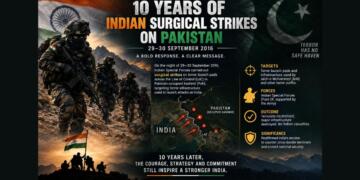
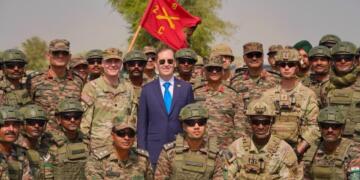





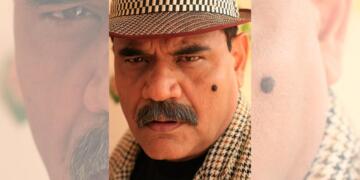


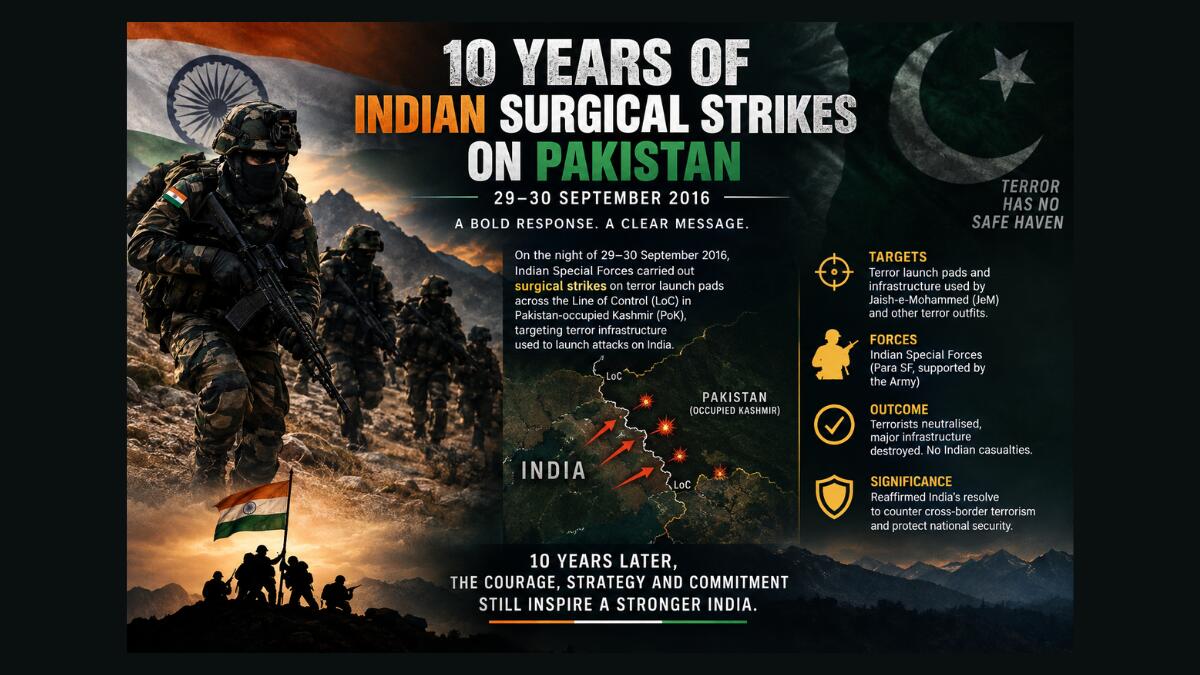
Ten years ago on this day, Indian special forces crossed the Line of Control and struck terror launch pads in Pakistan-occupied Kashmir, in an operation that has since become a reference point for India’s counter-terrorism posture. On the anniversary, Lieutenant General Rajendra Ramrao Nimbhorkar (Retd), who played a central role in the operation, said it was possible only because of the “steely resolve” shown by the political leadership at the time.
What Nimbhorkar said
“We had the capability, but somebody had to give the go-ahead. Till then, there was a lot of talk of avenging the death of our soldiers, but no action had been taken,” Nimbhorkar told PTI. He was the General Officer Commanding of the Nagrota-based 16 Corps, known as the White Knight Corps, and played a central role in operational preparedness and tactical execution in the border districts of Rajouri and Poonch.
“On the night of September 28, 2016, our soldiers went across the border and killed 82 terrorists across Uri, Poonch and Bhimber sectors,” he said. “We showed Pakistan that we can hit them hard. This was further carried forward in the Balakot strikes and Operation Sindoor.”
He said he was one of three senior Army commanders handling key operational commands during the strikes, adding, in a lighter vein, “The three of us were the junior most.” He said the soldiers were back on Indian territory by around 5 am the next day, having accomplished their mission, and that the Army received whatever equipment and air support it had asked for. “It was the steely resolve of PM Modi and Parrikar that helped accomplish this unprecedented mission,” he said.
How the political decision was taken
The strikes followed the September 18, 2016 terror attack on an Army camp in Uri, in which 19 soldiers were killed. According to an account in the book “Securing India the Modi Way” by Nitin A Gokhale, Prime Minister Narendra Modi walked into the Army’s military operations room in South Block around 9 pm on September 23, 2016, to decide how to respond. Present in the room were then Defence Minister Manohar Parrikar, National Security Adviser Ajit Doval, Army Chief General Dalbir Singh Suhag and Director General of Military Operations Lieutenant General Ranbir Singh. Modi decided that a special forces raid across the frontier was the best available course of action, but held it back until External Affairs Minister Sushma Swaraj had spoken at the UN General Assembly. The operation was launched on September 28, after northern Army commander Lieutenant General D S Hooda signalled the go-ahead.
Speaking on Sunday, Modi described the surgical strikes as India’s decisive response to the pain of terror attacks, and said they set a new example for the country’s counter-terrorism policy.
What Parrikar said at the time
Parrikar, as defence minister, defended the operation against sceptics in the years that followed. He said the Indian Army was the world’s best and that when it said something, it should be believed, adding that some politicians kept demanding proof of the strikes long after they were carried out. He also said the strikes had introduced “uncertainty” into the adversary’s calculations, describing this as a deliberate strategic aim. “Earlier, one thing was sure that India won’t cross the LoC. Now there is one thing that’s missing,” he said, arguing this had been achieved despite criticism that ceasefire violations rose after the operation.
A marker for later operations
Nimbhorkar’s comments this week place the 2016 strikes at the start of a line that runs through the 2019 Balakot air strikes and, more recently, Operation Sindoor, as instances of India responding militarily to cross-border terrorism. Military officers involved in the operation have consistently credited both the political leadership’s willingness to authorise action and the armed forces’ operational readiness. The strikes were carried out by the Army’s elite Parachute Regiment Special Forces, and accounts from the time describe an operation planned and executed with limited numbers of people aware of it in advance, to preserve secrecy.
A decade later, the anniversary has drawn renewed attention to how the decision was made and who made it, with both the military commanders who executed the raid and the political leadership that authorised it being credited for the outcome.