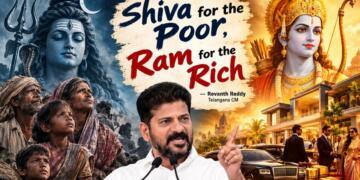

















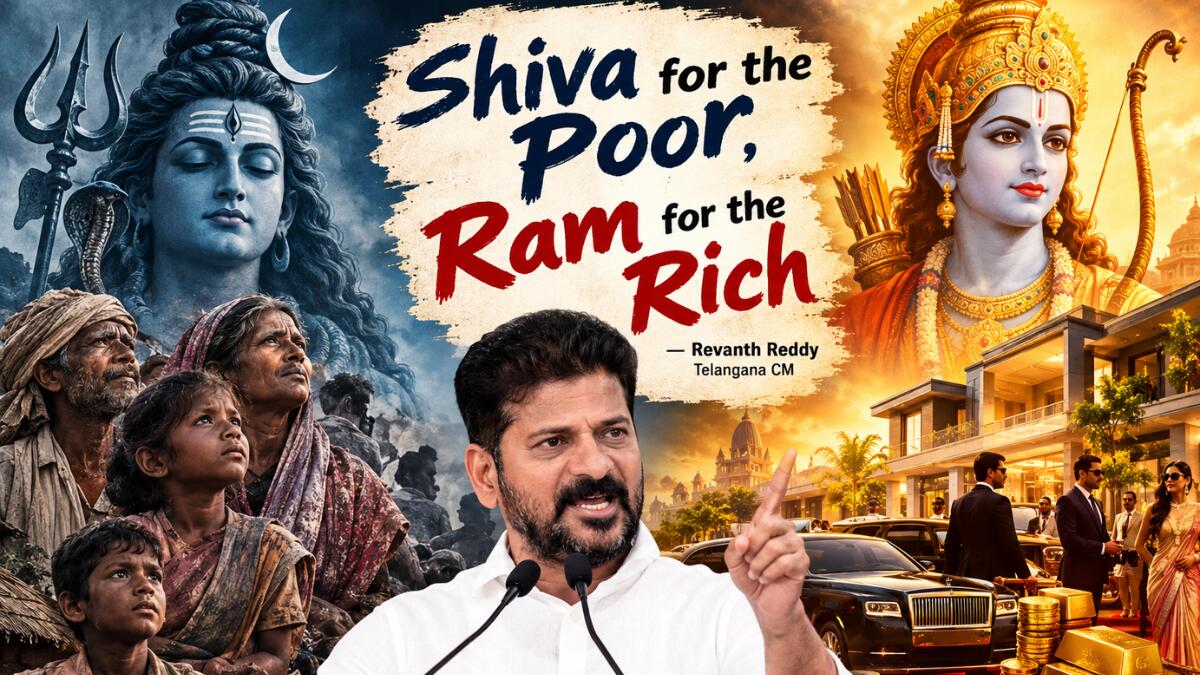
Telangana Chief Minister A Revanth Reddy has triggered a political row after contrasting the religious identities of Lord Ram and Lord Shiva, and by extension the political cultures of north and south India. The remark has drawn a sharp response from the BJP, which has accused him of trying to divide communities.
Speaking at a media event in Delhi on Monday, Reddy said, “We are devotees of Shiva. These are devotees of Lord Ram. BJP stole Ram,” and went on to argue that “Shiva is the God of the poor, Ram is the God of the rich, and the BJP is a party of the rich.” He also questioned why BJP leaders frequently chant “Jai Sri Ram” but do not similarly invoke “Har Har Mahadev,” and asked why Prime Minister Narendra Modi does not do the same. While drawing this contrast, Reddy did acknowledge that both deities are revered by devotees across the country.
He framed the remark within a wider argument about identity, describing Telangana and the south as rooted in a Dravidian tradition distinct from what he characterised as an Aryan tradition associated with the north. The remarks came alongside comments on Lok Sabha delimitation, an issue on which Reddy and other Congress leaders have argued that population-based seat allocation could reduce southern states’ political representation.
The angle: three lines of division in one remark
The statement draws at least three fault lines at once. The first is religious, setting up Shiva against Ram as gods of different classes, a framing that risks reducing two widely worshipped deities to opposing political symbols. The second is regional, reviving the older Dravidian-Aryan binary to argue that north and south India follow different religious and political cultures. The third is economic, mapping faith onto class by casting devotion to Ram as an attribute of the wealthy and devotion to Shiva as an attribute of the poor, a division with no clear basis in how either deity is actually worshipped across income groups in India.
Together, these threads turn a comment ostensibly about BJP’s political use of religious symbols into a statement that touches religion, region and class simultaneously, which is a large part of why it has drawn such a strong reaction.
The BJP’s response
Union Minister of State Bandi Sanjay Kumar accused Reddy of drawing “political boundaries between Lord Ram and Lord Shiva” and linked the remark to an earlier statement attributed to Reddy that “Muslim is Congress, Congress is Muslim,” suggesting a pattern of communal framing. Kumar also invoked the mythological detail that Lord Shiva drank the Halahala poison and became Neelakanth, implying a mismatch between the imagery Reddy used and Shiva’s actual iconography.
This is not the first time Reddy’s remarks on Hindu deities have drawn BJP fire. In December 2025, Union Minister Prahlad Joshi said insulting Hindus “has become a habit of the Congress party and their allies,” and BJP MP Sambit Patra said an earlier remark attributed to Reddy exposed the party’s “mindset against Hindus.”
A wider pattern in southern politics
Reddy’s comments follow a broader pattern of southern non-BJP leaders making remarks on Hindu religious figures that have triggered national controversy. In Tamil Nadu, DMK ministers have repeatedly made comments questioning aspects of Hinduism, including a claim by a minister that there is “no history” establishing Lord Ram’s existence, and an earlier call by another DMK leader to “annihilate” Sanatana Dharma, which put the DMK and its ally Congress on the defensive against BJP charges of insulting Hindus.
What it signals
Reddy’s remark, like those precedents, appears calculated to sharpen a political and cultural distinction between the south and the BJP’s traditional strongholds in the north, at a time when regional parties in the south have been vocal about delimitation and federal representation. Whether the strategy consolidates southern political identity or simply hands the BJP another opening to allege that the Congress and its allies disrespect Hindu symbols is likely to shape how the controversy plays out in the coming days.