





















By Maj Gen P. Rajagopal
Accidents occur all over the world, but what should concern us in India is the increasing frequency and repetitive nature of accidents resulting in grievous injuries and loss of life. It is a clear indication that after the initial noise, blame game, and assurances — and the wide coverage in print and electronic media — everything returns to normal sooner rather than later. As I write this, there is yet another building collapse in Delhi, with the same loss of lives and the same all-too-familiar response.
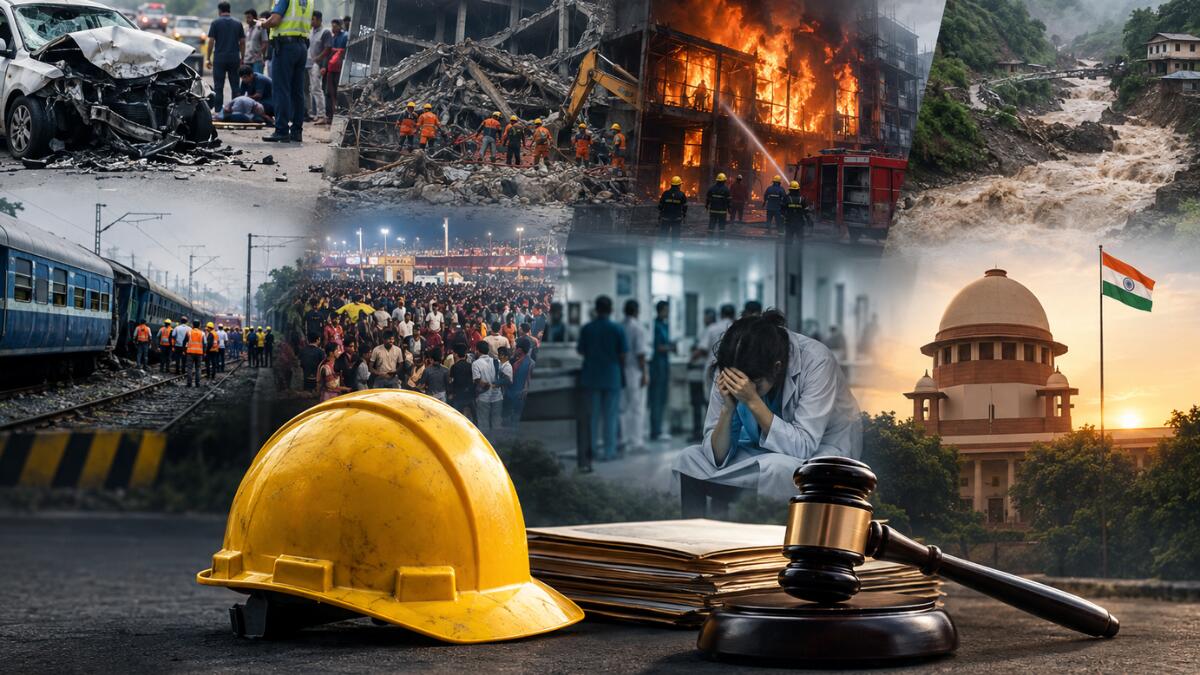
The pattern repeats itself: industrial accidents, road accidents, fire-related accidents, deaths due to weather events such as floods and landslides, people falling into open wells and drains, air and train accidents, stampedes at religious or political gatherings, and repeated assaults on doctors across the country — the list is endless. As a country prone to disasters, both man-made and natural, we also have a limited public attention span.
The next disaster arrives, and the lives lost earlier become just another statistic. At the end of the day, it is the injured, the permanently disabled, and the grieving relatives who are left to bear the cost. Only a few exceptional cases continue to occupy public attention for any length of time, usually for reasons unrelated to the incident itself. After the initial outrage fades, there is rarely any follow-up coverage of accountability — the criminal investigation or the final judgment of the courts. There is an abhorrent delay in the process, and the guilty mostly get away. This article attempts to identify common threads running across the broad spectrum of man-made and natural accidents, and to suggest a way forward to reduce, if not eliminate, them.
Road accidents. India apparently ranks highest in the world in road accident deaths, according to publicly available sources. Analysis shows that nearly 75–80% of accidents occur due to over-speeding, drunken driving, use of electronic devices while driving, not wearing seat belts, and poor driving practices in general. With improved vehicle technology, mechanical failures are now rare; over-speeding continues to account for the largest share of fatal road accidents. In 2024, Police Departments across states and union territories reported 4,87,707 road accidents, claiming 1,77,175 lives and injuring 4,71,441 people.
Among young men aged 15–29, road accidents are the single largest cause of death, responsible for more than one in five deaths in that age group. Road accident fatalities in India have been rising steadily, nearly doubling between 2000 and 2022. If drunken driving and over-speeding could be controlled, far fewer lives would be lost. We have all seen wealthy, reckless young drivers whose influential parents pull every string — through malpractice and corruption — to get them acquitted: switching blood samples, naming someone else as the driver, or having police delay blood tests to let alcohol content drop. Underlying all of this is a weak enforcement of speed limits and a widespread belief among offenders that even if caught, or even if a bystander dies, there will be a way out. Even when public scrutiny or media pressure forces the authorities to begin prosecution, cases can still be delayed indefinitely or quashed altogether. With no time-bound resolution at any level of the judicial process, there is neither justice for the victims nor any deterrent effect on future offenders.
Fire accidents. Deaths from fire accidents are also rising alarmingly, with 10,000–15,000 fatalities reported every year, alongside major business losses that could largely be prevented. Warehouses, hospitals, eateries, and high-rise buildings are all vulnerable. Organisations tend to rely on reactive rather than preventive measures, treating spending on security and fire safety as an unnecessary expense. Higher electrical loads, the use of combustible materials, and the rapid expansion of high-density infrastructure — high-rises and large warehouses — all add to the risk. While there is usually a proximate technical cause, such as an electrical fault, a gas explosion, or poor maintenance and storage practices, there are deeper reasons too. After almost every such incident, it emerges that the approvals and usage on the ground were faulty to begin with. Basic fire safety requirements — adequate entry and exit points, sufficient firefighting arrangements, occupancy limits — are routinely ignored.
It requires no great insight to conclude that even buildings falling short of mandatory fire safety standards can still secure approvals, and later, renewals, through the same compromised process. It is repeatedly seen that no one who granted the approvals, or who was responsible for lapses in inspection or renewal, is ever held to account. At best, to placate public anger, a few are suspended briefly — only to return to their posts once attention has moved on.
The consequences of fire accidents extend well beyond the immediate damage: human casualties, financial losses, destroyed machinery and assets, indefinite business closures, and often lasting environmental damage that affects not just the organisation but the surrounding community.
India is also witnessing a disturbing pattern of industrial accidents that points to systemic failures in workplace safety and regulatory enforcement. According to the National Disaster Management Authority, India has recorded hundreds of such incidents over the past decade, many of which go unreported or ignored. Regulatory failures, technological gaps, and management negligence are recurring causes. Certain categories of accidents — weather-related floods, for instance — happen almost every year, yet we are never adequately prepared. Some measures are taken to mitigate the immediate damage, only to be forgotten until the next year. Add to this the recurring incidents of people falling into open wells and drains, stampedes at religious or political events, and repeated assaults on doctors — the list goes on. Most of these are avoidable, yet they keep happening, again and again.
Whenever a major accident causes severe injury or loss of life, the response follows a familiar template, with minor variations depending on the situation: an outpouring of sympathy for the affected families, assurances of a high-level inquiry, the occasional lower-level suspension if public pressure is strong enough, and monetary compensation depending on the case. Yet similar tragedies keep recurring across factories, warehouses, construction sites, highways, high-rises, and industrial establishments. From stampedes to people falling into sewage tanks or open drains to fires in high-rise buildings, nearly every category of accident meets with the same response.
While each incident has its own immediate cause, together they point to deeper structural problems — in how approvals are granted by various agencies, and in how mandatory provisions and legal requirements are enforced. We are a developing country aspiring to become a developed one within a few years. We have a large, restless young population seeking jobs at home or opportunities to study and work abroad for a better life.
Generating more jobs domestically requires substantial investment, and for that we must be seen not merely as a country with a long list of rules and regulations, but as one that genuinely values the safety of its people, its industries, and its environment. Equally, we must be seen as a responsible country with a credible education system, one whose students are welcomed by foreign institutions and companies.
The impression we currently project to the world is of a country that does not sufficiently value human life — that living and working in India is not just unsafe, but dangerous. Foreign investors will think twice, since accidents can cause complete operational breakdowns, heavy losses, and penalties. Given how frequently accidents of the same nature keep recurring, we must confront the truth: we are not coming across as a country with high safety and environmental standards, and this hurts our attractiveness as an investment destination.
Why do accidents keep happening despite ample regulation and law to deal with violators? The lack of accountability is the principal cause. Inquiry committees formed after accidents rarely lead to exemplary punishment or meaningful policy reform. Even when punishment is eventually awarded, it comes so many years later that it has no deterrent effect — if anything, it only emboldens further violations.
Even as the country makes great strides across various fields on its path to becoming a developed nation, we urgently need to raise our safety standards. Safety regulations already exist for each sector — fire, motor vehicles, and others — but we need to approach the problem differently. We observe Safety Week, Safety Day, and similar initiatives, yet the persistence and similarity of these accidents makes it clear that our current approach is neither fully right nor adequate.
Major infrastructure projects are underway across the country, and while many are success stories, there have also been cases of road cave-ins, tunnel collapses, landslides, and bridge failures — none of which bodes well for the future. Change is needed, and the sooner it comes, the better for the country.
What can we do differently? There are four areas that need urgent attention.
1. Launch a sustained, nationwide multimedia campaign to build a culture of safety.
Unless people become genuinely aware of and concerned about safety, our present indifference will not change. We saw a similar shift with cleanliness: the Swachh Bharat campaign brought about a real change in public mindset. We now need a comparable, all-encompassing national campaign — conducted at the highest level — to raise safety awareness and highlight the enormous cost we pay, in lives, business disruption, and reputational damage, for our lackadaisical approach to man-made and natural disasters.
2. Create a central authority to track and monitor all safety-related incidents involving casualties or loss of life across the country.
The major gap today is the absence of central monitoring for major incidents that cause loss of life, property, or business disruption. Once media attention fades, cases are forgotten until the next tragedy strikes. Cases drag on in courts for years, suspensions against responsible individuals are quietly revoked once the outrage subsides, and things return to normal. This authority must be empowered by statute to track every case and provide regular, mandated updates on its status to the country.
3. Create fast-track courts.
Justice delayed is justice denied. The deterrent value of swift and certain punishment cannot be overstated. With crores of pending cases and thousands of vacant judicial posts, India’s courts have turned the wait for justice into a multi-generational ordeal. Since safety violations remain the norm across sectors, the only way to enforce compliance is through the credible fear of law — and that requires timely justice. Without it, there is no deterrence, and negligence continues unchecked.
4. Hold approving and monitoring authorities accountable — heads must roll.
In every such case, there are two sets of culpable individuals: those who physically commit the safety violation that leads to loss of life, and those who enable it — by granting approvals without due diligence, skipping mandated checks, or simply looking the other way. Both must be treated as criminally liable, and heads of departments must be held personally accountable.
About the author: Maj Gen P. Rajagopal retired as Head of the Territorial Army after 38 years of distinguished service in the Army, and has since held senior corporate roles managing HR, Security, and Administration across different organisations — bringing a valuable blend of military and private-industry experience. He is also qualified in Disaster Management. Views expressed in the above article are the author’s own and do not represent the stance of The Frustrated Indian.