





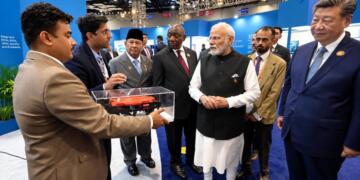









Beyond the headline-grabbing meeting with Chinese President Xi Jinping, Prime Minister Narendra Modi used the sidelines of the 18th BRICS Summit to run through a packed slate of bilateral engagements, meeting leaders from the UN, the Gulf, Southeast Asia and Africa in the space of little more than a day. Four of these talks took place at Hyderabad House on Saturday, with the Xi meeting at 5:45 PM at Bharat Mandapam as the day’s centerpiece.
Setting the tone with Guterres
The run of diplomacy actually began the night before the summit formally opened. Late Friday, Modi met UN Secretary-General António Guterres, with New Delhi saying the two leaders underscored the importance of multipolarity and the need to reform multilateral institutions, including the UN Security Council, to better reflect today’s realities. Their conversation ranged widely — touching on ongoing conflicts, freedom of navigation, sustainable development, human-centric AI, progress on renewable energy, and global food security.
Ethiopia: reviewing a strategic partnership
Modi’s Saturday schedule opened at 10 AM with Ethiopian Prime Minister Abiy Ahmed Ali. The two leaders used the meeting to review progress across their bilateral strategic partnership, covering the economy, defence and security, with an eye toward strengthening ties further in the years ahead.
Malaysia: building the ASEAN bridge
At 10:30 AM, Modi turned to Malaysian Prime Minister Anwar Ibrahim. The conversation carried weight beyond the bilateral relationship — Malaysia is one of BRICS’s partner nations, and the meeting fit into India’s broader push to deepen engagement with ASEAN. The two discussed strengthening cooperation as India looks to widen its footprint in Southeast Asia.
UAE: steadying the Gulf relationship
Perhaps the most closely watched of the non-Xi meetings was with Abu Dhabi Crown Prince Sheikh Khaled bin Mohamed bin Zayed Al Nahyan. Given the instability across West Asia — disrupted maritime routes, energy security concerns, and a region under strain — this meeting carried added significance for India, which depends heavily on the Gulf for energy supplies, trade, and its large expatriate community. Modi and the Crown Prince discussed the overall situation in West Asia and ways to advance the India-UAE strategic partnership, with Modi remarking afterward that a strong India-UAE relationship stands as “a symbol of stability, prosperity, peace” amid the uncertainty gripping the Middle East. As a fellow BRICS member, the UAE’s engagement with India also carried implications for the wider grouping, not just the bilateral track.
Vietnam: a fifth stop on a five-country day
Rounding out Modi’s Saturday bilaterals was a meeting with his Vietnamese counterpart, continuing a relationship Modi has nurtured through previous engagements, including talks on the sidelines of last year’s UNGA summit in New York.
A common thread: shielding trade from global shocks
Across the talks with the UAE, Malaysia, Vietnam and Ethiopia, a consistent theme emerged: critical minerals, energy and food security, with all four conversations aimed at insulating trade and supply chains from the turbulence of rising global tensions. Taken together with Friday’s meetings — which also included separate talks with Russian President Vladimir Putin and Iranian President Masoud Pezeshkian, plus an address to the BRICS Business Forum — Modi’s schedule reflected India’s attempt to use its BRICS chairship as a platform for building relationships across Asia, Africa and the Gulf simultaneously, even as the marquee Xi Jinping meeting dominated the day’s headlines.