























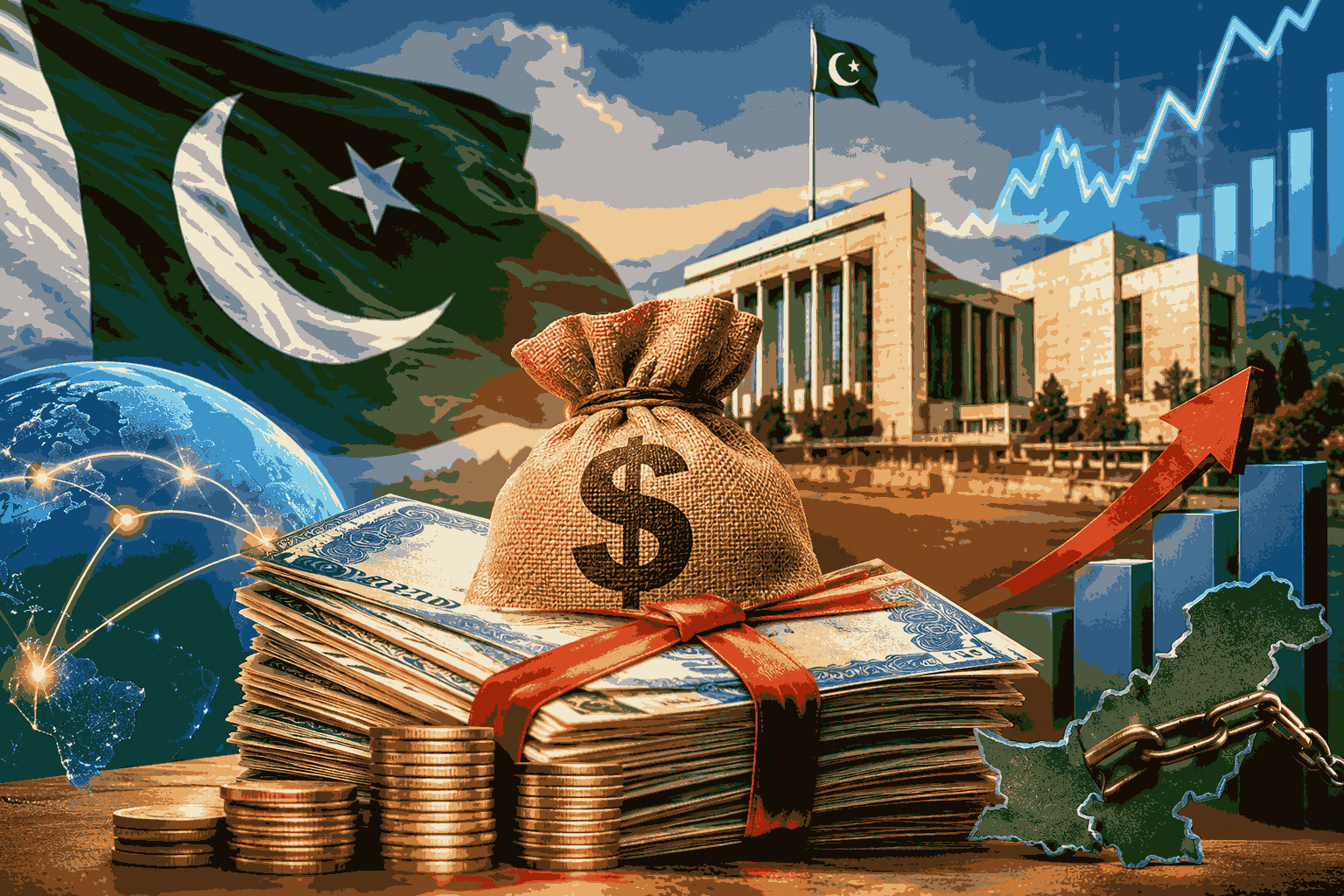
Pakistan has returned to international debt markets with a headline-grabbing $3 billion Eurobond sale, and the government is presenting the transaction as evidence that investor confidence in the country has been restored. The borrowing, however, comes as Islamabad remains dependent on external financing and faces the continuing challenge of managing a heavy debt burden.
The latest issue is Pakistan’s largest-ever international bond transaction in a single deal. According to the Ministry of Finance, the offering attracted nearly $6 billion in orders, almost twice the amount ultimately raised. Officials described the demand as a strong market signal, arguing that global investors are reassessing Pakistan’s economic and credit outlook. The transaction was split into two maturities: $1.75 billion through a 5.5-year bond carrying a 7.5 per cent coupon and $1.25 billion through a 10-year bond carrying a 7.9 per cent coupon.
On the surface, the numbers make for an impressive announcement. A $3 billion transaction gives Pakistan access to international capital at a moment when the government wants to show that the worst phase of its financial crisis is behind it. The strong order book also allows officials to argue that foreign investors are willing to put money into Pakistani sovereign debt again.
Yet borrowing money is not the same as creating wealth. A bond issue brings cash into government coffers, but it also creates an obligation to repay principal and interest. That distinction is particularly important for Pakistan, which has spent years dealing with foreign-exchange shortages, debt repayments and repeated dependence on multilateral and bilateral lenders.
The government says the $3 billion borrowing should be viewed as part of a broader strategy of sovereign liability management. The Finance Ministry argues that longer maturities can reduce refinancing and rollover risks and that international borrowing can replace shorter-term or more expensive obligations when economically justified. That objective is reasonable, but its success depends on whether the new debt improves the overall structure of Pakistan’s liabilities rather than merely postponing repayment pressures.
The latest deal follows Pakistan’s return to international bond markets earlier this year. In April, Islamabad initially raised $500 million through a three-year Eurobond, later increasing the issue to $750 million after stronger-than-expected demand. Pakistan also repaid a $1.4 billion Eurobond that matured in April, helping restore a pricing benchmark in international debt markets.
The $3 billion issuance also comes after improvements in Pakistan’s sovereign credit ratings. The government has pointed to these upgrades as evidence that its stabilisation programme is gaining credibility. Foreign-exchange reserves have improved from earlier lows, while the country continues to operate under an IMF-backed reform framework. These developments have strengthened Islamabad’s ability to approach international investors, although significant vulnerabilities remain.
But the cost of the new borrowing should not be overlooked. The two bonds carry coupons of 7.5 per cent and 7.9 per cent. Such rates remain significant for a sovereign that must devote substantial public revenue to servicing existing debt. Even when investors show strong demand, they are not providing free capital; they are pricing the risks associated with lending to Pakistan.
For Islamabad, the $3 billion sale is best understood as an opportunity rather than a final victory. It can help lengthen maturities, diversify funding sources and rebuild a regular presence in international markets. But the real test will come later, when Pakistan has to service the debt while financing development, managing its fiscal deficit and meeting other external obligations.
The $3 billion transaction may signal that international investors see a more stable Pakistan than they did during the depths of the recent crisis. But investor appetite should not be confused with economic independence. A country’s financial strength is ultimately measured not by how much it can borrow, but by how effectively it can grow its economy and repay what it owes.
For now, Islamabad can celebrate its return to the global bond market. The harder task is ensuring that this borrowing becomes part of a sustainable financial strategy rather than another temporary solution to a recurring problem. The $3 billion may provide valuable breathing space, but turning that space into durable economic strength will require reforms that go well beyond the bond market.