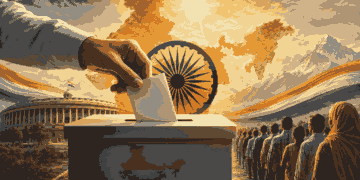















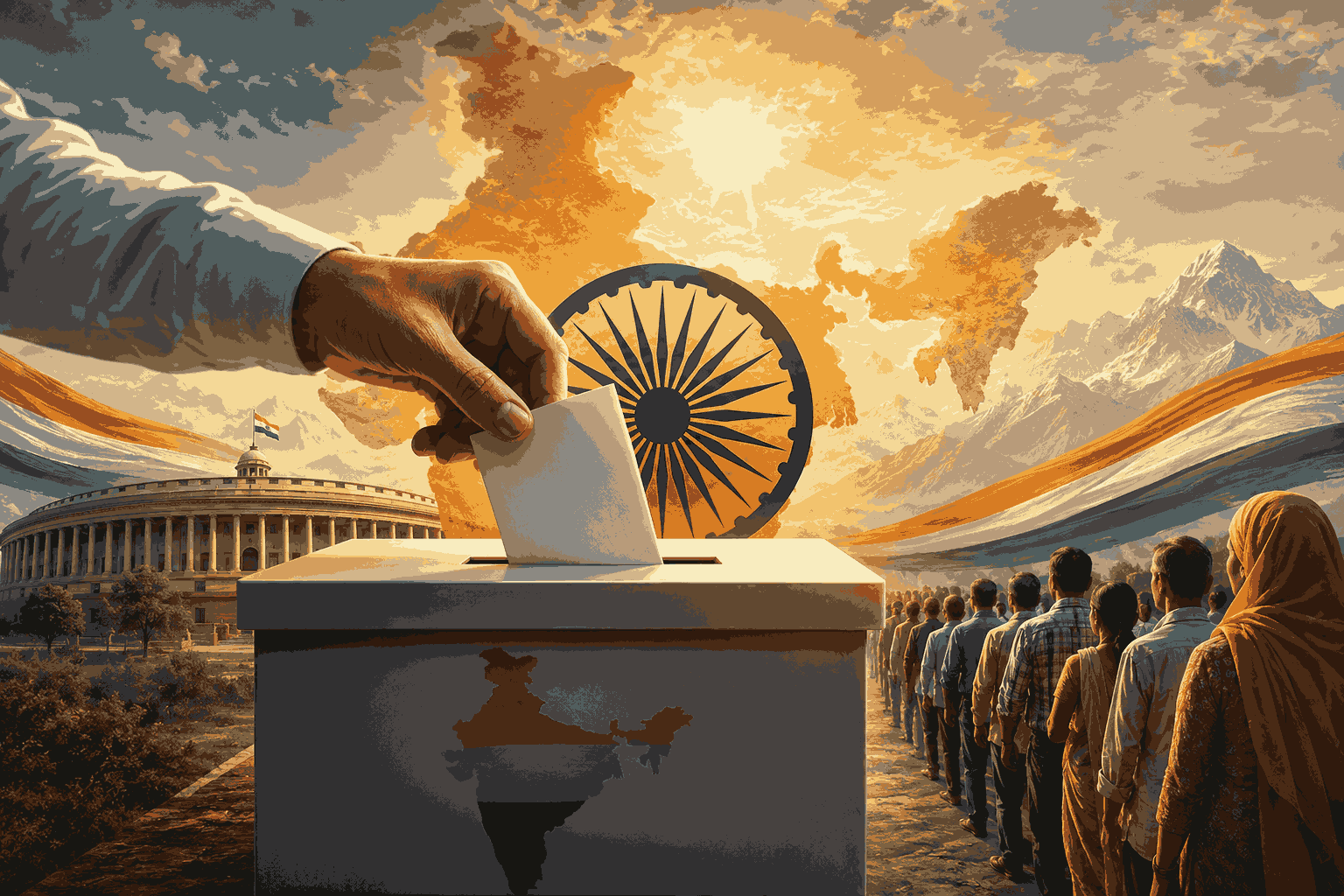
India could be heading towards a significant change in the way it conducts elections, with the Narendra Modi government examining whether One Nation-One Election could be implemented as early as the 2029 Lok Sabha polls. According to a report cited by OpIndia, the National Democratic Alliance is exploring a plan to synchronise Assembly elections in 22 NDA-ruled states and Union Territories with the next general election, potentially bringing forward a process that had earlier been expected to begin later. (OpIndia)
The proposal comes at a time when the Joint Parliamentary Committee examining the constitutional and legal framework for simultaneous elections is continuing consultations with political leaders, legislators, officials and other stakeholders. The committee is studying how election cycles can be aligned without leaving major constitutional questions unresolved. Its work could therefore prove decisive in determining whether the 2029 election cycle becomes the starting point for a broader synchronisation exercise.
At the heart of the proposal is a practical question: how can states whose Assembly terms end at different times be brought into a common electoral calendar? The current discussion reportedly involves several NDA-ruled states where governments could agree to dissolve their Assemblies before the completion of their normal terms. If implemented, some Assemblies could be dissolved as early as January 2029, allowing their elections to coincide with the Lok Sabha contest. (OpIndia)
The scale of the proposed adjustment is substantial. States such as Goa, Gujarat, Manipur, Uttar Pradesh and Uttarakhand could see their Assembly terms shortened by roughly three years, while Chhattisgarh, Madhya Pradesh, Meghalaya, Nagaland, Rajasthan and Tripura could face reductions of around four years. Andhra Pradesh, Arunachal Pradesh, Sikkim and Odisha already conduct Assembly elections alongside Lok Sabha elections, making their inclusion comparatively straightforward. (OpIndia)
The idea has received encouraging signals from some NDA chief ministers. Leaders from Goa, Uttarakhand, Haryana and Delhi have expressed support for synchronising elections during their interactions with the parliamentary committee. Delhi Chief Minister Rekha Gupta has indicated that her government would be prepared to make an appropriate adjustment if necessary in the national interest. Such political willingness could become important because synchronisation cannot be achieved merely through an administrative decision; it involves questions about the tenure of elected governments and the constitutional framework governing legislatures. (OpIndia)
For supporters, One Nation-One Election promises to address several longstanding concerns surrounding India’s increasingly frequent election cycle. The argument is that repeated elections consume substantial public resources, require the deployment of security personnel and election officials, and repeatedly bring the Model Code of Conduct into operation. The government’s earlier high-level committee on simultaneous elections had highlighted these issues while examining ways to reduce disruption to governance and development. (OpIndia)
The concept, however, remains politically contentious. Opposition parties argue that prematurely dissolving Assemblies could undermine the constitutional tenure of elected governments and weaken the federal character of Indian democracy. Congress general secretary Jairam Ramesh has maintained that his party opposes the proposal, describing it as unconstitutional and anti-democratic. Karnataka Chief Minister D K Shivakumar has also opposed the plan, while Congress and DMK members had objected to the Bills when they were introduced in Parliament. (OpIndia)
The disagreement illustrates why One Nation-One Election is considerably more complicated than simply choosing a common polling date. A government that loses its majority midway through its term, a hung Assembly, a successful no-confidence motion or another constitutional crisis could disrupt the synchronised cycle. The parliamentary process therefore has to determine what happens when one legislature falls while others continue. The original high-level committee was specifically tasked with examining such contingencies and suggesting safeguards for maintaining a common election cycle. (OpIndia)
The legislative foundation for the proposal already exists in Parliament. The Constitution (One Hundred and Twenty-Ninth Amendment) Bill, 2024, along with the Union Territories Laws (Amendment) Bill, was introduced in December 2024 and subsequently referred to the Joint Parliamentary Committee. The constitutional amendment seeks changes involving Articles 82, 83, 172 and 327 to create a framework for synchronised elections to the Lok Sabha and state Assemblies. (OpIndia)
The origins of One Nation-One Election are also older than the present political debate. India held simultaneous Lok Sabha and Assembly elections for much of the period between 1951-52 and 1967 before the cycle gradually broke down. The government-appointed high-level committee headed by former President Ram Nath Kovind later examined the issue in depth, producing an 18,626-page report after extensive consultations and research. (OpIndia)
Ultimately, the proposed 2029 timeline remains a plan under consideration rather than an accomplished fact. The parliamentary committee must complete its consultations, Parliament must consider the necessary legislation and constitutional amendments, and the broader political system must address legitimate concerns surrounding federalism, accountability and the tenure of elected governments. If those hurdles can be overcome, One Nation-One Election could represent one of the most consequential changes to India’s electoral architecture in decades. If not, the existing staggered system is likely to continue. Either way, the debate has moved well beyond a political slogan and into the difficult territory of constitutional design, administrative practicality and the future shape of Indian democracy.