















The Christian Fundamentalist label has entered a heated political debate in Tamil Nadu after The Commune published an article accusing Chief Minister Joseph Vijay’s TVK government of displaying a strong Christian political orientation. The article points to statements, appointments and public appearances involving Vijay, Assembly Speaker JCD Prabhakar and ministers. However, these are political allegations and should be distinguished from independently established evidence.
The controversy intensified after Prabhakar identified himself as a “Vanniyar Christian” while speaking in the Assembly about reservation benefits for Vanniyar community members who converted to Christianity. According to the report, Prabhakar recalled his association with the Tamil Nadu Deccan Vanniyar Christian Association and described efforts to secure reservation benefits for converted Christians. His remarks have become central to criticism of the administration.
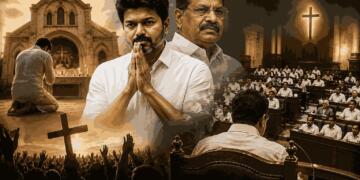
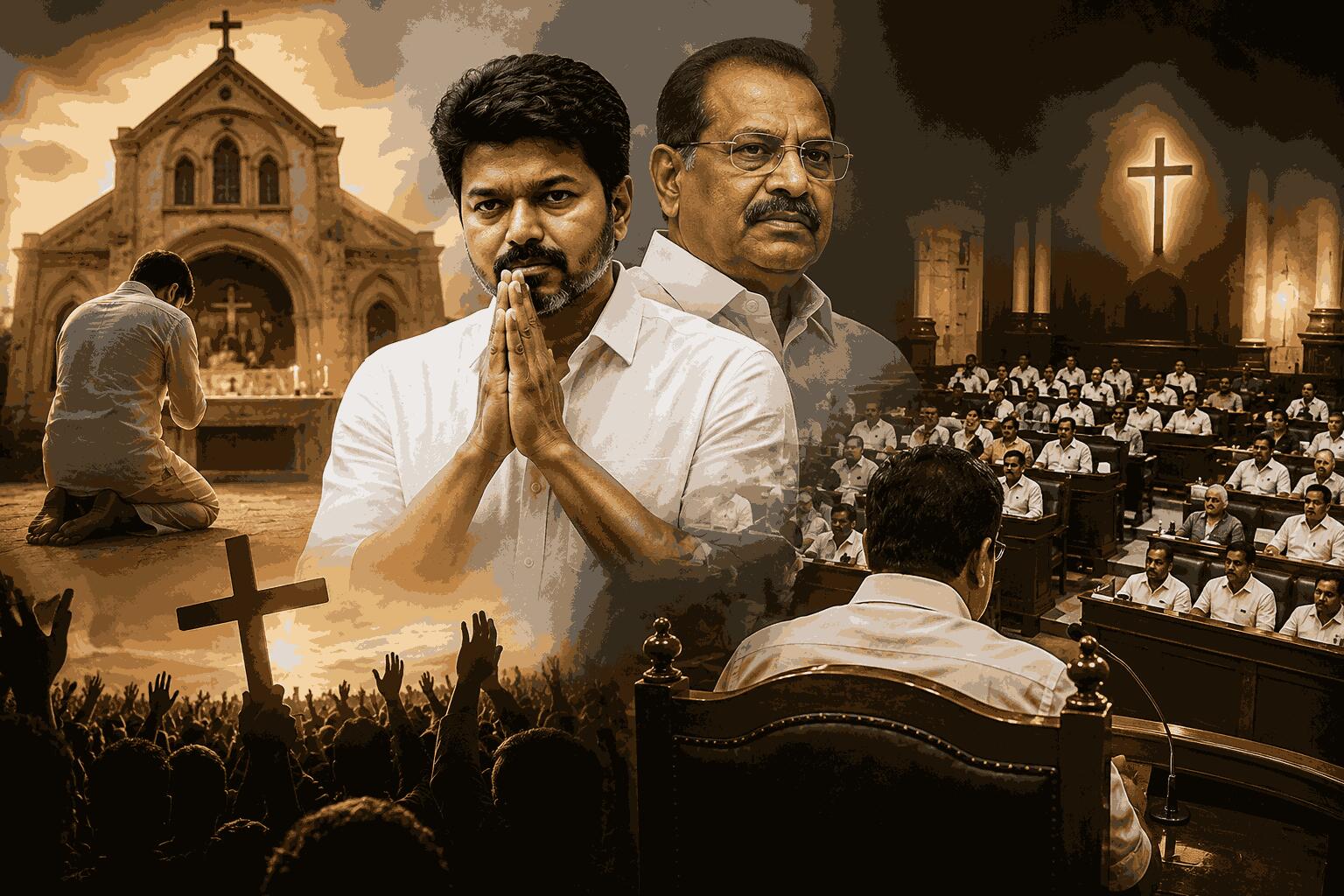
The article also revisits Vijay’s campaign before the 2026 Assembly election. It says Vijay, who filed his nomination as C. Joseph Vijay, visited St. Antony’s Church in Tiruchirappalli and was seen kneeling before the altar.
Another point concerns Vijay’s remarks after the government won its floor test. According to The Commune, Vijay described the administration as a “minority government” and said it would stand firmly with minority communities. Critics interpret the remarks as political signalling. Yet support for minority communities does not, by itself, establish religious discrimination or demonstrate that government policy is directed by a particular faith.
The Christian Fundamentalist argument has gained attention because of Prabhakar’s conduct inside the Assembly. The report says Bible verses were recited from the Speaker’s Chair after he assumed office, describing it as an unprecedented development in the Assembly’s history. Whether this represents inappropriate religious influence remains a matter of political and constitutional interpretation, not an established legal finding.
The Commune also cites a June meeting involving Prabhakar and the Tamil Nadu Christian Churches Federation. According to the publication, he discussed demands concerning church construction, burial grounds, evangelist support and pilgrimage assistance.
The Christian Fundamentalist controversy was further fuelled by appearances involving TVK leaders at Christian gatherings. The article points to a July conference at which Prabhakar and several TVK legislators were listed, his appearance at a Jesus film trailer launch, and participation in an anti-abortion awareness programme. It also notes Vijay’s appointment of party spokesperson Felix Gerald as chairperson of the Tamil Nadu State Minorities Commission.
Another episode concerns Finance Minister N. Marie Wilson, who reportedly referred openly to his Christian faith while responding to criticism over his use of Tamil in the Assembly. The article also notes Vijay’s meeting with Christian and Muslim minority representatives, including preacher Paul Dhinakaran, around the time the Assembly considered a resolution opposing the FCRA Amendment Bill. Critics connect these events to a broader political pattern, although association alone does not establish causation.
The Christian Fundamentalist charge also rests on Prabhakar’s reported comments at a Christian foundation event on August 14. According to the article, he claimed that the TVK government came to power by following the teachings of the Bible and linked the party’s electoral success with faith in God. Such remarks, if accurately reported and understood in context, raise questions about the relationship between religious conviction and public office.
At the heart of the dispute is the distinction between an individual politician’s beliefs and the conduct of a government. India’s Constitution protects freedom of religion while requiring the state to treat citizens equally. A politician can openly practise a faith without automatically turning a government into a religious administration. To establish such a transformation, critics would need evidence of policies or official actions that discriminate on religious grounds.
The Christian Fundamentalist description remains a political characterization advanced by critics, rather than an established constitutional classification. The government’s record will ultimately be judged through legislation, administrative decisions, court scrutiny and the treatment of citizens across communities.
For Tamil Nadu, the debate is likely to continue as TVK settles into power. The Christian Fundamentalist controversy has become a shorthand for a much larger argument about secular governance, minority outreach, personal faith and the boundaries of religious influence within elected institutions. The coming months will show whether those concerns translate into policy or remain political rhetoric.
Questions about minority rights and equal treatment deserve examination, but should be answered through evidence. The Christian Fundamentalist controversy may dominate political rhetoric, but the more consequential test will be whether the Joseph Vijay government governs impartially and maintains equal constitutional distance from all religions.