















RelatedPosts
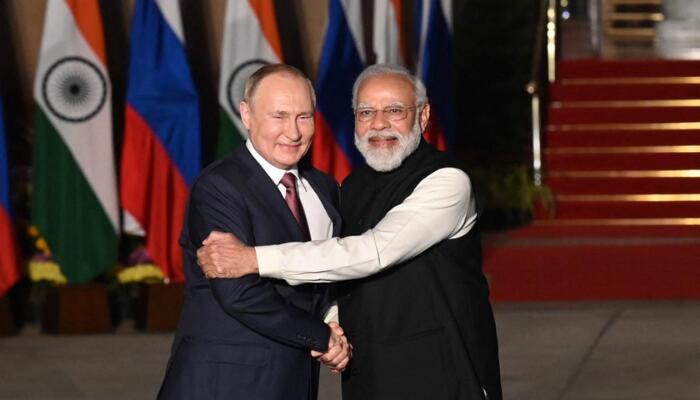
Russian President Vladimir Putin has reiterated Moscow’s confidence in India, describing the country as a reliable and sovereign partner whose foreign policy decisions are guided by national interest rather than external pressure.
His remarks came amid sustained Western scrutiny of India’s continued engagement with Russia, particularly in energy and trade. Yet Putin sought to blunt that criticism, arguing that attempts to pressure New Delhi have failed to produce any meaningful diplomatic shift.
He specifically defended Prime Minister Narendra Modi, saying that efforts to influence India through political or economic pressure are ultimately counterproductive and reveal a misunderstanding of India’s global standing.
A clear signal to the West
Putin’s message in St Petersburg carried an unmistakable subtext. Western capitals, particularly Washington, have intensified calls for India to reduce its strategic and energy ties with Moscow since the Ukraine conflict reshaped global alliances.
But the Russian President dismissed the effectiveness of such pressure. He argued that India, given its scale, economic trajectory, and political independence, cannot be coerced into realigning its foreign policy.
He emphasised that Russia has observed no adverse impact on bilateral ties despite India’s expanding partnerships with the United States and other Western economies. In his assessment, India has successfully maintained a calibrated balance in its external relations, without compromising its long-standing relationship with Moscow.
India’s autonomy at the centre of Moscow’s calculus
At the heart of Putin’s remarks was a broader recognition of India’s strategic autonomy. He portrayed India not as a passive actor in global geopolitics, but as a decisive power shaping its own diplomatic trajectory.
India, he said, engages with multiple global partners based on its national interest. Russia, he added, respects that approach and does not view it as contradictory to their bilateral relationship.
Putin’s framing was deliberate. It positioned India as an independent pole in an increasingly fragmented international system, one that resists binary alignments and retains flexibility in its external engagements.
Economic momentum strengthens the partnership
Beyond geopolitics, Putin placed significant emphasis on India’s economic rise. He described the country as one of the world’s major economies, underlining its rapid growth and expanding global footprint.
He linked India’s economic trajectory directly to the durability of the Russia-India relationship. As India grows, he suggested, so too does the structural depth of bilateral cooperation across energy, trade, and investment.
The Russian President noted that India’s economic expansion is not incidental but the result of sustained policy direction and governance continuity. This, he implied, has made India an increasingly central partner for Moscow at a time when Russia is recalibrating its global economic linkages.
Trade ambition: the $100 billion horizon
On economic engagement, Putin pointed to strong upward momentum in bilateral trade, which he said stood at approximately $68.7 billion in 2025. He expressed confidence that the figure could rise to $100 billion in the coming years.
This projection is not merely aspirational. It reflects a structural push by both countries to deepen cooperation in energy flows, infrastructure development, and diversified trade mechanisms, particularly under conditions of Western sanctions on Russia.
For Moscow, India remains one of the few major economies maintaining robust economic engagement despite geopolitical headwinds. For New Delhi, Russia continues to serve as a critical partner in energy security and strategic diversification.
A relationship insulated from geopolitical turbulence
Perhaps the most significant takeaway from Putin’s remarks was his assertion that India’s relations with other global powers do not come at the expense of its ties with Russia.
In an international environment increasingly defined by competing blocs and transactional diplomacy, Russia is projecting its partnership with India as resilient and insulated from external shocks.
Putin’s conclusion was firm in tone and strategic in implication. Russia, he suggested, does not merely “cooperate” with India. It trusts India’s political judgment, values its independence, and expects the partnership to deepen further regardless of external pressure.
In that sense, his message was less a statement of reassurance and more a declaration of strategic certainty: Russia is betting on India, and it is doing so with long-term conviction.