
























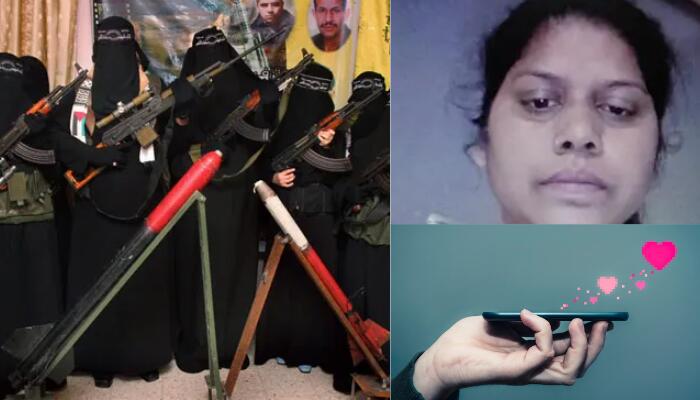
A 38-year-old woman from Jaipur has been arrested for planning to travel to Pakistan via Nepal to marry a suspected commander of the banned Jaish-e-Mohammed (JeM), a close associate of chief Masood Azhar. Authorities say the case has exposed a complex web of online radicalisation, cross-border handlers, and digital communication networks operating through social media and encrypted platforms. She has been booked under multiple provisions of the Unlawful Activities (Prevention) Act and remains in custody till June 27.
Identified as Babita Dhakad, also known as Khadija, the woman was arrested by the Rajasthan Anti-Terror Squad on Sunday after weeks of surveillance by military intelligence agencies. Officials said forensic examination of her electronic devices revealed multiple Pakistani contacts, including numbers suspected to be linked to Yusuf Azhar, a relative of Masood Azhar, and Qari Zarar, who is wanted in several cases in India.
Online Trail and Emergence of Foreign Contacts
According to investigators, Babita, who lived at her parental home in Jaipur’s Sitapura area, began engaging with Pakistan-based social media content following the 2025 Pahalgam attack. She reportedly started browsing Facebook pages related to Pakistan and Pakistan-occupied Kashmir, sending random friend requests and gradually connecting with individuals linked to extremist networks.
Officials said her mobile phone and social media accounts contained chats, videos, and contact details associated with JeM-linked profiles. She is also accused of sharing one-time passwords linked to Indian mobile numbers with a JeM operative, enabling access to communication platforms.
Emotional Ties and Radicalisation Pathway
During questioning, Babita reportedly told investigators that she developed emotional ties with a man identified as Abu Ubaidah, who initially contacted her online. She allegedly grew interested in JeM, frequently viewing and engaging with content featuring weapons and posts shared by supporters of the organisation.
FIR details cited by officials state that she was encouraged to learn Islamic practices and was invited to Pakistan to work for the organisation. She also began preparing for travel documentation, including obtaining a passport.
Cross-Border Plans and Cryptocurrency Links
Investigators said discussions between Babita and her handler included travel routes through Nepal, Saudi Arabia, and the United Arab Emirates. Funding arrangements were also reportedly explored using cryptocurrency, following which she downloaded related applications and researched digital assets.
Sources added that she spent long hours communicating through chats and video calls with Abu Ubaidah before discovering he was married, which reportedly left her disappointed.
Technical Evidence and Wider Concerns
Officials further claimed she searched online for methods to make explosives and was informed about operational networks within India. However, they stated that a detailed technical analysis of her devices will determine the full scope and authenticity of these inputs.
Authorities also noted that she showed no remorse during interrogation. The accused, the third among five siblings, was married in 2018 but separated shortly after.
The case, investigators said, centres on alleged online contact with JeM-linked individuals, cross-border travel planning, digital radicalisation pathways, and material recovered from her devices, raising renewed concerns over the use of social media platforms for extremist outreach and recruitment.