





















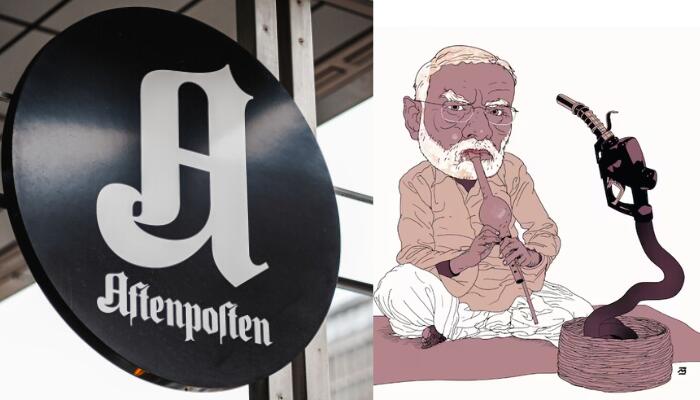
A cartoon published by Norwegian newspaper Aftenposten during Prime Minister Narendra Modi’s visit to Oslo has sparked criticism online. Many Indians accused the publication of promoting racist stereotypes under the guise of political commentary.
The illustration appeared alongside an opinion piece translated as “A clever yet annoying man”. It showed Modi as a snake charmer using a fuel-station pipe as a snake. The cartoon surfaced only hours before the Indian Prime Minister arrived in Norway for the Nordic summit. Soon after, it spread rapidly across social media platforms.
The backlash quickly moved beyond the cartoon itself. Critics argued that sections of the Western media still portray India through outdated colonial imagery whenever the country asserts itself internationally.
For many Indians, the “snake charmer” depiction did not qualify as satire. Instead, it reflected a stereotype that Western publications have repeatedly used for decades. India was long caricatured as a land of mysticism, superstition, elephants and snake charmers. Over the years, scholars and commentators have increasingly criticised such imagery as xenophobic and patronising.
The controversy intensified because it emerged during an already tense diplomatic moment. Questions over press freedom and democratic values had already become part of the public discourse surrounding Modi’s Norway visit.
Norway Visit Sparks Press Freedom Debate
The row escalated after Norwegian commentator Helle Lyng posted a video on X showing Modi leaving a joint media interaction with Norwegian Prime Minister Jonas Gahr Støre without taking questions from journalists.
In the clip, Lyng shouted, “Why don’t you take some questions from the freest press in the world?” Norway currently ranks first on the World Press Freedom Index. India recently slipped from 154 to 157.
The matter later spilled into another media interaction involving India’s Ministry of External Affairs. Lyng reportedly questioned why Norway should “trust” India amid allegations surrounding human rights and democratic backsliding.
Indian diplomat Sibi George firmly rejected the criticism. He defended India’s credibility by pointing to the country’s democratic traditions, civilisational history and global standing.
The exchange soon dominated television debates and online discussions in India. Many commentators argued that Western nations often frame India through selective and condescending narratives.
Old Stereotypes Return to the Forefront
The controversy has also revived memories of earlier incidents involving foreign publications.
In 2022, Spanish newspaper La Vanguardia faced criticism for using snake charmer imagery while discussing India’s economic rise. Many Indians viewed the illustration as another example of colonial prejudice masquerading as satire.
Prime Minister Modi himself has criticised such stereotypes in the past. During his 2014 visit to the United States, he remarked that India had moved from the era of “snake charmers” to one where Indians perform “magic with the mouse”. The statement referred to India’s technological transformation and digital progress.
Modi made a similar remark in 2013 while addressing the Vibrant Gujarat Youth Convention in Gandhinagar. He argued that India’s global image had fundamentally changed.
For many Indians, the Norway cartoon controversy now represents something larger than a single newspaper illustration. It has reinforced a growing belief that parts of the Western establishment remain uncomfortable with India’s expanding geopolitical influence and increasingly assertive voice in world affairs.
What started as a political cartoon has now evolved into a larger debate about racism, double standards and the persistence of colonial attitudes in sections of global media discourse surrounding India.
