



















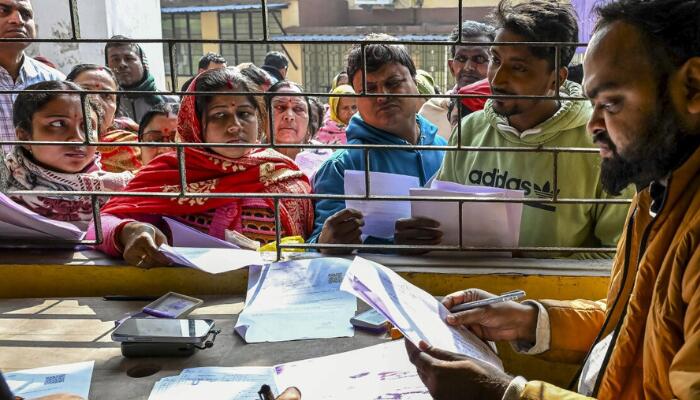
By the time counting trends settled in the 2026 Assembly elections, West Bengal had already made its position clear. The Bharatiya Janata Party did not just take the lead; it surged past the 200-seat mark with authority. In contrast, the incumbent All India Trinamool Congress struggled to hold ground. This was not a split verdict. Instead, voters delivered a decisive shift.
Yet, even as the scale of the result became evident, a competing narrative quickly took shape. Critics attempted to link the outcome to the Special Intensive Revision of the electoral rolls. However, that argument does not withstand closer examination.
Turnout Reflects Participation, Not Distortion
West Bengal recorded a voter turnout of nearly 92 per cent. Clearly, such participation signals strong public engagement. In fact, high turnout in a polarised contest usually reflects mobilisation and intent.
Some have argued that a reduced voter base inflated turnout percentages. While that may hold mathematically, it does not explain voter behaviour. After all, elections are not decided by ratios. Instead, they are decided by those who show up and vote. In Bengal, they showed up in large numbers and made a choice.
Meanwhile, Other States Tell Their Own Stories
At the same time, the broader electoral picture reinforces this reality. Tamil Nadu has delivered a surge for a new political entrant. Kerala, on the other hand, has returned to its familiar cycle, with the United Democratic Front poised to form the government. Similarly, Assam and Puducherry appear set to continue under BJP-led alliances.
Each of these outcomes reflects local political conditions. Therefore, no single administrative factor can explain them. Voters across states responded to leadership, governance, and credible alternatives. Against this backdrop, isolating West Bengal and attributing its result to one procedural exercise appears unconvincing.
Anti-Incumbency and Organisation Shaped the Outcome
More importantly, West Bengal’s political context offers a clearer explanation. A government in power for 15 years inevitably faces fatigue. Over time, dissatisfaction builds, even if it does not always surface loudly.
At the same time, the BJP steadily expanded its organisational base across the state. It strengthened booth-level presence, sharpened its messaging, and consolidated the contest into a direct fight. As a result, momentum converted into votes.
These developments did not emerge overnight. Instead, they built over the years and shaped voter sentiment well before polling began.
The SIR Argument Falls Apart
Even then, the attempt to credit the Special Intensive Revision for the outcome stretches the argument too far. Electoral roll revisions remain a routine exercise. Disputes around them are not new.
However, the scale of this verdict is new.
A 200-plus lead cannot be explained by marginal adjustments. Rather, such mandates emerge from broad voter alignment. They reflect political momentum, not administrative fine-tuning. Consequently, the SIR claim fails to account for the magnitude of the result.
The Verdict Speaks for Itself
Ultimately, efforts to reinterpret this outcome reveal more about political discomfort than electoral reality. While procedural questions may continue to surface, they cannot overshadow the core fact.
Voters in West Bengal made a clear and decisive choice.
And when a mandate reaches this scale, it does not need defending, explaining, or reworking. It simply stands.