

















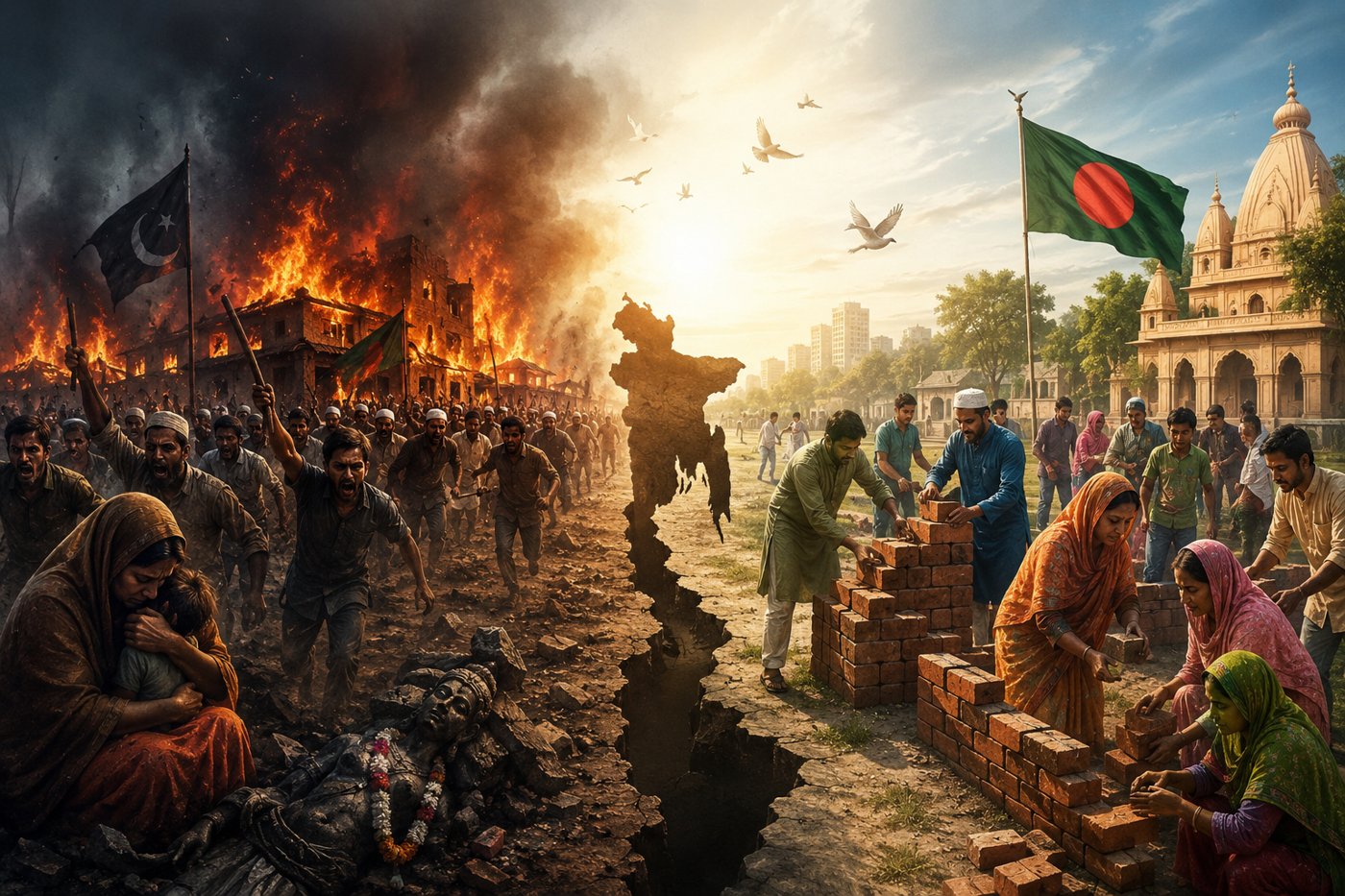
On 29 October 2016, a fisherman named Rasraj Das was beaten by a crowd in Nasirnagar, a small upazila in Brahmanbaria district in Bangladesh, and handed to the police. He had been accused of posting a photograph on Facebook showing the Hindu deity Shiva superimposed on the Kaaba in Mecca. The problem was that Rasraj Das had not posted the image. His account had been hacked. He said he did not even know how to use Facebook. By the time that was established, it no longer mattered. The rallies had already been called. Approximately 3,000 people participated in the attacks that followed. Around nineteen temples and approximately three hundred houses were vandalised. The actual perpetrator — an Awami League member named Dewan Atiqur Rahman Akhi, later identified as the mastermind । He was briefly suspended from his local post and then reinstated. In 2021 he received his party’s nomination for Union Parishad chairman.
The specific trigger was a manufactured insult. The fuel had been accumulating for fifty years, in a single phrase: agents of India.
Where the Phrase Was Born
The slur did not originate in independent Bangladesh. It was manufactured in Islamabad, as a tool of counterinsurgency. When the people of East Pakistan rose in revolt in 1971, demanding that the party which had won the election be allowed to govern. Pakistan’s military regime needed a story that was not “we are massacring our own citizens.” The story it chose was betrayal: Bengali Muslims had been corrupted by Hindus, who were agents of India, working to destroy Pakistan from within. The army was not committing genocide.
It was fighting a foreign-backed insurgency.
This framing had a specific operational purpose. If Hindus were by definition suspect enemies, their religion alone constituted their guilt. Villages with Hindu populations were treated as evidence of Indian infiltration. Between 200,000 and 400,000 women and girls were raped by Pakistani forces and their auxiliaries in nine months of war. The religious leaders who sanctioned this called Bengali women “the booty of war.” Pakistan’s official narratives still minimise all of it, which means the logic that produced the violence has never been formally repudiated.
The Slur That Survived Independence
Bangladesh was born in explicit rejection of that logic. And yet the phrase survived. It survived because the Islamist networks that had enforced Pakistan’s ideology in 1971 were not dismantled after independence. It survived because successive governments found it more convenient to leave those networks intact than to confront them. It survived because the underlying suspicion — that Hindus in Bangladesh are more loyal to India than to Bangladesh — proved remarkably flexible as a tool for local power brokers, land grabbers, and radical recruiters alike.
The Nasirnagar attacks of 2016 illustrate the mechanics precisely. The violence was not, investigators later concluded, a spontaneous response to a blasphemous post. The post itself had been fabricated by Islami Chhatra Shibir-linked Facebook accounts specifically designed to incite communal tension. The mastermind was a local political figure with land interests. The “Indian agent” charge was the cover story; dispossession was the aim.
The Mechanics of Fear
For Hindus and Buddhists in Bangladesh’s border districts or areas with a history of radical organising, the threat operates through a well-understood escalation.
First comes a rumour — about a blasphemous post, a disrespectful remark, an insult to Islam — which in ordinary circumstances might be ignored. When amplified through mosque networks or politically connected local figures, it becomes permission. What follows — the gathering crowd, the arson, the looting — is rarely fully spontaneous. Rights groups documenting these episodes have consistently noted the pattern: mobs that arrive with kerosene, that have lists of houses, that target the most economically successful Hindu families first.
The victims, afterwards, face a further ordeal. Filing a police report is dangerous when the perpetrators have local political protection. Staying in place after your home has been burned is dangerous. The cumulative logic of this, experienced across generations, is emigration — to Kolkata, to Agartala, to wherever a Hindu Bangladeshi family can start again in a country that will not treat them as a security threat. The census tells the quiet story: from thirty-three per cent of the population in 1901, to twenty-two per cent at Partition, to roughly thirteen per cent in 1974, to under eight per cent today.
What It Would Take to Break the Pattern
Pakistan bears direct historical responsibility for injecting this poison into Bangladesh’s political culture, and its continuing refusal to acknowledge the genocidal nature of its 1971 campaign keeps that ideology alive. But responsibility does not end in Islamabad. Bangladesh’s own political class has repeatedly chosen accommodation with Islamist networks over the harder work of protecting minority citizens. Attacks on Hindus and Buddhists have been routinely classified as “local disputes” rather than communal violence — a framing that insulates perpetrators and demoralises victims.
A fifty-year-old slur does not survive on its own. It survives because too many people in too many positions of power have found it useful: useful for winning votes, useful for acquiring land, useful for silencing critics. Until “agents of India” is treated not as political shorthand but as incitement to violence, it will continue to do what it was designed to do in 1971 — tell a crowd that the people on the other side of the door are not really citizens, and that whatever happens to them next is someone else’s problem.
Bangladesh at the Crossroads: Foreign Interference Allegations Reignite Debate Over Minority Protection
When Dipu Chandra Das was lynched and burned in Bhaluka, Mymensingh in December 2025, the immediate cause was a rumour about a blasphemous remark. A crowd gathered, and then did what crowds with a certain kind of permission tend to do. But Dipu Chandra Das did not die only because of a rumour. He died at the intersection of several things that had been building for a long time: a security vacuum created by political upheaval, radical networks emboldened by that vacuum, and — according to intelligence assessments in both Dhaka and New Delhi — external pressure from across Bangladesh’s western border that has been deliberately exploiting every fracture it can find.
The External Hand
Indian and Bangladeshi intelligence assessments have identified Pakistan’s Inter-Services Intelligence as an active external actor in the unrest that followed the fall of the Sheikh Hasina government in 2024. The specific allegation describes ISI funding and operational guidance flowing to Jamaat-e-Islami, its student wing Islami Chhatra Shibir, and associated radical networks, with the stated strategic objective of shifting Bangladesh’s political alignment away from India and toward Pakistan and China.
Security sources have cited evidence of ICS cadres undergoing training in Pakistan and Afghanistan — allegations that have been documented by the South Asia Terrorism Portal and reported by regional security analysts for years, though ICS denies them and independent verification remains limited. ISI-linked financial flows underwriting street mobilisation and propaganda have been alleged but not publicly proven to a court standard.
These are serious allegations. They should be treated as such — which means neither dismissing them as Indian propaganda nor presenting them as established facts. What can be said with certainty is that Pakistan’s military-intelligence establishment has a documented history of using non-state proxies to project influence across its neighbourhood, and that Bangladesh’s political environment since 2024 has seen a warming of Dhaka-Islamabad relations at precisely the moment that minority protection has deteriorated sharply. Chief Adviser Yunus met Pakistani Prime Minister Shehbaz Sharif in December 2024 and called for moving past unresolved 1971 issues in the name of trade cooperation. Senior-level intelligence talks between the two countries followed in early 2025, the first in fifteen years.
Whether that rapprochement has come at a strategic cost to Bangladesh’s minorities is a question that demands honest scrutiny.
The Gap Between the Constitution and the Street
Bangladesh’s constitution formally guarantees equality and protection to its religious and ethnic minorities. What happens on the ground is a different matter. Since the 2024 political transition, rights groups have documented a surge in violence against Hindus, Ahmadis, and other minorities.
The Bangladesh Hindu Buddhist Christian Unity Council recorded 522 incidents of communal violence across Bangladesh in 2025 alone, resulting in 66 deaths, 28 cases of violence against women, and 95 attacks on places of worship. A coalition of over 125 international organisations appealed to the UN describing what they saw as a pattern of ethnic and religious cleansing if not urgently addressed. Amnesty International has called for swift, impartial investigations.
The gap between constitutional promise and lived reality is most visible in the response of law enforcement. In episode after episode documented by rights observers, police arrived too late, failed to file charges, or were accused of passive complicity. When witnesses came forward, they faced pressure to retract. The perpetrators, often with connections to local Islamist networks or political machines, calculated correctly that the cost of violence against minorities was low.
What Accountability Would Actually Look Like
Bangladesh’s civil society has not given up. Rights defenders, minority organisations, women’s groups, and student collectives continue to document abuses and demand accountability, often at personal risk. Their demands are concrete: specialised hate-crime units, proper witness protection, judicial reform, and a government commitment that attacks on minorities will be prosecuted as national security matters rather than dismissed as local disorder.
On the question of Pakistan’s alleged interference, those calling for accountability are equally specific — targeted sanctions on ISI officials where evidence supports it, tighter scrutiny of Pakistani financial flows, and a willingness in international forums to name external actors rather than hiding behind vague references to “outside interference.” India and other partners can raise this directly with Islamabad in bilateral and multilateral settings without Bangladesh’s sovereignty being the casualty.
The alternative, continuing to treat external interference as a speculative side story rather than a driver of the crisis — has a documented cost. It is visible in the burned homes and the declining census figures that record, decade by decade, the gradual disappearance of communities from the country they helped build. Bangladesh was founded in rejection of the logic that some citizens are less than citizens. Allowing that logic to reassert itself, whether from within or from across the border, is not a geopolitical inconvenience. It is a betrayal of everything 1971 was supposed to mean.