













A fresh controversy has emerged in Tamil Nadu’s Madurai district, where the proposed renovation of a centuries-old shrine has triggered tensions between communities. The issue revolves around the Vinaynagar Temple, a 300-year-old place of worship, whose restoration—despite judicial approval—has become the focal point of a heated local dispute.
According to reports, the situation escalated in Thummanayakkanpatti village in Peraiyur taluk when a section of the Muslim community objected to the renovation work. The temple, which is dedicated to Vinayagar and Karuppannasamy, is not only historically significant but also deeply embedded in the religious life of local Hindu residents.
The controversy gained further intensity because the renovation had already received clearance from relevant authorities, including expert committees and the Madurai Bench of the Madras High Court. Earlier petitions opposing the renovation were dismissed, and the court explicitly allowed the restoration work to proceed. This legal backing has made the ongoing opposition a matter of serious concern for temple authorities and local devotees.
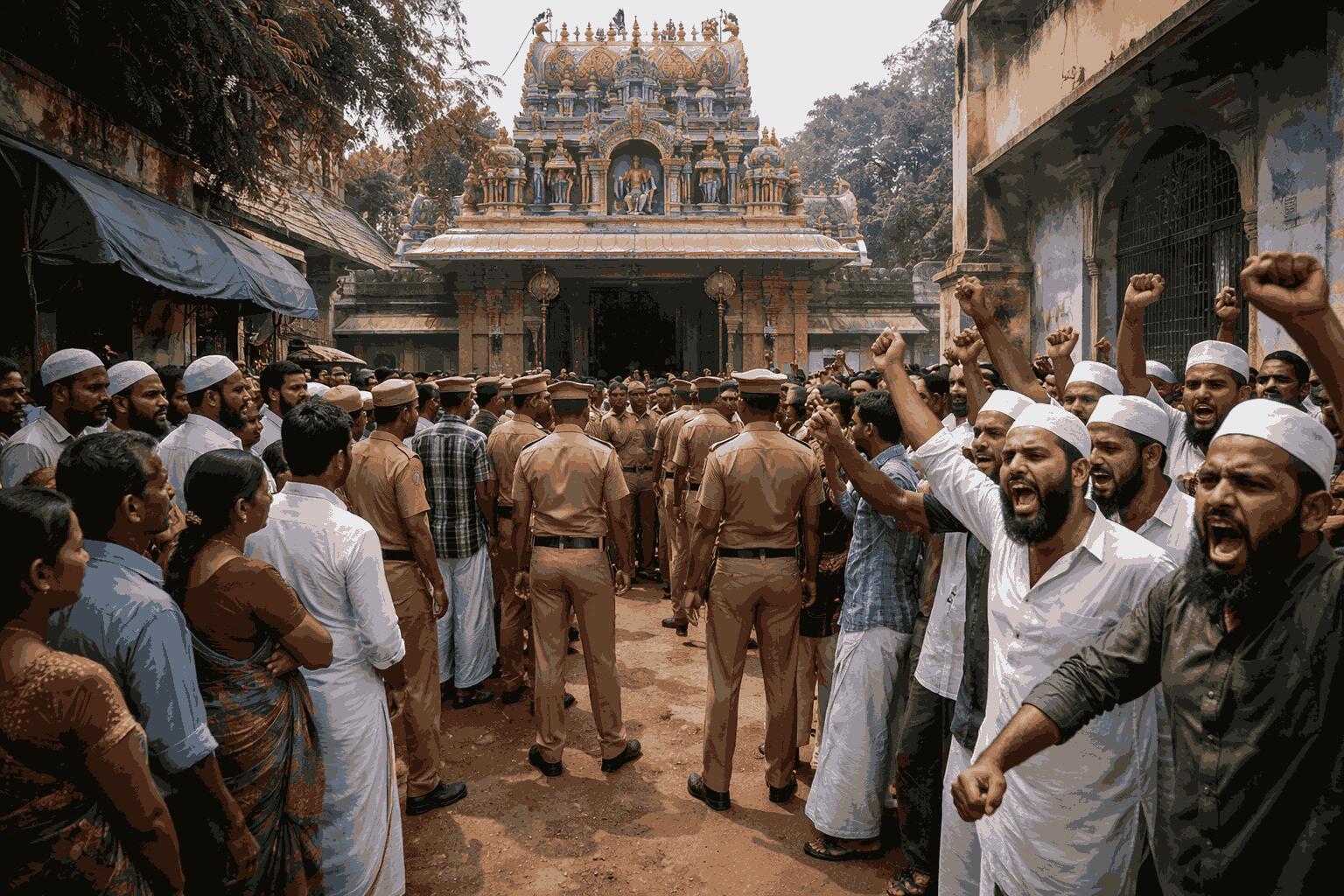
Despite the court’s decision, protests broke out when attempts were made to begin the renovation. Reports indicate that a group of Muslims entered the temple premises and staged demonstrations, demanding that the temple either not be renovated or be relocated elsewhere. This development has shocked many residents, especially those who see the renovation as a rightful continuation of longstanding religious practices.
Local Hindu organisations and residents have responded strongly, arguing that obstructing a court-approved project undermines the rule of law. They have also pointed out that the temple falls under the administration of the Hindu Religious and Charitable Endowments (HR&CE) Department, further reinforcing its legal and institutional standing. For them, the dispute is not just about renovation but about the protection of religious rights and traditions.
Adding another layer to the issue is the presence of a mosque built near the temple about a century ago. Some residents claim that tensions have periodically arisen due to the proximity of the two religious structures. However, the current dispute appears to have intensified due to the renovation effort, which many believe has reignited underlying sensitivities in the area.
In response to the escalating tensions, temple trustees and villagers have approached local authorities seeking police protection. They have requested that security be provided until the completion of the renovation and the conduct of the kumbabhishekam ceremony. The High Court had earlier directed that police protection be ensured, highlighting the seriousness of the situation and the need to maintain law and order.
Police officials have intervened on multiple occasions to defuse tensions and persuade protesters to disperse. While temporary calm has been restored at times, the underlying disagreement remains unresolved. Authorities now face the delicate task of balancing legal enforcement with maintaining communal harmony in a sensitive environment.
The incident has also sparked broader debates about religious coexistence, legal authority, and the role of the state in resolving such disputes. Observers note that Tamil Nadu has a long tradition of interfaith coexistence, but localized conflicts like this can quickly escalate if not handled carefully.
For many, the Vinaynagar Temple dispute is a test case for how India’s democratic and legal institutions respond to grassroots-level tensions involving faith and identity. The emphasis on court orders and administrative processes underscores the importance of rule-based governance, even in emotionally charged situations.
At the same time, voices from civil society have called for dialogue and mutual understanding to resolve the impasse. They argue that while legal clarity is essential, long-term peace can only be achieved through cooperation between communities.
As the situation continues to evolve, the spotlight remains firmly on Madurai. Whether the renovation proceeds smoothly or further tensions arise will depend largely on how effectively authorities manage the situation and how willing local stakeholders are to seek a peaceful resolution.
In the end, the dispute surrounding the Vinaynagar Temple is not just about a structure—it reflects the complex interplay of history, faith, law, and community dynamics in contemporary India.