















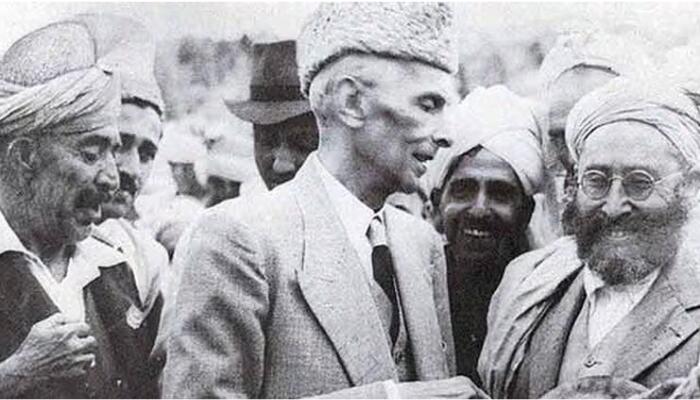
A major controversy has broken out at the University of Jammu after the inclusion of a chapter on Muhammad Ali Jinnah in its revised postgraduate Political Science syllabus triggered protests by the RSS-affiliated Akhil Bharatiya Vidyarthi Parishad, which has demanded its immediate withdrawal and termed the move “unacceptable”.
The revised syllabus, prepared for the 2026–2028 academic session under the National Education Policy 2020, places Jinnah in the “Modern Indian Political Thought” module under the paper “Minorities and the Nation”. The module also includes figures such as Sir Syed Ahmed Khan and Muhammad Iqbal, alongside other major political thinkers.
Protests escalate over representation of Partition-era figures
Led by ABVP Jammu and Kashmir secretary Sannak Shrivats, activists assembled on campus, raised slogans against the administration and tore posters of Jinnah, demanding the immediate removal of the chapter. The organisation argued that individuals like Jinnah and Sir Syed Ahmed Khan, who it claimed played a role in the Partition and advanced the Two-Nation Theory, should not be presented as representatives of minorities in academic curricula.
Shrivats asserted that academic freedom must not disregard national sentiment and warned that if the university fails to act, the ABVP would launch a wider democratic agitation across Jammu and Kashmir. He further said that if minority representation is the objective, the curriculum should include figures who genuinely worked for minority welfare rather than those associated with the country’s division.
University defends syllabus, cites national academic standards
The university has strongly defended the inclusion, maintaining that it is purely academic and in line with norms set by the University Grants Commission. Officials stated that similar content is already part of curricula in universities across India, including institutions in Rajasthan, Maharashtra, and Kolkata.
Head of the Political Science Department, Baljit Singh Mann, clarified that the syllabus was approved through a formal academic process and was not the decision of any individual. He emphasised that the course covers a wide ideological spectrum, including Mahatma Gandhi, B. R. Ambedkar, Jawaharlal Nehru, Sardar Vallabhbhai Patel, as well as Vinayak Damodar Savarkar and M. S. Golwalkar.
Mann stated that the objective is to present diverse viewpoints to enable critical evaluation rather than promote any ideology. He added that figures such as Jinnah, Iqbal, and Sir Syed Ahmed Khan also held nationalist views in their earlier years, and understanding the evolution of their ideas is essential for historical clarity.
He further warned that removing such topics could disadvantage students preparing for competitive examinations such as the National Eligibility Test, where comprehensive knowledge of political thought is required.
Committee constituted to examine concerns
Amid the escalating row, the university administration, on the directions of the Vice-Chancellor, has constituted a committee through the Office of the Dean of Academic Affairs to examine the issue. The panel is convened by Prof Naresh Padha and includes the heads of the departments of Philosophy, History, and Sociology, along with the Director of the Directorate of Studies and Research. The Assistant Registrar (Academic Affairs) will serve as Member Secretary.
The committee has been tasked with examining all concerns related to the syllabus and submitting its report at the earliest.
Debate reflects wider tensions over curriculum and ideology
The controversy highlights a broader national debate over the role of academic institutions in engaging with contentious historical figures. While the university has framed the inclusion as part of a structured academic exercise aligned with national standards, the protests underscore continuing tensions between academic autonomy and political sensitivities.
With protests ongoing and a formal review now underway, the outcome of the committee’s findings is expected to determine not only the future of the syllabus at the University of Jammu but also contribute to the larger discourse on how history and political thought are taught in India.
