





















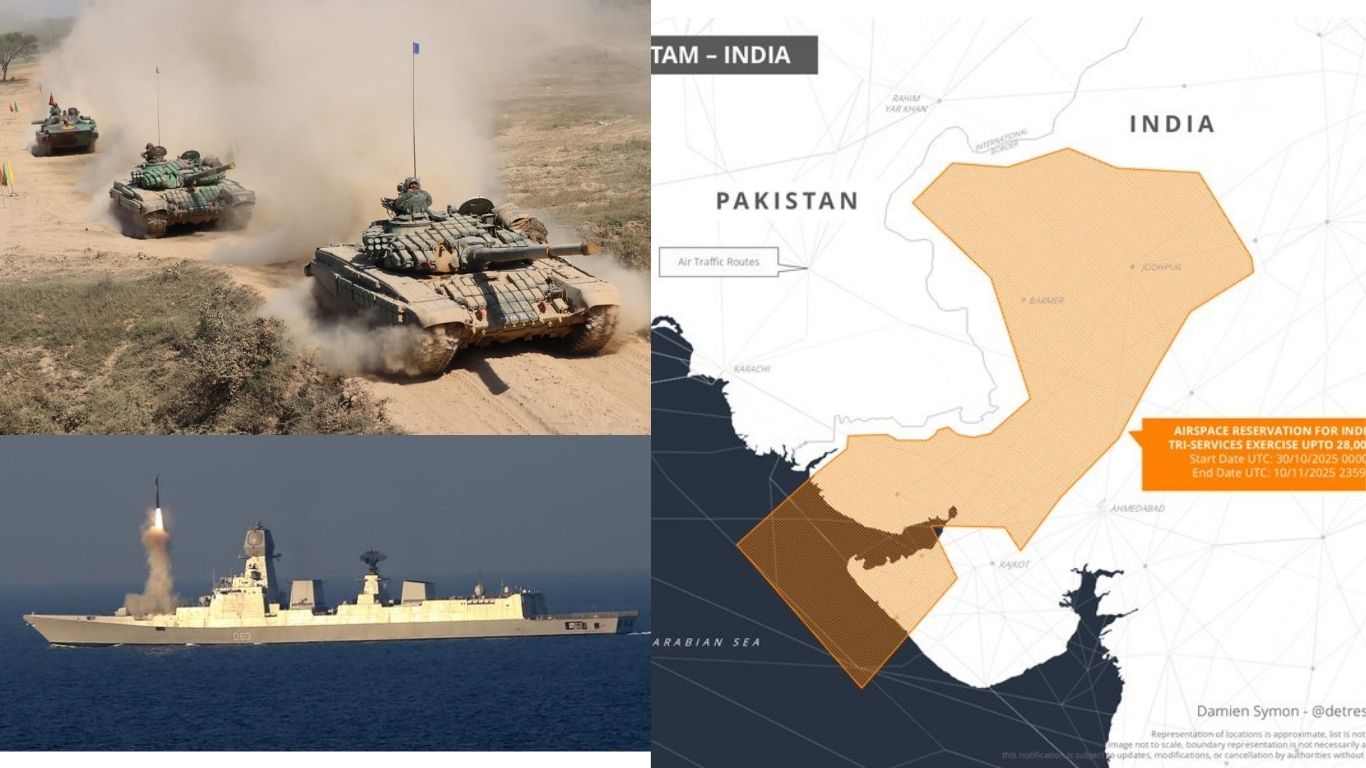
India has issued a large-scale Notice to Airmen (NOTAM) along the Pakistan border for an upcoming tri-services military exercise involving the Indian Army, Navy, and Air Force a move that signals New Delhi’s assertive military posture following heightened regional tensions after Operation Sindoor. Scheduled from October 30 to November 10, the exercise named “Ex Trishul” will test India’s joint warfare capabilities across land, air, and sea. But what makes this development truly striking is the unusual scale and location of the drills, encompassing sectors rarely activated together, from the Rann of Kutch’s creek areas to the Arabian Sea off the Saurashtra coast. The reservation of airspace up to 28,000 feet, as revealed by satellite imagery analysts, underscores a high level of operational intensity.
Also rattled by this exercise Pakistan has issued a notification restricting multiple air traffic routes across its central and southern airspace just as India gears up for a tri-services exercise, Trishul, along the border. While Pakistan has not stated any reason for the Notam (notice to airmen) for October 28-29.
A Strategic NOTAM with Unusual Scope
The recent NOTAM issued by India is far from routine. It covers a vast stretch along the Pakistan border, integrating multiple domains land, sea, and air in one unified theatre of operations. According to reports and satellite observations by geo-intelligence researcher Damien Symon, the marked zones reflect “highly unusual scale and coordination,” suggesting that India is not merely conducting a standard readiness exercise but rather validating integrated warfare models under real-time conditions.
This is the first major tri-services drill after Operation Sindoor India’s retaliatory air and ground operation against Pakistan’s terror infrastructure earlier this year. The new exercise comes in a politically charged environment, with the Indian establishment sending a strong message to Islamabad that India’s preparedness is not reactive, but preemptive and strategic.
The scale of the NOTAM with airspace reserved up to 28,000 feet indicates live firepower integration involving fighter aircraft, drones, naval ships, amphibious units, and ground troops, operating in synchronized precision. It’s a demonstration of India’s ability to coordinate multiple forces under a unified command structure, a key pillar of the Modi government’s defence reform vision. Indian tri-services exercise along the western frontier has reportedly set alarm bells ringing in Pakistan, with Islamabad said to have put multiple commands and bases on high alert,
A top Pakistani security source quoted by News 18 said the country has issued high alerts for Southern Commands in Sindh and South Punjab, mobilising the Air Force and Navy on stand-by to respond to any perceived aggression. Pakistan’s Bahawalpur Strike Corps and Karachi (Sindh) Corps were specifically singled out for special preparedness measures, the source said. Air bases reportedly put on standby include Shorkot, Bahawalpur, Rahim Yar Khan, Jacobabad, Bholari and Karachi; naval directives have also been issued to increase patrolling and operations in the Arabian Sea, the source added.
‘Ex Trishul’ – The Spirit of Jointness and Atmanirbharta
Exercise Trishul derives its name from the trident symbolic of power, precision, and unity representing the three services operating as one. According to the Ministry of Defence, the aim of the exercise is to showcase jointness, Atmanirbharta (self-reliance), and innovation, aligning with Prime Minister Narendra Modi’s ‘JAI’ vision Jointness, Aatmanirbharta, and Innovation for the Indian Armed Forces.
Troops from Southern Command will lead several critical components of the exercise, including offensive manoeuvres in the desert and creek sectors, amphibious operations off the Saurashtra coast, and multi-domain drills focusing on Intelligence, Surveillance, and Reconnaissance (ISR), Electronic Warfare (EW), and Cyber operations.
Unlike earlier service-specific drills, Ex Trishul represents the operational realization of theatreisation integrating all three services under the Integrated Defence Staff (IDS) to fight as one cohesive unit. This reflects India’s gradual shift toward network-centric warfare, where decisions and responses are driven by real-time intelligence and technological superiority.
Learning from Operation Sindoor: From Reaction to Deterrence
The timing of Ex Trishul is critical. It comes just months after Operation Sindoor, when India executed precision airstrikes on Pakistan’s terror camps in response to the Pahalgam terror attack in April. The operation, which neutralised over 100 terrorists, reaffirmed India’s capacity for swift and decisive retaliation.
Defence Minister Rajnath Singh, during his visit to Jaisalmer last week, made it clear that Sindoor had served as a “strong warning” to Pakistan, ensuring that any future misadventure would be met with even harsher retribution. Addressing soldiers during Barakhana, Singh said Pakistan has now learned that “India will strike where it hurts most.”
During the Naval Commanders’ Conference in New Delhi, Singh also credited the Indian Navy for maintaining a deterrent posture that restricted Pakistan’s naval assets to their coastal harbours during Operation Sindoor. He emphasised that the exercise reaffirmed India’s maritime dominance, marking a turning point in the Indian military’s readiness posture across the western front.
A New Era of Indigenous Strength and Strategic Assertiveness
The Trishul exercise also aims to highlight the growing use of indigenous systems and technologies developed under the Make in India initiative. From advanced ISR drones and radar systems to electronic warfare tools and smart munitions, the drill is expected to validate home-grown tactical capabilities that enhance India’s self-reliance.
The Defence Ministry noted that the exercise will focus on the application of Atmanirbharta in real-time combat scenarios, refining tactics and techniques suited to modern hybrid warfare. India’s strategic community sees Ex Trishul as a precursor to full-fledged theatre commands, an essential step in future-proofing the nation’s military structure.
By combining high-altitude surveillance, sea-based operations, and ground-level offensive manoeuvres, India is effectively simulating multi-front war conditions, ensuring readiness across diverse terrains from deserts to coastlines.
A Message of Strength Beyond Borders
Ex Trishul isn’t just another military drill it’s a statement of India’s evolving defence philosophy. From the plains of Rajasthan to the Arabian Sea, every component of this exercise sends a clear message: India’s armed forces are no longer divided by silos but united by purpose.
By choosing to conduct this unusually large tri-services operation right along the Pakistan border, India is asserting deterrence through demonstration. It’s a reminder that after Operation Sindoor, India’s response framework has transformed from reacting to provocations to projecting power as a deterrent.
Under Prime Minister Narendra Modi’s leadership, India’s military vision has moved beyond mere defence to strategic dominance, rooted in self-reliance, joint capability, and indigenous innovation. Ex Trishul thus stands as a powerful testament to an India that is not only prepared to defend itself but ready to define the rules of engagement in its neighbourhood.