























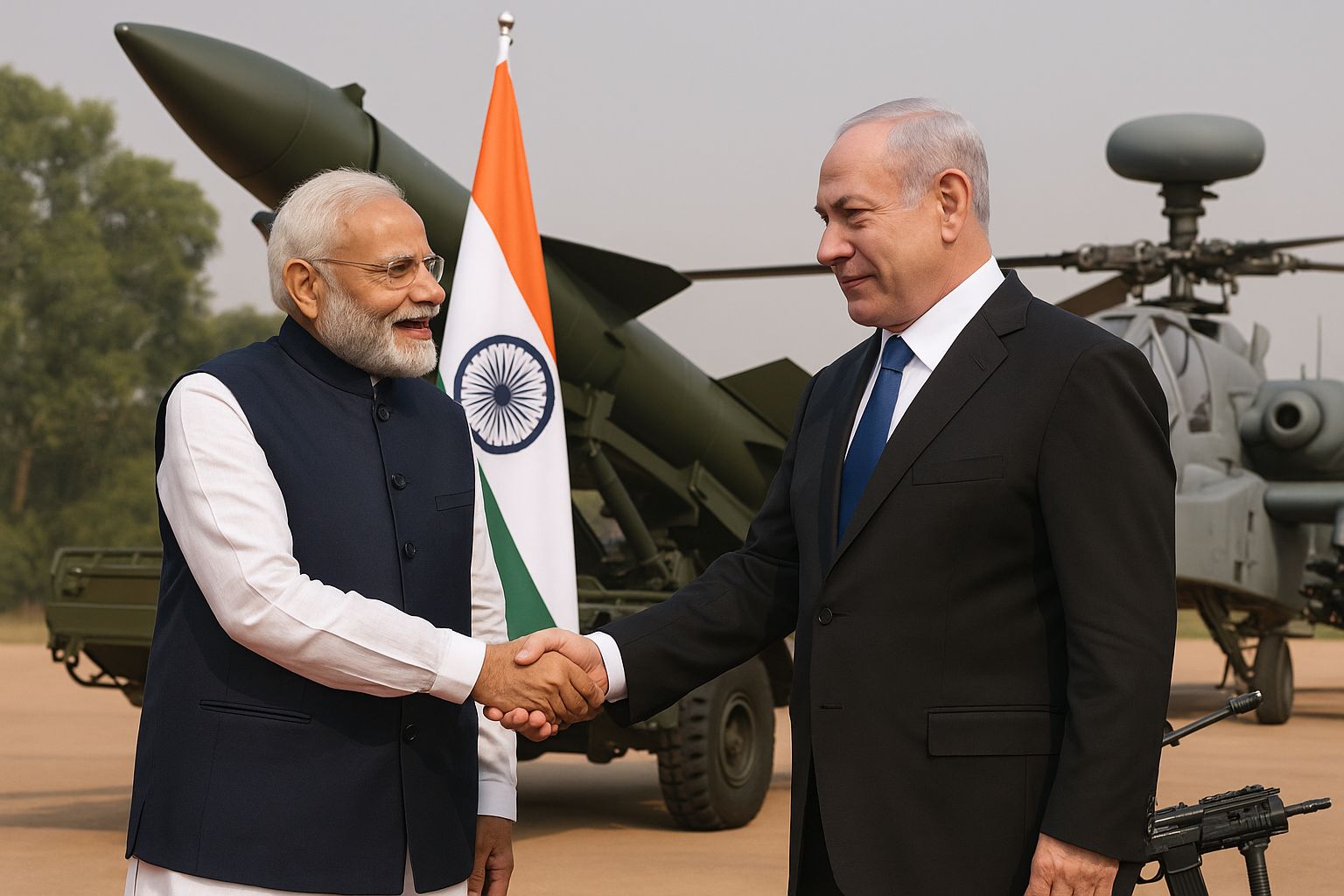
On the global stage, the escalating tensions between Israel and Iran have given unprecedented depth to the steadily developing defense relations between India and Israel. This relationship has transcended the conventional framework of trade and evolved into a refined, multidimensional, and strategically significant alliance — one defined by a shared security vision and unshakable mutual trust.
Strategic Deepening in an Unstable World
The current global environment is characterised by volatility and shifting power balances. Within this context, the tensions surrounding Israel have imparted an extraordinary and inevitable momentum to the evolution of the India–Israel strategic partnership.
What was once confined to the traditional supplier–buyer model of arms procurement has now transformed into a sophisticated, deeply integrated, and decisive alliance.
This transformation rests on a foundation of shared understanding of security challenges, intensive technological co-development, and strong bilateral trust — positioning it as a leading force for regional and international security.
Importantly, this change is not merely theoretical but visible in tangible outcomes: increased joint research and development in strategic technologies, frequent and complex diplomatic engagements beyond standard trade transactions, and a shared commitment to reinforcing regional and international stability in an increasingly uncertain world.
Proof of Operational Capability: Victory of Co-developed Technology
The real, battle-proven strength of this alliance was demonstrated on June 16, 2025, when the Israeli Navy successfully intercepted an Iranian drone attack with remarkable precision.
At the heart of this defensive operation was the Barak Magen Air Defense System, whose missile technology was jointly developed by India and Israel through dedicated research and development.
Its first real-world deployment stands as proof that years of collaborative innovation, technology transfer, and industrial effort are now yielding highly effective, combat-proven results.
This success underscores not only technical excellence but also the alliance’s capacity to deliver operational superiority in high-risk strategic environments.
Diplomacy and the Art of Strategic Balance
During complex regional developments, India’s diplomatic maneuvers have reflected a balanced, pragmatic, and farsighted approach to foreign policy.
After Israel’s counter-response to regional tensions, Prime Minister Narendra Modi held high-level talks with Israeli Prime Minister Benjamin Netanyahu, where he reaffirmed India’s support for Israel’s sovereign right to self-defense.
At the same time, Modi urged both sides to exercise maximum restraint and prioritize efforts to de-escalate tensions to avert a broader regional crisis.
India’s measured and strategically adept response — guided by the ethos of Vasudhaiva Kutumbakam (the world is one family) — underscores its commitment to regional stability and its unique ability to maintain strong, multifaceted relations with both Israel and Iran.
This delicate balance highlights India’s irreversible strategic autonomy, enabling it to engage effectively across geopolitical divides while securing its own strategic interests.
A New Era of Defense Collaboration
While India’s diverse strategic and economic interests remain at stake, the recent regional tensions have pushed India–Israel defense cooperation beyond traditional arms transactions toward deeper technological integration.
The Joint Task Force established in 2021 has already begun shaping a comprehensive long-term defense strategy aimed at promoting mutual innovation and advancement through intensive technology sharing.
This forward-looking initiative also focuses on strengthening tactical coordination and operational readiness through joint military exercises. Additionally, it seeks to address emerging security threats — such as hybrid warfare, cyber domains, and space-based challenges — transforming the partnership from a reactive model into a proactive, future-oriented alliance.
One of the most tangible and economically significant outcomes of this collaboration is Israel’s active participation in India’s “Make in India” defense initiative.
Leading Israeli defense firms such as Elbit Systems have forged strategic partnerships with Indian companies to manufacture drones (UAVs), advanced sensors, and electronic warfare systems within India.
This model not only strengthens India’s defense industrial base but also reduces dependence on external supply chains, thereby enhancing strategic self-reliance while ensuring cost efficiency and domestic capability building.
A Natural and Complementary Alliance
Despite the geographical distance, the India–Israel partnership has taken shape as a natural alliance, rooted in shared security concerns and complementary military strengths.
This cooperation now extends far beyond proven military hardware — it is future-focused.
Under the visionary 2021 agreement, both nations have committed to joint research, development, and deployment of disruptive technologies such as Artificial Intelligence (AI), robotics, and autonomous systems, reflecting the depth and forward-looking nature of their relationship.
Given China’s aggressive naval presence in the Indian Ocean and the growing threats of piracy, deeper naval cooperation between India and Israel has become imperative.
Their partnership gains additional strength through the I2U2 group (India, Israel, UAE, and USA), which underscores shared strategic interests in maritime security, advanced technology, and counter-terrorism efforts.
In this framework, Israel emerges as a vital supplier of advanced electronic warfare and anti-jamming systems for India — crucial for enhancing naval and aerial operations — while Israeli underwater drone (UUV) technology bolsters India’s deep-sea missions and anti-submarine warfare capabilities.
A Strategic Axis of the 21st Century
In the shifting landscape of global power, India–Israel defense cooperation has matured into a decisive strategic partnership.
When Israel’s cutting-edge technological innovation merges with India’s rapidly advancing industrial strength and expansive geopolitical vision, the result is a new security architecture for the modern era.
This alliance now goes far beyond weapons and defense deals — it has become a defining force shaping security dynamics from the Indo-Pacific to the Middle East.
In the evolving strategic architecture of the 21st century, the India–Israel partnership stands as a formidable strategic axis — one that not only fortifies both nations’ security needs but also gives India and Israel a significant new dimension in the global strategic discourse.