


















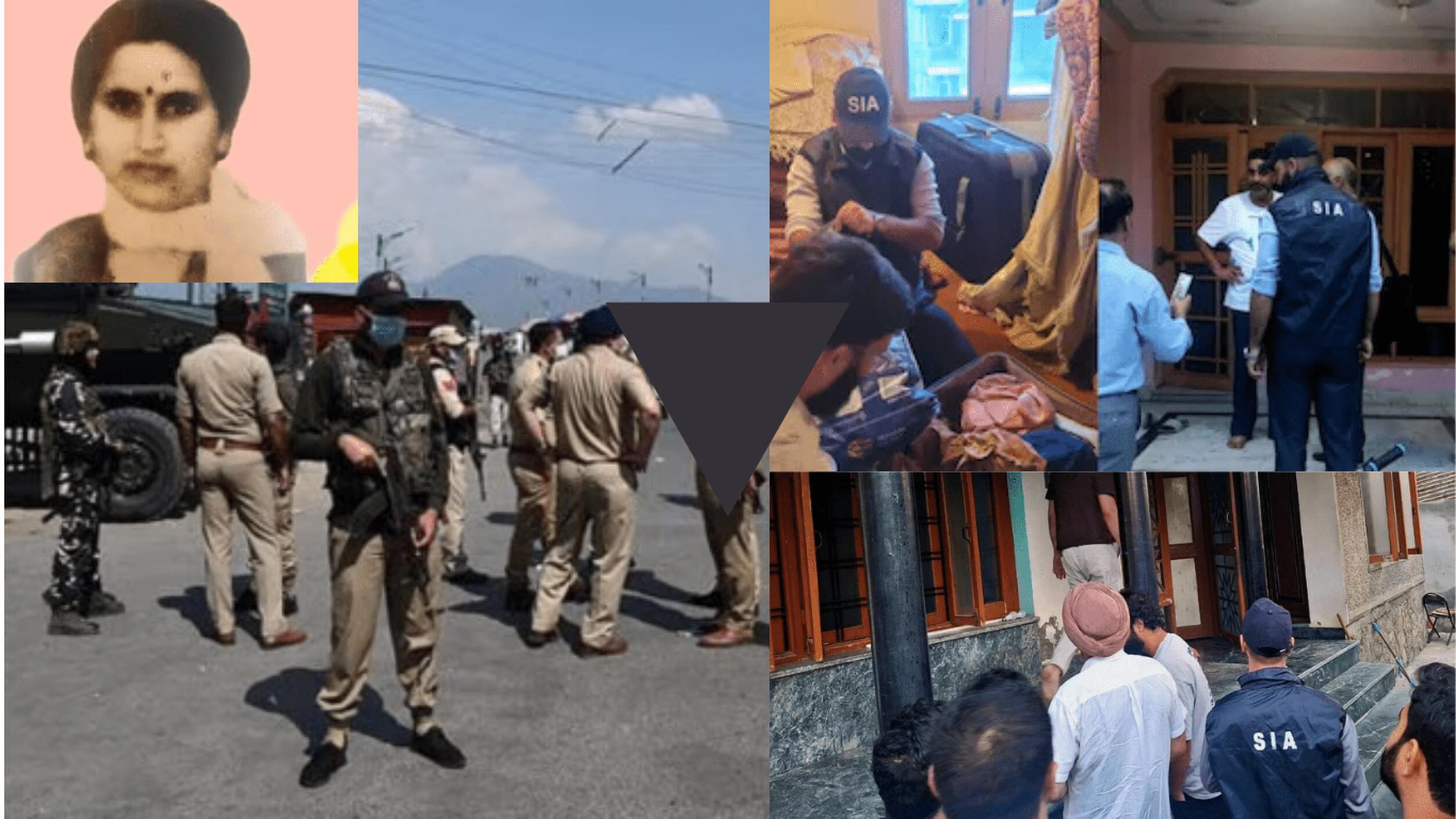
More than three decades after one of the most shocking murders during the early years of militancy in Jammu & Kashmir, the State Investigation Agency (SIA) has breathed new life into the probe into the killing of 27-year-old nurse Sarla Bhat. The case, long considered a symbol of the brutality faced by Kashmiri Pandit’s in 1990, is now back under scrutiny with a renewed determination to bring the perpetrators to justice. This is about sending a message no matter how much time has passed, the state will pursue justice for terror victims
A Crime That Shook the Valley
Sarla Bhat, a resident of Anantnag, served at the Sher-i-Kashmir Institute of Medical Sciences (SKIMS) in Soura, Srinagar. It was April 1990 — a period when the Kashmir Valley was engulfed in insurgency, and armed terrorists were systematically targeting Kashmiri Pandit, issuing open threats to leave their homes or face dire consequences. Many families fled. But Sarla refused to abandon her service at the hospital’s Habba Khatoon Hostel, openly defying the diktats of terrorist outfits.
On the night of April 18, 1990, her defiance cost her life. Terrorists affiliated with the Jammu and Kashmir Liberation Front (JKLF) abducted her from her hostel. The next morning, her bullet-riddled body was found at Umar Colony, Mallabagh, Soura. A handwritten note lay beside her body, falsely accusing her of being a police informant a classic militant tactic to justify targeted killings.
Her killing sent shockwaves through the medical fraternity, already reeling from the atmosphere of fear and intimidation. For the Kashmiri Pandit community, it became another grim reminder of the systematic campaign of violence that would ultimately lead to their mass exodus from the Valley.
Targeted for Defiance
Investigators believe Sarla’s refusal to leave her post, despite repeated threats, made her a marked target. She symbolised the resilience of Kashmiri Pandits who chose to stay back, even as militants sought to purge the Valley of its Hindu population.
“She openly challenged JKLF’s threats, refusing to abandon her duty or her home. That defiance marked her out in the eyes of the terrorists,” a senior investigator told CNN-News18.
The intimidation did not end with her killing. Locals sympathetic to the militants reportedly warned her family against holding a public cremation. Under the shadow of fear, the last rites were performed quietly, reflecting the climate of terror that gripped the Valley.
A Case Frozen by Fear
In April 1990, an FIR (No. 56/1990) was registered at Police Station Nigeen. However, progress was minimal. Witnesses were unwilling to come forward, fearing retribution, and local police struggled to investigate militant-linked crimes during the height of the insurgency.
This was not an isolated case numerous targeted killings of Kashmiri Pandits from that era remain unresolved. The lack of justice for victims like Sarla has long been a sore point for the displaced community, who see these cases as emblematic of the state’s initial failure to protect them and later, to prosecute the culprits.
SIA Takes Over : A Renewed Push for Justice
The turning point came last year when, on orders from the competent authorities, the case was transferred from local police to the SIA — Jammu & Kashmir’s premier counter-terror investigation agency. The move was part of Lieutenant Governor Manoj Sinha’s broader directive to re-examine unsolved cases of targeted killings from the 1990s, ensuring that even decades-old crimes are not forgotten.
On Tuesday, the SIA conducted coordinated raids at eight locations across Srinagar district. Officials confirmed the recovery of “incriminating evidence” linked to the killing, though they declined to reveal specifics. Sources say these findings could be “pivotal” in reconstructing the events of April 1990, identifying the perpetrators, and mapping out the conspiracy behind the murder.
“This is not a symbolic move. The message is clear no matter how much time has passed, justice will be pursued for terror victims,” an official involved in the probe stated.
A Symbol Beyond One Case
For many Kashmiri Pandits, reopening Sarla’s case is about more than one victim. It is a signal that the state is willing to confront its troubled past, hold killers accountable, and validate the pain of those forced to flee their homeland.
The case also underscores the importance of institutional memory in counter-terror investigations. Crimes committed in the early years of insurgency particularly against Kashmiri Pandits shaped the Valley’s demographic and political landscape. Revisiting them is not merely about historical closure it is about reasserting the rule of law in a region where militancy once thrived on impunity.
Justice as a Message to the Future
The SIA’s action in the Kashmiri Pandit Sarla Bhat case is a rare instance where justice delayed may not mean justice denied. It is an acknowledgement of the sacrifices and sufferings of the Kashmiri Pandit community, whose displacement remains one of the most painful chapters in India’s recent history.
If the investigation leads to arrests and convictions, it will mark not only legal victory but also a moral one affirming that the state will not forget its citizens, no matter how much time has passed. In the words of an official, “This is about sending a message no matter how much time has passed, the state will pursue justice for terror victims.”