















TFIPOST हिन्दी
TFIPOST Global
Tfipost.com
Tfipost.com
No Result
View All Result
  • Premium
  • Politics
    • All
    • Analysis
    • Opinions
    • Trending
    Shah agrees to reply on student protests, but the Opposition holds out for a second debate

    Shah agrees to reply on student protests, but the Opposition holds out for a second debate

    FCRA amendment bill: what’s driving the row over foreign funding rules

    FCRA amendment bill: what’s driving the row over foreign funding rules

    Raghav Chadha meets PM Modi in first such interaction since his switch to BJP

    Raghav Chadha meets PM Modi in first such interaction since his switch to BJP

    RSS Chief Mohan Bhagwat Says Gen Z Protesters Are 'Not Anti-National,' Calls for Dialogue

    RSS Chief Mohan Bhagwat Says Gen Z Protesters Are ‘Not Anti-National,’ Calls for Dialogue

    • Analysis
    • Opinions
    • Trending
  • Economy
    • All
    • Business
    • Economy1
    • Finance
    National Handloom Day 2026: PM Modi Salutes India’s Weavers, Ministry Confers Awards at Rashtrapati Bhavan

    National Handloom Day 2026: PM Modi Salutes India’s Weavers, Ministry Confers Awards at Rashtrapati Bhavan

    How to Start Trading Forex and Crypto in India: A Beginner’s Roadmap

    How to Start Trading Forex and Crypto in India: A Beginner’s Roadmap

    Small-Ticket EMIs Are Turning Into India’s New Credit Habit

    Small-Ticket EMIs Are Turning Into India’s New Credit Habit

    Borrowing in the US and India: Their Economic Effects

    Borrowing in the US and India: Their Economic Effects

    • Business
    • Finance
  • Defense
    • All
    • Defence
    • Strategy
    • Weaponry
    Why CRPF suicides are at a five-year high

    Why CRPF suicides are at a five-year high

    Why Moscow is looking past the sea for a route to India

    Why Moscow is looking past the sea for a route to India

    Navy chief begins four-day Mauritius visit to boost maritime cooperation

    Navy chief begins four-day Mauritius visit to boost maritime cooperation

    Netflix’s Biggest India Series Yet Was Filmed at 16,000 Feet With Real Air Force Jets — And a Widow’s Memories

    Netflix’s Biggest India Series Yet Was Filmed at 16,000 Feet With Real Air Force Jets — And a Widow’s Memories

    • Defence
    • Strategy
    • Weaponry
  • Geopolitics
    • All
    • Africa
    • Americas
    • Asia Pacific
    • Europe
    • South Asia
    • West Asia
    Why Moscow is looking past the sea for a route to India

    Why Moscow is looking past the sea for a route to India

    Hiroshima Peace Memorial on 81st atomic bombing anniversary amid rising global nuclear tensions

    Hiroshima at 81: how close is the world to a nuclear crisis?

    Modi-Takaichi Summit Signals India-Japan’s Strategic Pivot Towards a Stronger Indo-Pacific Alliance

    Modi-Takaichi Summit Signals India-Japan’s Strategic Pivot Towards a Stronger Indo-Pacific Alliance

    PoK Leadership Explodes at Islamabad as Khawaja Asif’s Kashmir Remark Sparks Rare Public Break and Identity Showdown

    PoK Leadership Explodes at Islamabad as Khawaja Asif’s Kashmir Remark Sparks Rare Public Break and Identity Showdown

    • Africa
    • Americas
    • Asia Pacific
    • Europe
    • South Asia
    • West Asia
  • Knowledge
    • All
    • Culture
    • Education
    • History
    • Indology
    National Handloom Day 2026: PM Modi Salutes India’s Weavers, Ministry Confers Awards at Rashtrapati Bhavan

    National Handloom Day 2026: PM Modi Salutes India’s Weavers, Ministry Confers Awards at Rashtrapati Bhavan

    Flags of India and Pakistan with the United Nations emblem, representing the Kashmir dispute and UN resolutions on plebiscite and troop withdrawal.

    Selective Invocation: Pakistan’s Plebiscite-Only Narrative

    Why Choose an MBA After B.Com? Here’s the Case

    Why Choose an MBA After B.Com? Here’s the Case

    Shankaracharya, Dharma, and Politics: The Avimukteshwaranand Question

    Can a Shankaracharya Be Political? The Avimukteshwaranand Debate Through the Lens of Dharma

    • Culture
    • History
    • Indology
  • Law
  • Lounge
    • All
    • Books
    • Cinema
    • Entertainment
    • Food
    • Games
    • Health
    • Lifestyle
    • Satire
    • Sports
    • technology
    • Travel
    Operation Safed Sagar review: an honest, moving portrait of the IAF’s Kargil war

    Operation Safed Sagar review: an honest, moving portrait of the IAF’s Kargil war

    Dil Chahta Hai turns 25: Farhan Akhtar says Akash, Sameer and Sid ‘don’t look like they’ve aged a day’

    Netflix’s Biggest India Series Yet Was Filmed at 16,000 Feet With Real Air Force Jets — And a Widow’s Memories

    Netflix’s Biggest India Series Yet Was Filmed at 16,000 Feet With Real Air Force Jets — And a Widow’s Memories

    Five Football Matches That Could Define the Season

    Five Football Matches That Could Define the Season

    • Books
    • Cinema
    • Food
    • Health
    • Sports
    • technology
    • Travel
    • Satire
Tfipost.com
  • Premium
  • Politics
    • All
    • Analysis
    • Opinions
    • Trending
    Shah agrees to reply on student protests, but the Opposition holds out for a second debate

    Shah agrees to reply on student protests, but the Opposition holds out for a second debate

    FCRA amendment bill: what’s driving the row over foreign funding rules

    FCRA amendment bill: what’s driving the row over foreign funding rules

    Raghav Chadha meets PM Modi in first such interaction since his switch to BJP

    Raghav Chadha meets PM Modi in first such interaction since his switch to BJP

    RSS Chief Mohan Bhagwat Says Gen Z Protesters Are 'Not Anti-National,' Calls for Dialogue

    RSS Chief Mohan Bhagwat Says Gen Z Protesters Are ‘Not Anti-National,’ Calls for Dialogue

    • Analysis
    • Opinions
    • Trending
  • Economy
    • All
    • Business
    • Economy1
    • Finance
    National Handloom Day 2026: PM Modi Salutes India’s Weavers, Ministry Confers Awards at Rashtrapati Bhavan

    National Handloom Day 2026: PM Modi Salutes India’s Weavers, Ministry Confers Awards at Rashtrapati Bhavan

    How to Start Trading Forex and Crypto in India: A Beginner’s Roadmap

    How to Start Trading Forex and Crypto in India: A Beginner’s Roadmap

    Small-Ticket EMIs Are Turning Into India’s New Credit Habit

    Small-Ticket EMIs Are Turning Into India’s New Credit Habit

    Borrowing in the US and India: Their Economic Effects

    Borrowing in the US and India: Their Economic Effects

    • Business
    • Finance
  • Defense
    • All
    • Defence
    • Strategy
    • Weaponry
    Why CRPF suicides are at a five-year high

    Why CRPF suicides are at a five-year high

    Why Moscow is looking past the sea for a route to India

    Why Moscow is looking past the sea for a route to India

    Navy chief begins four-day Mauritius visit to boost maritime cooperation

    Navy chief begins four-day Mauritius visit to boost maritime cooperation

    Netflix’s Biggest India Series Yet Was Filmed at 16,000 Feet With Real Air Force Jets — And a Widow’s Memories

    Netflix’s Biggest India Series Yet Was Filmed at 16,000 Feet With Real Air Force Jets — And a Widow’s Memories

    • Defence
    • Strategy
    • Weaponry
  • Geopolitics
    • All
    • Africa
    • Americas
    • Asia Pacific
    • Europe
    • South Asia
    • West Asia
    Why Moscow is looking past the sea for a route to India

    Why Moscow is looking past the sea for a route to India

    Hiroshima Peace Memorial on 81st atomic bombing anniversary amid rising global nuclear tensions

    Hiroshima at 81: how close is the world to a nuclear crisis?

    Modi-Takaichi Summit Signals India-Japan’s Strategic Pivot Towards a Stronger Indo-Pacific Alliance

    Modi-Takaichi Summit Signals India-Japan’s Strategic Pivot Towards a Stronger Indo-Pacific Alliance

    PoK Leadership Explodes at Islamabad as Khawaja Asif’s Kashmir Remark Sparks Rare Public Break and Identity Showdown

    PoK Leadership Explodes at Islamabad as Khawaja Asif’s Kashmir Remark Sparks Rare Public Break and Identity Showdown

    • Africa
    • Americas
    • Asia Pacific
    • Europe
    • South Asia
    • West Asia
  • Knowledge
    • All
    • Culture
    • Education
    • History
    • Indology
    National Handloom Day 2026: PM Modi Salutes India’s Weavers, Ministry Confers Awards at Rashtrapati Bhavan

    National Handloom Day 2026: PM Modi Salutes India’s Weavers, Ministry Confers Awards at Rashtrapati Bhavan

    Flags of India and Pakistan with the United Nations emblem, representing the Kashmir dispute and UN resolutions on plebiscite and troop withdrawal.

    Selective Invocation: Pakistan’s Plebiscite-Only Narrative

    Why Choose an MBA After B.Com? Here’s the Case

    Why Choose an MBA After B.Com? Here’s the Case

    Shankaracharya, Dharma, and Politics: The Avimukteshwaranand Question

    Can a Shankaracharya Be Political? The Avimukteshwaranand Debate Through the Lens of Dharma

    • Culture
    • History
    • Indology
  • Law
  • Lounge
    • All
    • Books
    • Cinema
    • Entertainment
    • Food
    • Games
    • Health
    • Lifestyle
    • Satire
    • Sports
    • technology
    • Travel
    Operation Safed Sagar review: an honest, moving portrait of the IAF’s Kargil war

    Operation Safed Sagar review: an honest, moving portrait of the IAF’s Kargil war

    Dil Chahta Hai turns 25: Farhan Akhtar says Akash, Sameer and Sid ‘don’t look like they’ve aged a day’

    Netflix’s Biggest India Series Yet Was Filmed at 16,000 Feet With Real Air Force Jets — And a Widow’s Memories

    Netflix’s Biggest India Series Yet Was Filmed at 16,000 Feet With Real Air Force Jets — And a Widow’s Memories

    Five Football Matches That Could Define the Season

    Five Football Matches That Could Define the Season

    • Books
    • Cinema
    • Food
    • Health
    • Sports
    • technology
    • Travel
    • Satire
No Result
View All Result
Tfipost.com
Tfipost.com
No Result
View All Result
  • Premium
  • Politics
  • Economy
  • Defense
  • Geopolitics
  • Knowledge
  • Law
  • Lounge

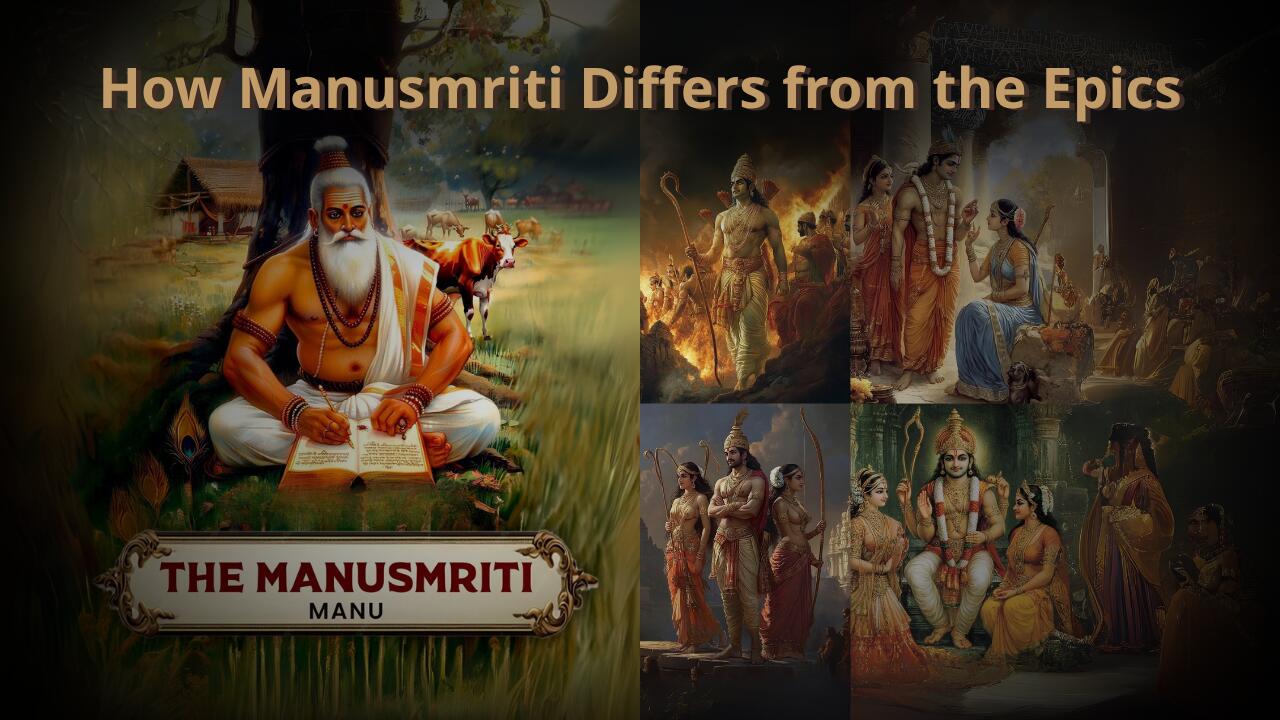
How Manusmriti Differs from the Epics

The Mahabharata and Ramayana stir the heart and imagination. The Manusmriti stirs the mind. It challenges us to reflect on how societies justify inequality and how norms are sanctified.

Prof Vivek Misra by Prof Vivek Misra
17 July 2025
in Opinions, Trending
How Manusmriti Differs from the Epics

How Manusmriti Differs from the Epics

Share on FacebookShare on X

Ancient Indian texts are among humanity’s richest intellectual and moral legacies. From the Vedas and Upanishads to the Mahabharata, Ramayana, Arthashastra, and Manusmriti, these works together shaped the civilizational ethos of the Indian subcontinent for millennia. However, not all texts are alike. While many students are familiar with the grand epics — the Mahabharata and the Ramayana — relatively few take the time to deeply study the Manusmriti.

For the youth of India, the Manusmriti (also known as the Manava Dharma Shastra) is indispensable. It is not a heroic epic or a divine saga of battles and miracles. Rather, it is a systematic code — a manual of social, moral, and legal precepts which governed ancient Hindu society. Its value lies not merely in its prescriptive verses but in what it reveals about ancient India’s socio-political structures, debates over authority, moral codes, and the evolution of legal consciousness.

RelatedPosts

Millionaire’s Son Escapes Bitter Bait of Forced Conversion Network in Uttar Pradesh

From Displacement to Ownership: Yogi Government to Hand Land Rights to 1,645 Pakistan-Origin Families in Rehabilitation Initiative

Bengal Buries Mamata’s ‘Appeasement Model’ as Suvendu Govt Ends Imam-Muezzin Allowances

Load More

The young generation needs to study the Manusmriti with an inquisitive mind. An attempt has been made to explain how the Manusmriti differs from the epics, how it has been both revered and criticised across centuries, how it is different, and how to approach its complex legacy with scholarly integrity. Some illustrative verses from the Manusmriti are cited to show its unique aspects.

The Difference

First, when compared to the two great epics-Mahabharat and Ramayana , we must understand the genre. The Mahabharata and Ramayana are Itihasas — narrative epics that blend history, legend, theology, and moral instruction through stories of kings, sages, battles, and cosmic struggles. They appeal to the imagination. They offer moral dilemmas wrapped in grand tales: Krishna’s counsel to Arjuna on the battlefield or Rama’s struggle to uphold dharma in the face of personal tragedy. The Manusmriti, on the other hand, is a Dharmashastra — a treatise meant to codify the social and moral duties (dharma) of individuals based on their stage of life (ashrama) and their social group (varna). The core concern of the Manusmriti is order: social, moral, and cosmic. It does not enthral with heroes or wars. Instead, it instructs through normative injunctions: what is right conduct, who should do what, how justice should be administered, how society should be organised, how penance should be done when laws are broken.

To state in simple words: The Ramayana is about Rama’s life as an ideal man and king, and The Mahabharata is about the complex conflicts between dharma and power in a family and kingdom. Whereas, the Manusmriti is about laying down the rules by which an ideal society should be governed. Thus, the Manusmriti is less about stories and more about structure, norms, governance, and social control.

Unlike the epics, which are oral traditions rich with interpolations and retellings, the Manusmriti is more systematic. It organises its 2,684 verses into twelve chapters that deal with: Creation and cosmogony; Sources of dharma; Duties of the four varnas; Rules of daily conduct; Food and purification; Rules for ascetics; Duties of kings; Civil and criminal law; Law of inheritance; Mixed castes and occupations; Penances; Transmigration and karma. It is part legal code, part moral code, and part metaphysical treatise. No other ancient text attempts this breadth with such didactic directness.

Its Uniqueness

The Manusmriti is believed to have been composed around 200 BCE – 200 CE, although it draws on earlier Vedic ideas. It is traditionally attributed to Manu, regarded as the progenitor of mankind in Hindu mythology — the first lawgiver who received the laws from Brahma.

Let us look at some examples which illustrate how the Manusmriti differs fundamentally from other Indian epics:

While detailing about the role of the King, Manusmriti says that:“When the king protects his subjects in accordance with dharma, he shares in the spiritual merit of everyone. When he fails to protect them, he takes on their sins.” (Manusmriti 7.14-15). This simple verse shows that the king’s authority is not only secular but moral and spiritual. In the Mahabharata, we see kings in action on battlefields; in the Manusmriti, the king’s duty is carefully prescribed as a moral guardian.

According to the Manusmriti the duties of a King include:“A king who does not inflict punishment becomes liable to punishment himself; and the king who inflicts punishment according to law protects himself and his realm.” (Manusmriti 7.20). This verse shows that the king’s duty is not just optional — neglecting to punish wrongdoers is itself a punishable offense. The king is held to an obligation to uphold danda (punishment), tying political power to moral order. This differs from the Mahabharata’s more situational ethics where heroes often bend laws for a higher good.

The Manusmriti also believes that: “Where there is no king, the strong prey upon the weak; the king punishes the strong and protects the weak.”(Manusmriti 8.15). Such a prescription echoes the Hobbesian idea that without law and sovereign power, there is anarchy. The Manusmriti predates modern political philosophy yet recognises the necessity of coercive power to maintain social order — an early seed of political realism.

According to Manusmriti:“When conflicting witnesses give evidence in a lawsuit, the king shall decide the case by inference, by tradition, by documents, and by circumstantial evidence.”(Manusmriti 8.79). Here you see an ancient system of adjudication recognising multiple sources of evidence. This shows the Manusmriti is not just moralistic — it is procedural, seeking practical ways to deliver justice.

Moreover, the King is not the supreme source of law, Manusmriti says that:“The root of dharma is the entire Veda, and the tradition and conduct of those who know the Veda; also the customs of holy men, and what is satisfactory to oneself.” (Manusmriti 2.6). This shows that law is not just the king’s word — it comes from scriptures, tradition, and community practices. Unlike the Mahabharata’s situational ethics, the Manusmriti seeks universal norms.

The Manusmriti is famous (and controversial) for its varna system. It says:“For the sake of protecting this universe, He divided His body into four parts… From His mouth came the Brahmin, from His arms the Kshatriya, from His thighs the Vaishya, from His feet the Shudra.” (Manusmriti 1.87-91). While the Mahabharata’s Bhagavad Gita mentions varna too, it does so more philosophically. The Manusmriti turns it into a rigid social code. For students, this is critical to study: how ancient texts codified hierarchy, how these ideas persisted, and how they were later challenged.

The enforcement of Law has been highlighted in Manusmriti: “Punishment alone governs all beings, punishment alone protects them, punishment watches while they sleep; the wise declare punishment to be dharma.” (Manusmriti 8.316). Here, we see the seeds of ancient political thought: law enforcement is the backbone of civil order. This anticipates later theories by thinkers like Kautilya in the Arthashastra, who also stressed the king’s role in policing and punishing.

Manusmriti preaches that moral and social order can be restored even after it has been violated. It says: “By confession, by repentance, and by reciting mantras a man is freed from sin; by giving alms, by austerities, and by sacrifices, he is purified.” (Manusmriti 11.131)
This shows that the Manusmriti is not only punitive but also restorative. It gives a framework for penance and expiation, aiming to restore moral and social order when it is breached.

Manusmriti even talks about of purity and ritual conduct, by emphasising that:“A man is purified by bathing, by fasting, by giving alms, by reciting mantras, by repentance, and by penance according to rule.” (Manusmriti 5.85). This illustrates how Manusmriti seeks to regulate everyday life through rules of ritual purity and atonement — much broader than the moral dilemmas of the epics. It systematises ritual conduct to maintain social and cosmic order.

The teacher is regarded in high esteem by the Manusmriti: “Of him who gives natural birth and of him who gives knowledge of the Veda, the giver of knowledge of the Veda is the more venerable father, for the birth which he gives is immortal.” (Manusmriti 2.140-14).
This beautiful line elevates the spiritual teacher (guru) above even the biological father — showing the high place the Manusmriti gives to the preservation and transmission of sacred knowledge. It emphasises an ordered chain of authority and respect.

A controversial but important dimension is Manusmriti’s prescriptions on women. For instance: “Even in her own house, a female should never do anything independently.” (Manusmriti 5.148). Such verses have been critiqued strongly by modern thinkers. But for the youth, they show how patriarchy was rationalised and sanctified — which makes the Manusmriti a vital source to study the roots of gender inequality. An another verse which is severely debated is: “In childhood a woman must be subject to her father, in youth to her husband, and when her lord is dead to her sons; a woman must never be independent.”(Manusmriti 5.154). This verse also depicts how the Manusmriti explicitly tries to fix the role of women within patriarchal family structures. Unlike in the epics, where women like Draupadi or Sita sometimes defy or question norms, the Manusmriti codifies a rigid ideal.

When we talk about Kautilya’s Arthashastra, the Arthashastra is more pragmatic, secular, and power-centric. It focuses on strategy, espionage, administration, and realpolitik. But, the Manusmriti combines spiritual cosmology with social rules. It roots its laws in religious sanction. Thus, studying both together helps students see how law was imagined either as divine order (dharma) or practical necessity (artha).

These are some of the many verses of the Manusmriti which are central which focus on:  fixing social roles and duties; give detailed rules for ritual purity; prescribe the moral obligations of rulers; establishes an early legal framework; and offer penances to restore cosmic and social harmony.

Such systematic codification is what makes the Manusmriti unique among ancient Indian texts. It is not storytelling — it is social engineering through prescriptive norms.

Legacy of the Manusmriti

Over the centuries, the Manusmriti was both influential and contested. Smritis were not static laws but guides for jurists. Local customs and kingly edicts often overruled them. Medieval commentaries by scholars like Medhatithi and Govindaraja reinterpreted it in changing contexts.

In the colonial period, British administrators used the Manusmriti to justify codified Hindu law, often ignoring local variations. Social reformers like B.R. Ambedkar criticised it harshly, especially for its casteism and gender bias. Ambedkar publicly burned copies of the Manusmriti in 1927 as a symbolic act against untouchability.

Yet, it is precisely this contested legacy that makes the Manusmriti a compelling text for young scholars. It is not to be worshipped blindly or dismissed outright, but studied critically to understand how religious authority and social order were intertwined.

Why Should Today’s Youth Read the Manusmriti?

The youth of today generally ask: why read a text that is outdated or even regressive in parts? The answer to this is very simple and logical. The youth must go through this to understand the roots of social hierarchy. The Manusmriti shows how inequality was institutionalised. Understanding this is the first step to dismantling it. At the same time the young generation will understand the dynamics of power, by reading how kings were expected to rule, maintain order, and punish, one gets insights into early theories of governance.

The youth will also get to know how indigenous jurisprudence evolved before modern law codes, the Manusmriti shaped legal thinking in large parts of India. It influenced debates on family law, inheritance, property, and punishment.

Modern thinkers from Jyotirao Phule to Periyar to Ambedkar engaged with it critically. Reading the Manusmriti arms you with knowledge to engage with those debates meaningfully. Studying the Manusmriti trains you to read normative texts carefully — to separate descriptive reality from prescriptive ideals.

Conclusion

The Manusmriti is neither a divine commandment frozen in time nor merely an obsolete relic. It is a historical document that reveals the aspirations and contradictions of an ancient society trying to institutionalise order.

The Mahabharata and Ramayana stir the heart and imagination. The Manusmriti stirs the mind. It challenges us to reflect on how societies justify inequality and how norms are sanctified. As postgraduates, your task is not to bow before ancient authority but to question it rigorously.

By reading the Manusmriti critically, you join a lineage of thinkers who believe that tradition must be understood before it is reformed. That, indeed, is the true spirit of political science: to understand power, law, and society — and to challenge them when necessary. So, pick up the Manusmriti– read it with curiosity and courage, see how far we have come, and how far we have yet to go.

Tags: AmbedkarDebate on ManusmritiHindu scripturesIndian EpicsMahabharatMahabharataManusmritiProf Vivek MisraRamayanRamayanaSage ManuSanatan Dharma
ShareTweetSend
Previous Post

Karnataka Man Forced into Islam, Renamed Without Consent, Threatened With False Rape Case by Wife

Next Post

Robert Vadra in Trouble as ED Files Charge Sheet in Shikohpur Land Deal Case

Related Posts

RSS Chief Mohan Bhagwat Says Gen Z Protesters Are 'Not Anti-National,' Calls for Dialogue
Trending

RSS Chief Mohan Bhagwat Says Gen Z Protesters Are ‘Not Anti-National,’ Calls for Dialogue

6 August 2026

Amid weeks of youth-led unrest over the NEET paper leak, RSS chief Mohan Bhagwat used a Mumbai address on...

Mark Zuckerberg and PM Narendra Modi amid Meta controversy over Facebook video removal and CSAM lapses in India
Trending

Zuckerberg apologises to India over Modi video removal and CSAM lapses, but questions on accountability remain

6 August 2026

Meta chief executive Mark Zuckerberg has apologised to the Indian government over the temporary removal of a Facebook video...

Army Chief General Dhiraj Seth Reviews Central Command’s Combat Readiness, Pushes for Future-Ready Force
Defense

Army Chief General Dhiraj Seth Reviews Central Command’s Combat Readiness, Pushes for Future-Ready Force

5 August 2026

General Dhiraj Seth, Chief of the Army Staff (COAS), undertook a two-day visit to formations of Central Command on...

Load More

Leave a Reply Cancel reply

Your email address will not be published. Required fields are marked *

I agree to the Terms of use and Privacy Policy.
This site is protected by reCAPTCHA and the Google Privacy Policy and Terms of Service apply.

Currently Playing

India Eyes Sixth-Generation Fighters: Why FCAS Matters Beyond AMCA

India Eyes Sixth-Generation Fighters: Why FCAS Matters Beyond AMCA

00:05:03

Beyond S-400: Why India's Indigenous Kusha Missile Could Change Air Defence

00:03:42

Rigvedic Names in Denmark? Nick Collins on India’s Forgotten Links With Europe

00:32:39

INS NIPUN: MEET INDIA’S NEW DSV

00:03:05

POJK ERUPTS IN PROTEST

00:02:53
Facebook Twitter Instagram Youtube
tfipostTfipost.com
Right Wing | News Analysis | Indian Opinion
  • About us
  • Contact Us
  • Careers
  • Brand Partnerships
  • Terms of use
  • Privacy Policy
  • Sitemap

©2026 TFI Media Private Limited

No Result
View All Result
  • Premium
  • Politics
    • Analysis
    • Opinions
    • Trending
  • Economy
    • Business
    • Finance
  • Defense
    • Defence
    • Strategy
    • Weaponry
  • Geopolitics
    • Africa
    • Americas
    • Asia Pacific
    • Europe
    • South Asia
    • West Asia
  • Knowledge
    • Culture
    • History
    • Indology
  • Law
  • Lounge
    • Books
    • Cinema
    • Food
    • Health
    • Sports
    • technology
    • Travel
    • Satire
TFIPOST हिन्दी
TFIPOST Global

©2026 TFI Media Private Limited