


















TFIPOST हिन्दी
TFIPOST Global
Tfipost.com
Tfipost.com
No Result
View All Result
  • Premium
  • Politics
    • All
    • Analysis
    • Opinions
    • Trending
    EC Ahead of Bengal: Elections: 91 Lakh Names Removed

    Election Roll Clean-Up in West Bengal: Nearly 91 Lakh Names Removed as EC Tightens Electoral Integrity Ahead of Polls

    Manipur Govt Suspends Internet, Clamps Curfew After Bomb Attack in Bishnupur Creates Tensions

    Manipur Govt Suspends Internet, Clamps Curfew After Bomb Attack in Bishnupur Creates Tensions

    DRDO’s Gas Turbine Research Establishment Receives Bomb Threat, Mail Targets TN CM’s Grandson

    DRDO’s Gas Turbine Research Establishment Receives Bomb Threat, Mail Targets TN CM’s Grandson

    Anti-terrorism operation in Srinagar (AI Generated Image)

    Security Forces Crack Interstate Lashkar-e-Taiba Network in Srinagar, Arrest Fugitive Terror Operative After 16 Years

    • Analysis
    • Opinions
    • Trending
  • Economy
    • All
    • Business
    • Economy1
    • Finance
    Manipur Govt Suspends Internet, Clamps Curfew After Bomb Attack in Bishnupur Creates Tensions

    Manipur Govt Suspends Internet, Clamps Curfew After Bomb Attack in Bishnupur Creates Tensions

    India’s 3-Stage Nuclear Strategy Explained: How India’s Fast Breeder Reactors Power the Uranium–Thorium Shift

    India’s 3-Stage Nuclear Strategy Explained: How India’s Fast Breeder Reactors Power the Uranium–Thorium Shift

    France’s Rafale Strategy Faces Global Pushback: UAE Walks Away, India Presses for Access, Germany Challenges FCAS

    France’s Rafale Strategy Faces Global Pushback: UAE Walks Away, India Presses for Access, Germany Challenges FCAS

    IAF Seeks Clearance for 2,500 Homegrown Software Defined Radios Induction to Build ‘Airborne Internet’ Network

    IAF Seeks Clearance for 2,500 Homegrown Software Defined Radios Induction to Build ‘Airborne Internet’ Network

    • Business
    • Finance
  • Defense
    • All
    • Defence
    • Strategy
    • Weaponry
    Anti-terrorism operation in Srinagar (AI Generated Image)

    Security Forces Crack Interstate Lashkar-e-Taiba Network in Srinagar, Arrest Fugitive Terror Operative After 16 Years

    India’s 3-Stage Nuclear Strategy Explained: How India’s Fast Breeder Reactors Power the Uranium–Thorium Shift

    India’s 3-Stage Nuclear Strategy Explained: How India’s Fast Breeder Reactors Power the Uranium–Thorium Shift

    Modi Pushing India Into Next Phase of Nuclear Power

    India Enters Second Stage of Nuclear Programme as Kalpakkam Breeder Reactor Achieves Criticality

    Rajnath Singh at Base Hospital, Delhi

    Army Medical Infrastructure Gets Major Boost as Rajnath Singh Unveils New Specialised Facilities.

    • Defence
    • Strategy
    • Weaponry
  • Geopolitics
    • All
    • Africa
    • Americas
    • Asia Pacific
    • Europe
    • South Asia
    • West Asia
    US-Iran Two Week Ceasefire

    Ninety Minutes to Midnight: How a Last-Minute Ceasefire Halted a Devastating US Strike on Iran

    France’s Rafale Strategy Faces Global Pushback: UAE Walks Away, India Presses for Access, Germany Challenges FCAS

    France’s Rafale Strategy Faces Global Pushback: UAE Walks Away, India Presses for Access, Germany Challenges FCAS

    US C-130 Mission in Iran: Daring Pilot Rescue or Covert Uranium Operation?

    US C-130 Mission in Iran: Daring Pilot Rescue or Covert Uranium Operation?

    Trump Says US Sent Guns to Iranian Protesters, Alleges ‘Kurds Kept Weapons Sent’

    Trump Says US Sent Guns to Iranian Protesters, Alleges ‘Kurds Kept Weapons Sent’

    • Africa
    • Americas
    • Asia Pacific
    • Europe
    • South Asia
    • West Asia
  • Knowledge
    • All
    • Culture
    • Education
    • History
    • Indology
    The 1973 Constitution and ‘Bhutto’ the Man Who Made It: What Pakistan Owes and What It Destroyed

    The 1973 Constitution and ‘Bhutto’ the Man Who Made It: What Pakistan Owes and What It Destroyed

    Future-Ready Learning: CBSE Launches AI Curriculum for Classes 3–8 to Boost Digital Readiness in Young Learners

    Future-Ready Learning: CBSE Launches AI Curriculum for Classes 3–8 to Boost Digital Readiness in Young Learners

    From Devotion to Divine Strength: Celebrating Lord Hanuman, Eternal Symbol of Courage, Humility

    From Devotion to Divine Strength: Celebrating Lord Hanuman, Eternal Symbol of Courage, Humility

    Benefits of Smart Learning in the Digital Age

    Benefits of Smart Learning in the Digital Age

    • Culture
    • History
    • Indology
  • Law
  • Lounge
    • All
    • Books
    • Cinema
    • Entertainment
    • Food
    • Games
    • Health
    • Lifestyle
    • Satire
    • Sports
    • technology
    • Travel
    Rajnath Singh at Base Hospital, Delhi

    Army Medical Infrastructure Gets Major Boost as Rajnath Singh Unveils New Specialised Facilities.

    Stylish Maxi Dress Ideas for Wedding Guests

    Stylish Maxi Dress Ideas for Wedding Guests

    Live Dealer Roulette Online Casinos: A Real Player’s Guide to Real-Time Roulette

    Live Dealer Roulette Online Casinos: A Real Player’s Guide to Real-Time Roulette

    Beginning a Career in Ethical Hacking in 2026: Opportunities, Software, and Required Knowledge

    Beginning a Career in Ethical Hacking in 2026: Opportunities, Software, and Required Knowledge

    • Books
    • Cinema
    • Food
    • Health
    • Sports
    • technology
    • Travel
    • Satire
Tfipost.com
  • Premium
  • Politics
    • All
    • Analysis
    • Opinions
    • Trending
    EC Ahead of Bengal: Elections: 91 Lakh Names Removed

    Election Roll Clean-Up in West Bengal: Nearly 91 Lakh Names Removed as EC Tightens Electoral Integrity Ahead of Polls

    Manipur Govt Suspends Internet, Clamps Curfew After Bomb Attack in Bishnupur Creates Tensions

    Manipur Govt Suspends Internet, Clamps Curfew After Bomb Attack in Bishnupur Creates Tensions

    DRDO’s Gas Turbine Research Establishment Receives Bomb Threat, Mail Targets TN CM’s Grandson

    DRDO’s Gas Turbine Research Establishment Receives Bomb Threat, Mail Targets TN CM’s Grandson

    Anti-terrorism operation in Srinagar (AI Generated Image)

    Security Forces Crack Interstate Lashkar-e-Taiba Network in Srinagar, Arrest Fugitive Terror Operative After 16 Years

    • Analysis
    • Opinions
    • Trending
  • Economy
    • All
    • Business
    • Economy1
    • Finance
    Manipur Govt Suspends Internet, Clamps Curfew After Bomb Attack in Bishnupur Creates Tensions

    Manipur Govt Suspends Internet, Clamps Curfew After Bomb Attack in Bishnupur Creates Tensions

    India’s 3-Stage Nuclear Strategy Explained: How India’s Fast Breeder Reactors Power the Uranium–Thorium Shift

    India’s 3-Stage Nuclear Strategy Explained: How India’s Fast Breeder Reactors Power the Uranium–Thorium Shift

    France’s Rafale Strategy Faces Global Pushback: UAE Walks Away, India Presses for Access, Germany Challenges FCAS

    France’s Rafale Strategy Faces Global Pushback: UAE Walks Away, India Presses for Access, Germany Challenges FCAS

    IAF Seeks Clearance for 2,500 Homegrown Software Defined Radios Induction to Build ‘Airborne Internet’ Network

    IAF Seeks Clearance for 2,500 Homegrown Software Defined Radios Induction to Build ‘Airborne Internet’ Network

    • Business
    • Finance
  • Defense
    • All
    • Defence
    • Strategy
    • Weaponry
    Anti-terrorism operation in Srinagar (AI Generated Image)

    Security Forces Crack Interstate Lashkar-e-Taiba Network in Srinagar, Arrest Fugitive Terror Operative After 16 Years

    India’s 3-Stage Nuclear Strategy Explained: How India’s Fast Breeder Reactors Power the Uranium–Thorium Shift

    India’s 3-Stage Nuclear Strategy Explained: How India’s Fast Breeder Reactors Power the Uranium–Thorium Shift

    Modi Pushing India Into Next Phase of Nuclear Power

    India Enters Second Stage of Nuclear Programme as Kalpakkam Breeder Reactor Achieves Criticality

    Rajnath Singh at Base Hospital, Delhi

    Army Medical Infrastructure Gets Major Boost as Rajnath Singh Unveils New Specialised Facilities.

    • Defence
    • Strategy
    • Weaponry
  • Geopolitics
    • All
    • Africa
    • Americas
    • Asia Pacific
    • Europe
    • South Asia
    • West Asia
    US-Iran Two Week Ceasefire

    Ninety Minutes to Midnight: How a Last-Minute Ceasefire Halted a Devastating US Strike on Iran

    France’s Rafale Strategy Faces Global Pushback: UAE Walks Away, India Presses for Access, Germany Challenges FCAS

    France’s Rafale Strategy Faces Global Pushback: UAE Walks Away, India Presses for Access, Germany Challenges FCAS

    US C-130 Mission in Iran: Daring Pilot Rescue or Covert Uranium Operation?

    US C-130 Mission in Iran: Daring Pilot Rescue or Covert Uranium Operation?

    Trump Says US Sent Guns to Iranian Protesters, Alleges ‘Kurds Kept Weapons Sent’

    Trump Says US Sent Guns to Iranian Protesters, Alleges ‘Kurds Kept Weapons Sent’

    • Africa
    • Americas
    • Asia Pacific
    • Europe
    • South Asia
    • West Asia
  • Knowledge
    • All
    • Culture
    • Education
    • History
    • Indology
    The 1973 Constitution and ‘Bhutto’ the Man Who Made It: What Pakistan Owes and What It Destroyed

    The 1973 Constitution and ‘Bhutto’ the Man Who Made It: What Pakistan Owes and What It Destroyed

    Future-Ready Learning: CBSE Launches AI Curriculum for Classes 3–8 to Boost Digital Readiness in Young Learners

    Future-Ready Learning: CBSE Launches AI Curriculum for Classes 3–8 to Boost Digital Readiness in Young Learners

    From Devotion to Divine Strength: Celebrating Lord Hanuman, Eternal Symbol of Courage, Humility

    From Devotion to Divine Strength: Celebrating Lord Hanuman, Eternal Symbol of Courage, Humility

    Benefits of Smart Learning in the Digital Age

    Benefits of Smart Learning in the Digital Age

    • Culture
    • History
    • Indology
  • Law
  • Lounge
    • All
    • Books
    • Cinema
    • Entertainment
    • Food
    • Games
    • Health
    • Lifestyle
    • Satire
    • Sports
    • technology
    • Travel
    Rajnath Singh at Base Hospital, Delhi

    Army Medical Infrastructure Gets Major Boost as Rajnath Singh Unveils New Specialised Facilities.

    Stylish Maxi Dress Ideas for Wedding Guests

    Stylish Maxi Dress Ideas for Wedding Guests

    Live Dealer Roulette Online Casinos: A Real Player’s Guide to Real-Time Roulette

    Live Dealer Roulette Online Casinos: A Real Player’s Guide to Real-Time Roulette

    Beginning a Career in Ethical Hacking in 2026: Opportunities, Software, and Required Knowledge

    Beginning a Career in Ethical Hacking in 2026: Opportunities, Software, and Required Knowledge

    • Books
    • Cinema
    • Food
    • Health
    • Sports
    • technology
    • Travel
    • Satire
No Result
View All Result
Tfipost.com
Tfipost.com
No Result
View All Result
  • Premium
  • Politics
  • Economy
  • Defense
  • Geopolitics
  • Knowledge
  • Law
  • Lounge

Nuclear power takes off: India’s rise to energy dominance under Modi Government

Shubham Bajpai by Shubham Bajpai
11 February 2023
in Economy
Nuclear power India
Share on FacebookShare on X

India Nuclear power: Energy and power are undoubtedly essential for the development of any country. Be it households or industries, energy is the foundation that supports the socio-economic fabric of society. However, energy generation has been a long-standing threat to the environment, and this has posed a new challenge to the world. As a result, the search for a green source of energy has become a new quest for the world.

While there are solutions available in the form of solar, hydro, and wind power, nuclear power is also an option that is clean and cost-effective. The Indian government appears determined to use it more extensively to reduce its dependence on coal and lignite and to counter the cost limitations of other sources. This can be seen from various initiatives.

RelatedPosts

Security Forces Crack Interstate Lashkar-e-Taiba Network in Srinagar, Arrest Fugitive Terror Operative After 16 Years

India’s 3-Stage Nuclear Strategy Explained: How India’s Fast Breeder Reactors Power the Uranium–Thorium Shift

France’s Rafale Strategy Faces Global Pushback: UAE Walks Away, India Presses for Access, Germany Challenges FCAS

Load More

Now let’s examine the Modi government’s approach towards nuclear energy.

Nuclear quantum jump

During his speech in the Rajya Sabha, the Union Minister of State for Atomic Energy, Dr. Jitendra Singh, stated that the nuclear power capacity of India has seen a significant increase after 2014. Since Narendra Modi became the Prime Minister of India, the central government’s policies have proven effective in enhancing the nation’s nuclear capabilities. In his statement, the minister also provided statistics on the growth of nuclear power generation capacity of India and its impact.

According to the data presented by him on the floor of the house, India’s nuclear power capacity has increased by 30-40 per cent in the past 8 and a half years. In 2013-14, India’s annual nuclear power generation capacity was 35,333 million units, which has risen to 47,112 million units in 2021-22.

Regarding the nuclear reactors in the country, he further stated that there were only 22 nuclear reactors until 2017. Under the leadership of Prime Minister Modi, the cabinet gave permission to construct 11 new indigenous pressurized heavy water reactors with a combined capacity of 7,000 megawatts. To achieve this goal, the Indian government allocated Rs. 1.05 lakh crores.

Furthermore, he also mentioned the ground breaking decision to open up the space department for private players. Joint ventures with public sector undertakings (PSUs) to enhance India’s nuclear program were also permitted. Following a decision to this effect in 2015, the Nuclear Power Corporation of India Limited (NPCIL) is currently working on two joint ventures, one with the National Thermal Power Corporation Limited (NTPC) and the other with the Indian Oil Corporation Limited (IOCL).

Dr. Jitendra Singh also informed the Upper House that previous nuclear reactors were located in the southern part of India, Maharashtra, or Gujarat. However, the current Modi government is planning to expand it across India. To illustrate this, he cited the example of the Gorakhpur nuclear power plant in the Gorakhpur district of Haryana, which will become operational in the near future.

In reply to another question, he answered that the world’s first thorium-based nuclear plant “Bhavni,” which will be entirely indigenous and using Uranium-233, is being set up in Kalpakkam, Tamil Nadu.

India has made significant progress in the energy sector in recent years, with a focus on renewable energy sources such as solar power. Despite the growth of solar energy, the country still heavily relies on traditional sources like coal and lignite for its power generation needs. Currently, only 1.7 per cent of India’s power requirements are met through nuclear sources. Despite this low percentage, there has been a noticeable increase in electricity generation capacity from nuclear power, rising by over 30per cent.

As the country continues to shift towards renewable energy, the use of solar power is becoming increasingly accessible to the general population, resulting in a decrease in the share of nuclear power in the country’s energy mix, dropping from 3.2 per cent to 1.7 per cent. However, it is expected that once the threshold of solar expansion has been reached, the use of coal and lignite will be replaced by nuclear energy, increasing the share of nuclear power in India’s energy basket.

Despite a decrease in the share of nuclear power in India’s energy mix due to the country’s focus on renewable energy sources like solar power, there has been a remarkable increase in electricity generation capacity from nuclear sources. As renewable energy sector continues to grow, the use of nuclear power is expected to increase, making it a crucial component of energy portfolio of India.

As India is becoming more nuclear in its power generation capacity, it becomes important to understand the benefits of nuclear energy.

Also read: Focusing on nuclear energy can save India billions of rupees annually

Nuclear energy and its pros and cons

First and most significant advantage of the nuclear energy over other fossil fuels is its direct carbon neutrality. It does not produce greenhouse gas emissions such as Methane and Carbon Dioxide.

According to reports, the average emissions for nuclear power generation are 29 tonnes of CO2 per gigawatt-hour, while it is 1,054 tonnes per gigawatt-hour for lignite and 888 tonnes per gigawatt-hour for coal. Even when compared to renewable sources, it produces fewer emissions than the most used solar energy. The CO2 emissions in power generation through solar energy are 85 tonnes per GWh.

Secondly, it is not intermittent, meaning that, unlike solar and wind energy, which depend on the intensity of light and the speed of wind, respectively, the nuclear power generation process is less prone to interruption. A nuclear power plant can run continuously without interruption or maintenance, making it a more reliable source of energy.

Lastly, the most important benefit is its cost-effectiveness. According to estimates, the cost of nuclear power generation is cheaper than most other conventional processes. Despite the costs of managing radioactive fuel and its disposal, a nuclear power plant costs 33-50 per cent less than a coal plant and 20-25 per cent less than a gas combined-cycle power plant.

In addition to the low running cost, the energy produced from nuclear sources is also superior to most other forms. According to studies by the US Department of Energy, 2GW of coal or 3-4 GW of other renewable base power plants would be required to replace a 1GW nuclear power plant and generate the same amount of electricity.

The only disadvantages of nuclear power are its proneness to disaster, nuclear waste and the high cost of building a plant. These can be effectively managed with strong policies, as demonstrated by countries like France.

Also read: The world’s biggest nuclear project is coming in India and this time Modi govt is in no mood to listen to leftists

India as compared to other countries

With as many as 440 nuclear reactors, 32 countries of the world generate 10 per cent of the world’s electricity through nuclear energy.

Specifically, the top generator of nuclear power is the United States, with a capacity of 91.5 GW. France follows closely behind with a capacity of 61.3 GW, which accounts for almost 70 per cent of its electricity requirements. 17 per cent of France’s power is generated through recycled nuclear fuel.

China, Japan, and Russia are also significant producers of nuclear power, with capacities of 50.8 GW, 31.7 GW, and 29.6 GW respectively. South Korea has a capacity of 24.5 GW, while Canada and Ukraine both have a capacity of around 13 GW. India does not hold a place in the top 10 countries for nuclear power generation.

However, India is the 7th largest in terms of number of nuclear reactors, with a combined capacity of 6,795 MW as of 2021. This capacity has increased steadily over the years, from 4,301 MWe in 2012, to 5,218 MWe in 2013, 6,150 MWe in 2016, and ultimately to 6,795 in 2021. Using this capacity, India generated 39,758 GWh of electricity in 2021.
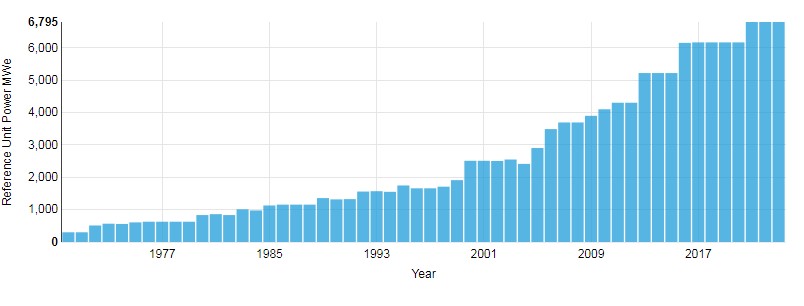
Source: World nuclear association

Also read: The world is transitioning from green energy to nuclear energy

India’s initiative for nuclear power

In 2004, the goal for nuclear power generation was set at 20 GWe by 2020. However, in June 2009, the Nuclear Power Corporation of India Limited (NPCIL) revised the goal to 60 GWe by 2032. This target was reaffirmed in 2010, but later the Parliament was informed that more achievable targets were 14,600 MWe by 2020-21 and 27,500 MWe by 2032.

In March 2018, it was revealed that the government’s goal of 63 GWe in nuclear capacity outlined in the 12th five-year plan for 2012-17 would not be met. The total nuclear capacity was estimated to reach 22.5 GWe by 2031, which would require a 231 per cent increase in nuclear power generation capacity in the next 9 years.

In 2005, India signed the “123 agreements” with the US under the Indo-US civil nuclear deal. This agreement allowed India to trade in nuclear materials without being a member of the Nuclear Suppliers Group (NSG). India also signed the Indo-French cooperation on the peaceful use of nuclear energy in 2008, which opened up opportunities for the sale of French-made nuclear reactors to India.

Despite the special waiver granted by the Indo-US civil nuclear deal and the Indo-French cooperation on “peaceful use of nuclear energy,” previous governments were reluctant to increase the number of nuclear reactors in India. However, the current government is taking steps to make India’s power generation more environmentally friendly, with a special emphasis on nuclear power.

In November 2022, the Ministry of Environment, Forest and Climate Change released a revised long-term low-carbon strategy that includes a goal to triple India’s nuclear power generation capacity by 2032. In further support of this goal, the government of India has recently signed a trilateral cooperation initiative with France and the United Arab Emirates. This group, named the “Rafael Group,” aims to advance cooperation in the energy sector, particularly in the areas of solar and nuclear energy.

Way ahead for India

Nuclear power plays a crucial role in the growth and advancement of a nation. As the world shifts away from non-renewable fossil fuels due to their negative impact on the environment and climate, nuclear energy is seen as a promising alternative. Nuclear power is not only more cost-effective than fossil fuels, but it also serves as a cleaner energy source that does not release harmful pollutants into the atmosphere.

India is taking initiatives to augment its use of nuclear energy, with a plan to add 11 new reactors to its existing facilities. Once these reactors are in operation, India will have a total of 33 reactors, placing it in the fifth position globally, alongside Japan. The increase in the number of reactors will result in a proportional increase in the power generation capacity, enabling the country to meet its increasing energy demands in a more efficient manner.

Support TFI:

Support us to strengthen the ‘Right’ ideology of cultural nationalism by purchasing the best quality garments from TFI-STORE.COM

Also Watch:

Tags: Fossil FuelsGreen EnergyGreenhouse Gas EmissionsIndiaNuclear EnergyNuclear Power PlantRenewable energy
ShareTweetSend
Previous Post

Different paths, diverse journeys but same destination: Comparing Aghoris and Naga Sadhus

Next Post

India’s lithium expedition: Liberating India from dependence

Related Posts

Manipur Govt Suspends Internet, Clamps Curfew After Bomb Attack in Bishnupur Creates Tensions
Crime

Manipur Govt Suspends Internet, Clamps Curfew After Bomb Attack in Bishnupur Creates Tensions

7 April 2026

The Manipur government on Tuesday suspended mobile internet for three days across five districts after a bomb explosion in...

India’s 3-Stage Nuclear Strategy Explained: How India’s Fast Breeder Reactors Power the Uranium–Thorium Shift
Economy

India’s 3-Stage Nuclear Strategy Explained: How India’s Fast Breeder Reactors Power the Uranium–Thorium Shift

7 April 2026

India has crossed a significant milestone in its long-term nuclear energy journey, with fresh momentum in the second stage...

France’s Rafale Strategy Faces Global Pushback: UAE Walks Away, India Presses for Access, Germany Challenges FCAS
Analysis

France’s Rafale Strategy Faces Global Pushback: UAE Walks Away, India Presses for Access, Germany Challenges FCAS

7 April 2026

France’s reputation as a fiercely independent military aviation power is now facing a new kind of test, not on...

Load More

Leave a Reply Cancel reply

Your email address will not be published. Required fields are marked *

I agree to the Terms of use and Privacy Policy.
This site is protected by reCAPTCHA and the Google Privacy Policy and Terms of Service apply.

Currently Playing

Ethanol, EVs and Solar- How India’s Energy Game Is Changing | Modi on LPG & Crude Oil | war| Hormuz

Ethanol, EVs and Solar- How India’s Energy Game Is Changing | Modi on LPG & Crude Oil | war| Hormuz

00:05:21

Truth of IRIS Dena: 8 Days That Changed Narrative | War zone Reality, Not an Indian Navy Exercise

00:08:02

300 Million Euros for SCALP: Strategic Necessity or Costly Dependency on France300

00:04:06

Tejas Mk1A: 19th aircraft coupled but Not Delivered: What Is Holding Back the IAF Induction?

00:07:21

Agni-3 Launch Decoded: Why Test an Active Nuclear Missile That’s Already Deployed?

00:05:05
Facebook Twitter Instagram Youtube
tfipostTfipost.com
Right Wing | News Analysis | Indian Opinion
  • About us
  • Contact Us
  • Careers
  • Brand Partnerships
  • Terms of use
  • Privacy Policy
  • Sitemap

©2026 TFI Media Private Limited

No Result
View All Result
  • Premium
  • Politics
    • Analysis
    • Opinions
    • Trending
  • Economy
    • Business
    • Finance
  • Defense
    • Defence
    • Strategy
    • Weaponry
  • Geopolitics
    • Africa
    • Americas
    • Asia Pacific
    • Europe
    • South Asia
    • West Asia
  • Knowledge
    • Culture
    • History
    • Indology
  • Law
  • Lounge
    • Books
    • Cinema
    • Food
    • Health
    • Sports
    • technology
    • Travel
    • Satire
TFIPOST हिन्दी
TFIPOST Global

©2026 TFI Media Private Limited