


















TFIPOST हिन्दी
TFIPOST Global
Tfipost.com
Tfipost.com
No Result
View All Result
  • Premium
  • Politics
    • All
    • Analysis
    • Opinions
    • Trending
    CBSE Re-Evaluation Portal Hit By Massive Cyber Pressure As 1.5 Million Requests Flood System In Minutes

    CBSE Re-Evaluation Portal Hit By Massive Cyber Pressure As 1.5 Million Requests Flood System In Minutes

    India’s Mega Rafale Push Enters Crucial Phase as IAF Chief Takes Strategic Talks to France

    India’s Mega Rafale Push Enters Crucial Phase as IAF Chief Takes Strategic Talks to France

    UPI Sets New Benchmark With ₹29.9 Lakh Crore in May as India’s Digital Payments System Deepens Roots

    UPI Sets New Benchmark With ₹29.9 Lakh Crore in May as India’s Digital Payments System Deepens Roots

    Saket Collapse: Six Lives Lost as Illegal Construction and Oversight Gaps Come Under Scanner in South Delhi

    Saket Collapse: Six Lives Lost as Illegal Construction and Oversight Gaps Come Under Scanner in South Delhi

    • Analysis
    • Opinions
    • Trending
  • Economy
    • All
    • Business
    • Economy1
    • Finance
    India Joins Global Digital Elite, Climbs Into Fifth Spot as AI Revolution and Digital Infrastructure Reshape Economy

    India Joins Global Digital Elite, Climbs Into Fifth Spot as AI Revolution and Digital Infrastructure Reshape Economy

    How gaming merchants choose a payment gateway in India

    How gaming merchants choose a payment gateway in India

    The Informal Economy Pays the Price: Street Traders, Small Shops and the Hidden Cost of Trade Policy

    The Informal Economy Pays the Price: Street Traders, Small Shops and the Hidden Cost of Trade Policy

    Bank Guarantee Process: Ensuring Trust in Tenders, Contracts, and Trade Agreements

    Bank Guarantee Process: Ensuring Trust in Tenders, Contracts, and Trade Agreements

    • Business
    • Finance
  • Defense
    • All
    • Defence
    • Strategy
    • Weaponry
    Rajesh Kumar Singh Reveals Vietnam BrahMos Deal, Indonesia Agreement in Final Stages

    Rajesh Kumar Singh Reveals Vietnam BrahMos Deal, Indonesia Agreement in Final Stages

    Delhi Police Arrest Nine Linked to ISI-Dawood Network; Nuclear Facilities, Airports and Railway Stations Among Targets

    Delhi Police Arrest Nine Linked to ISI-Dawood Network; Nuclear Facilities, Airports and Railway Stations Among Targets

    Operation Sindoor Kept Pakistan Navy Docked as India Tightened Its Grip at Sea, Says Rajnath Singh

    Operation Sindoor Kept Pakistan Navy Docked as India Tightened Its Grip at Sea, Says Rajnath Singh

    After Guiding the Navy Through Operation Sindoor, Ajay Kochhar Takes Charge as Vice Chief

    After Guiding the Navy Through Operation Sindoor, Ajay Kochhar Takes Charge as Vice Chief

    • Defence
    • Strategy
    • Weaponry
  • Geopolitics
    • All
    • Africa
    • Americas
    • Asia Pacific
    • Europe
    • South Asia
    • West Asia
    India and Venezuela Signal Energy Recalibration as Rodríguez Visits New Delhi for Crucial Talks

    India and Venezuela Signal Energy Recalibration as Rodríguez Visits New Delhi for Crucial Talks

    Iranian President Pezeshkian Sent Resignation to Supreme Leader, Says IRGC Has Taken Control of State Power

    Iranian President Pezeshkian Sent Resignation to Supreme Leader, Says IRGC Has Taken Control of State Power

    AK-47 Funeral for Pulwama Plotter Exposes Fractures Inside Pakistan’s Terror Networks

    AK-47 Funeral for Pulwama Plotter Exposes Fractures Inside Pakistan’s Terror Networks

    Global Food Chains Collapse After the Ukraine War

    When the World Ran Dry: India’s Wheat Corridor Kept Bangladesh Fed During the Russia–Ukraine Shock

    • Africa
    • Americas
    • Asia Pacific
    • Europe
    • South Asia
    • West Asia
  • Knowledge
    • All
    • Culture
    • Education
    • History
    • Indology
    CBSE OSM Fallout Deepens as 4 Lakh Students Rush for Re-evaluation, Raising Serious Questions on Digital Checking System

    CBSE OSM Fallout Deepens as 4 Lakh Students Rush for Re-evaluation, Raising Serious Questions on Digital Checking System

    Veer Savarkar

    When Nehru Government Imprisoned Veer Savarkar for the Pakistani Prime Minister

    Career Outcomes After Completing an Executive MBA in India

    Career Outcomes After Completing an Executive MBA in India

    Bhojshala: The Emerging Truth Between History, Faith and Evidence

    Bhojshala: The Emerging Truth Between History, Faith and Evidence

    • Culture
    • History
    • Indology
  • Law
  • Lounge
    • All
    • Books
    • Cinema
    • Entertainment
    • Food
    • Games
    • Health
    • Lifestyle
    • Satire
    • Sports
    • technology
    • Travel
    Supreme Court Verdict Crushes Opposition’s SIR Narrative, Reasserts Election Commission’s Constitutional Authority

    Judicial Expansion at the Apex: Centre Clears Appointment of Five Judges to Supreme Court, Strength Nearing Full Capacity

    How Online Gambling Platforms Are Changing With Games Like Tower Rush

    How Online Gambling Platforms Are Changing With Games Like Tower Rush

    India’s Fastest Man: Gurindervir Singh Breaks the Barrier That Indian Sprinting Was Told Never to Cross

    India’s Fastest Man: Gurindervir Singh Breaks the Barrier That Indian Sprinting Was Told Never to Cross

    Why simple games still make serious business sense

    Why simple games still make serious business sense

    • Books
    • Cinema
    • Food
    • Health
    • Sports
    • technology
    • Travel
    • Satire
Tfipost.com
  • Premium
  • Politics
    • All
    • Analysis
    • Opinions
    • Trending
    CBSE Re-Evaluation Portal Hit By Massive Cyber Pressure As 1.5 Million Requests Flood System In Minutes

    CBSE Re-Evaluation Portal Hit By Massive Cyber Pressure As 1.5 Million Requests Flood System In Minutes

    India’s Mega Rafale Push Enters Crucial Phase as IAF Chief Takes Strategic Talks to France

    India’s Mega Rafale Push Enters Crucial Phase as IAF Chief Takes Strategic Talks to France

    UPI Sets New Benchmark With ₹29.9 Lakh Crore in May as India’s Digital Payments System Deepens Roots

    UPI Sets New Benchmark With ₹29.9 Lakh Crore in May as India’s Digital Payments System Deepens Roots

    Saket Collapse: Six Lives Lost as Illegal Construction and Oversight Gaps Come Under Scanner in South Delhi

    Saket Collapse: Six Lives Lost as Illegal Construction and Oversight Gaps Come Under Scanner in South Delhi

    • Analysis
    • Opinions
    • Trending
  • Economy
    • All
    • Business
    • Economy1
    • Finance
    India Joins Global Digital Elite, Climbs Into Fifth Spot as AI Revolution and Digital Infrastructure Reshape Economy

    India Joins Global Digital Elite, Climbs Into Fifth Spot as AI Revolution and Digital Infrastructure Reshape Economy

    How gaming merchants choose a payment gateway in India

    How gaming merchants choose a payment gateway in India

    The Informal Economy Pays the Price: Street Traders, Small Shops and the Hidden Cost of Trade Policy

    The Informal Economy Pays the Price: Street Traders, Small Shops and the Hidden Cost of Trade Policy

    Bank Guarantee Process: Ensuring Trust in Tenders, Contracts, and Trade Agreements

    Bank Guarantee Process: Ensuring Trust in Tenders, Contracts, and Trade Agreements

    • Business
    • Finance
  • Defense
    • All
    • Defence
    • Strategy
    • Weaponry
    Rajesh Kumar Singh Reveals Vietnam BrahMos Deal, Indonesia Agreement in Final Stages

    Rajesh Kumar Singh Reveals Vietnam BrahMos Deal, Indonesia Agreement in Final Stages

    Delhi Police Arrest Nine Linked to ISI-Dawood Network; Nuclear Facilities, Airports and Railway Stations Among Targets

    Delhi Police Arrest Nine Linked to ISI-Dawood Network; Nuclear Facilities, Airports and Railway Stations Among Targets

    Operation Sindoor Kept Pakistan Navy Docked as India Tightened Its Grip at Sea, Says Rajnath Singh

    Operation Sindoor Kept Pakistan Navy Docked as India Tightened Its Grip at Sea, Says Rajnath Singh

    After Guiding the Navy Through Operation Sindoor, Ajay Kochhar Takes Charge as Vice Chief

    After Guiding the Navy Through Operation Sindoor, Ajay Kochhar Takes Charge as Vice Chief

    • Defence
    • Strategy
    • Weaponry
  • Geopolitics
    • All
    • Africa
    • Americas
    • Asia Pacific
    • Europe
    • South Asia
    • West Asia
    India and Venezuela Signal Energy Recalibration as Rodríguez Visits New Delhi for Crucial Talks

    India and Venezuela Signal Energy Recalibration as Rodríguez Visits New Delhi for Crucial Talks

    Iranian President Pezeshkian Sent Resignation to Supreme Leader, Says IRGC Has Taken Control of State Power

    Iranian President Pezeshkian Sent Resignation to Supreme Leader, Says IRGC Has Taken Control of State Power

    AK-47 Funeral for Pulwama Plotter Exposes Fractures Inside Pakistan’s Terror Networks

    AK-47 Funeral for Pulwama Plotter Exposes Fractures Inside Pakistan’s Terror Networks

    Global Food Chains Collapse After the Ukraine War

    When the World Ran Dry: India’s Wheat Corridor Kept Bangladesh Fed During the Russia–Ukraine Shock

    • Africa
    • Americas
    • Asia Pacific
    • Europe
    • South Asia
    • West Asia
  • Knowledge
    • All
    • Culture
    • Education
    • History
    • Indology
    CBSE OSM Fallout Deepens as 4 Lakh Students Rush for Re-evaluation, Raising Serious Questions on Digital Checking System

    CBSE OSM Fallout Deepens as 4 Lakh Students Rush for Re-evaluation, Raising Serious Questions on Digital Checking System

    Veer Savarkar

    When Nehru Government Imprisoned Veer Savarkar for the Pakistani Prime Minister

    Career Outcomes After Completing an Executive MBA in India

    Career Outcomes After Completing an Executive MBA in India

    Bhojshala: The Emerging Truth Between History, Faith and Evidence

    Bhojshala: The Emerging Truth Between History, Faith and Evidence

    • Culture
    • History
    • Indology
  • Law
  • Lounge
    • All
    • Books
    • Cinema
    • Entertainment
    • Food
    • Games
    • Health
    • Lifestyle
    • Satire
    • Sports
    • technology
    • Travel
    Supreme Court Verdict Crushes Opposition’s SIR Narrative, Reasserts Election Commission’s Constitutional Authority

    Judicial Expansion at the Apex: Centre Clears Appointment of Five Judges to Supreme Court, Strength Nearing Full Capacity

    How Online Gambling Platforms Are Changing With Games Like Tower Rush

    How Online Gambling Platforms Are Changing With Games Like Tower Rush

    India’s Fastest Man: Gurindervir Singh Breaks the Barrier That Indian Sprinting Was Told Never to Cross

    India’s Fastest Man: Gurindervir Singh Breaks the Barrier That Indian Sprinting Was Told Never to Cross

    Why simple games still make serious business sense

    Why simple games still make serious business sense

    • Books
    • Cinema
    • Food
    • Health
    • Sports
    • technology
    • Travel
    • Satire
No Result
View All Result
Tfipost.com
Tfipost.com
No Result
View All Result
  • Premium
  • Politics
  • Economy
  • Defense
  • Geopolitics
  • Knowledge
  • Law
  • Lounge

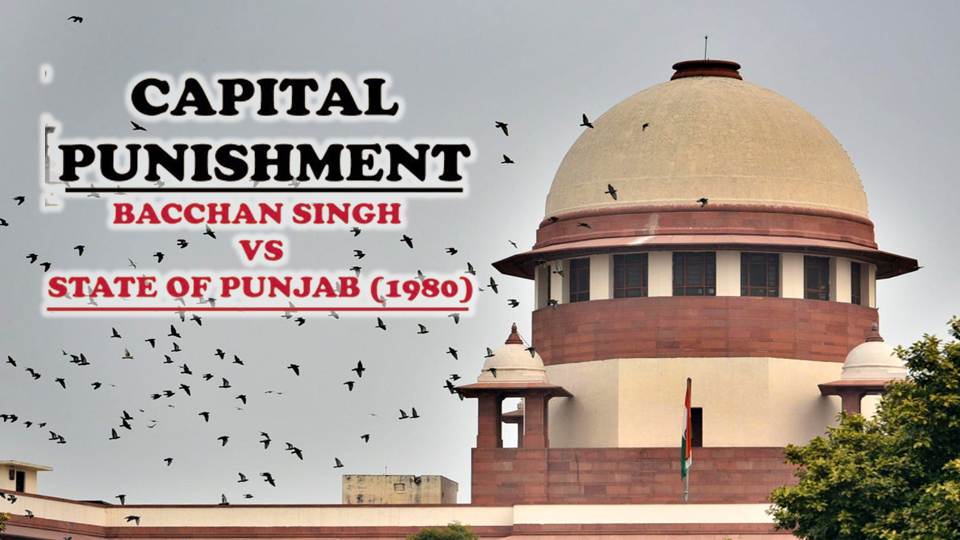
1980, Bachan Singh vs State Of Punjab: When Judiciary clearly defined ‘Rarest of the Rare’ case

Shivam Jaiswal by Shivam Jaiswal
21 November 2022
in Law
Bachan Singh vs State Of Punjab
Share on FacebookShare on X

Bachan Singh vs State Of Punjab case: Democracies are primarily centred on the five core values of right to life, liberty, economic freedom, and the pursuit of happiness. At the heart of this philosophy lies the cornerstone principle of the Gandhian ideology: “Hate the sin, not the sinner.” Consequently, the Supreme Court of India came up with the “doctrine of the rarest of the rare” in awarding capital punishment.

Doctrine of Rarest of Rare

The debate on capital punishment is not new to democracies around the globe. The Indian judiciary is of the view that punishment should be pursuant to deterrent, retributive, preventive, expiatory, compensatory, incapacitation, and utilitarian theories. Preference for one theory over the other is believed to be an unpleasant policy for awarding punishment. In consonance with this philosophy, the Supreme Court established the “Doctrine of the Rarest of the Rare” in the historic case of Bachan Singh and others vs State of Punjab and others.

RelatedPosts

SC Reinforces Bodily Autonomy in Teen Rape Survivor Case, Questions State Control Over Abortion Rights

Justice Hans Raj Khanna: A judge who stood firm in the face of adversity

It is really unfair to criticize Judges for post-retirement jobs. Here is why

Load More

Facts: Bachan Singh and others vs. the State of Punjab and others

The landmark judgement in Bachan Singh was pronounced by the Constitution Bench composed of Chief Justice Y.V. Chandrachud, Justice N.L. Untwalia, Justice P.N. Bhagwati, Justice R.S. Sarkaria, and Justice A.C. Gupta with a 4:1 split. The said criminal appeal before the Supreme Court arose out of the conviction of one Bachan Singh for the horrific murders of Desa Singh, Durga Bai, and Veeran Bai under Section 302 of the Indian Penal Code.

Issue in the Bachan Singh vs State Of Punjab Case

The prominent issue for the purpose of determination before the Bench was with respect to the constitutional validity of the death penalty under Section 302 of the Indian Penal Code read with Section 354 Subsection (3) of the Code of Criminal Procedure, 1973, as opposed to Article 14, Article 21 of the Constitution of India, and Article 6(1) of the International Covenant on Civil and Political Rights, adopted as the Stockholm Declaration.

Majority view pronounced by Justice Sarkaria 

Adhering to the principle of natural justice, Hon’ble Justice Sarkaria proposed the “Doctrine of the Rarest of Rare Cases.” The Hon’able Justice held that whenever a person commits a murder in a gruesome, ridiculous, and heinous way that shakes the conscience of society, there is a strong possibility that the Bachan Singh vs State Of Punjab case would fall under the category of the rarest of the rare.

The apex court later laid down some of the instances where this doctrine can be applied. Firstly, when the accused puts the victim on fire; secondly, for gruesome and inhumane murder; and lastly, for mutilation of the victim’s body into pieces.

Not violative of Article 14

Justice Sarkaria took the view that every crime may superficially appear to be the same, but the facts and circumstances of a crime are widely different, making a distinction between murder and gruesome murder. Thus, the provision in Section 302 of the Penal Code as not violative of Article 14 of the Constitution on the ground that it confers on the judges an unguided and uncontrolled discretion in the matter of awarding capital punishment, citing Maneka Gandhi and Minerva Mills’ case.

Not Violative of Article 21

Justice Sarkaria observed that Clauses (1) and (2) of Article 6 of the International Covenant on Civil and Political Rights do not abolish or prohibit the imposition of the death penalty in all circumstances. All that they require is that, firstly, the death penalty shall not be arbitrarily inflicted, and secondly, it shall be imposed only for the most serious crimes in accordance with a law that shall not be ex post facto legislation. Thus, the requirements of these clauses are substantially the same as the guarantees or prohibitions contained in Articles 20 and 21 of our Constitution, citing Maneka Gandhi and Minerva Mills.

35th Report of the Law Commission

Justice Sarkaria took into consideration the 35th Report of the Law Commission, 1967, and the judgement made in the case of Jagmohan Singh, and recognised that the death penalty serves as a deterrent. However, it did go into the scientific findings for the purpose of this case.

Retributive Theory of Punishment

Justice Sarkaria was of the view that retributive measures are mandatory to ensure proper deterrence against heinous crimes that involve the barbaric intent of the accused. That is to say, neither the new interpretative dimensions given to Articles 19 and 21 by the Supreme Court in Maneka Gandhi and Charles Sobraj v. The Superintendent, Central Jail, Tihar, New Delhi, nor the acceptance by India of the International Covenant on Civil and Political Rights make any change in the prevailing standards of decency and human dignity. The International Covenant does not outlaw capital punishment for murder altogether.

Dissenting view of Justice P.N Bhagwati

The majority judgement received sharp criticism from Justice P.N. Bhagwati, who proposed that “reformation and rehabilitation” should be the principle and that the court must adhere to the principle of proportionality.

He highlighted that “murder most foul” cannot be distinguished from simple murder. He further pointed out the inability of the legislature to provide those exceptional instances in which death sentences may be regarded as proportionate.

Also Read: Shraddha Case: The legality of dating apps in India

Reformative Theory of Punishment

More so, he proposed that the judiciary refrain from a “tit for tat” method by adopting a “Retributive/Vengeance Theory of Punishment” and rather proceed with a softer approach following the “Reformative Theory of Punishment.”

Justice P.N. Bhagwati failed to appreciate how it should make any difference to the penalty whether the murder is a simple murder or a brutal one. Highlighting the fact, that merely because a murder is heinous, it cannot be said that the death penalty is proportionate to the offence.

Environment of Deterrence

On the issue of capital punishment being awarded to create an environment of deterrence, Justice P.N. Bhagwati cited the provision of the death penalty as an alternative punishment for murder as being unreasonable and not in the public interest as it sub-serves a penological goal.

Sentinel of the Constitution

Further, castigating the majority view that there are sociologists, legislators, judges, and jurists who firmly believe in the worth and necessity of capital punishment, Justice Bhagwati held that the “qui vive” to guard the fundamental rights guaranteed by the Constitution is vested on the judges, and they cannot shy away from their responsibilities by relying on public opinions.

Imposition of death penalty arbitrary and capricious

Further, Justice Bhagwati held that there is no uniform pattern of judicial behaviour in the imposition of the death penalty, and the judicial practise does not disclose any coherent guidelines for the award of capital punishment.

The judges have been awarding or refusing to award the death penalty according to their own scale of values and social philosophy, and it is not possible to discern any consistent approach to the problem in the judicial decisions, rendering the “special reasons” as arbitrary.

He stated unequivocally that there can be no equal protection without equal principles in the exercise of discretion and any form of arbitrariness, whether it is executive irrationality or judicial adhocism as radical prejudice against the Constitution.

Violation of Article 14 and Article 21

Moving ahead, Justice Bhagwati held the view that if judicial discretion is not guided by any standards or norms, it will degenerate into judicial caprice. He expressed his apprehension that an unregulated and unprincipled sentencing discretion in a highly sensitive area involving a question of life and death would clearly be arbitrary and hence violative of the equal protection clause contained in Article 14 and would also mitigate against Article 21 as interpreted in Maneka Gandhi’s case.

Also Read: 1997: Vishakha and others Vs. State of Rajasthan – The iconic case that led to the Prevention of Sexual Harassment Act 

Non-compliance with International Standards

Justice Bhagwati took a rigid stance, saying that the judgement is regressive in its approach and has failed to take into consideration the international standards, citing Gregg v. Goergia of the US Supreme Court and Rex v. Miller of the Canadian Supreme Court.

To conclude the dissenting order dated May 9, 1980, which declared the death penalty provided under Section 302 of the Indian Penal Code read with Section 354 sub-section (3) of the Code of Criminal Procedure, 1973, as unconstitutional and violative of Articles 14 and 21

But, with a 4:1 split verdict, the majority view against the order of Justice Bhagwati upheld the validity of these sections and called them good law.

Support TFI:

Support us to strengthen the ‘Right’ ideology of cultural nationalism by purchasing the best quality garments from TFI-STORE.COM

Also Watch:

https://www.youtube.com/watch?v=76muz7j6cKQ

Tags: Article 14Article 21Justice P.N. BhagwatiJustice SarkariaLaw CommissionManeka Gandhi CaseMinerva Mills' CaseReformative Theory of Punishment
ShareTweetSend
Previous Post

Who is the first education minister of India and short biography?

Next Post

Who is the father of cricket? Biography and Career

Related Posts

‘Chop a Limb and People Will Obey Law’: Karnataka HC Calls for Stronger Deterrence While Denying Bail in Rape Case
Crime

‘Chop a Limb and People Will Obey Law’: Karnataka HC Calls for Stronger Deterrence While Denying Bail in Rape Case

2 June 2026

The Karnataka High Court has refused to grant bail to a 23-year-old engineering student accused of rape, making unusually...

Supreme Court Verdict Crushes Opposition’s SIR Narrative, Reasserts Election Commission’s Constitutional Authority
Law

Judicial Expansion at the Apex: Centre Clears Appointment of Five Judges to Supreme Court, Strength Nearing Full Capacity

1 June 2026

The Supreme Court of India is set to function with near-full strength after the Central Government cleared the appointment...

Nashik TCS BPO Case: SIT Files Eight Chargesheets, Tightens Legal Grip in Workplace Misconduct Probe
Crime

Nashik TCS BPO Case: SIT Files Eight Chargesheets, Tightens Legal Grip in Workplace Misconduct Probe

29 May 2026

The Nashik city police have escalated their investigation in the TCS-linked BPO case by filing eight chargesheets in eight...

Load More

Leave a Reply Cancel reply

Your email address will not be published. Required fields are marked *

I agree to the Terms of use and Privacy Policy.
This site is protected by reCAPTCHA and the Google Privacy Policy and Terms of Service apply.

Currently Playing

From Runways to Warships: India’s Firefighting Warrior Built for Bases & Battles| IAF | VayuShakti

From Runways to Warships: India’s Firefighting Warrior Built for Bases & Battles| IAF | VayuShakti

00:05:40

Ethanol, EVs and Solar- How India’s Energy Game Is Changing | Modi on LPG & Crude Oil | war| Hormuz

00:05:21

Truth of IRIS Dena: 8 Days That Changed Narrative | War zone Reality, Not an Indian Navy Exercise

00:08:02

300 Million Euros for SCALP: Strategic Necessity or Costly Dependency on France300

00:04:06

Tejas Mk1A: 19th aircraft coupled but Not Delivered: What Is Holding Back the IAF Induction?

00:07:21
Facebook Twitter Instagram Youtube
tfipostTfipost.com
Right Wing | News Analysis | Indian Opinion
  • About us
  • Contact Us
  • Careers
  • Brand Partnerships
  • Terms of use
  • Privacy Policy
  • Sitemap

©2026 TFI Media Private Limited

No Result
View All Result
  • Premium
  • Politics
    • Analysis
    • Opinions
    • Trending
  • Economy
    • Business
    • Finance
  • Defense
    • Defence
    • Strategy
    • Weaponry
  • Geopolitics
    • Africa
    • Americas
    • Asia Pacific
    • Europe
    • South Asia
    • West Asia
  • Knowledge
    • Culture
    • History
    • Indology
  • Law
  • Lounge
    • Books
    • Cinema
    • Food
    • Health
    • Sports
    • technology
    • Travel
    • Satire
TFIPOST हिन्दी
TFIPOST Global

©2026 TFI Media Private Limited