











TFIPOST हिन्दी
TFIPOST Global
Tfipost.com
Tfipost.com
No Result
View All Result
  • Premium
  • Politics
    • All
    • Analysis
    • Opinions
    • Trending
    Delhi government

    Delhi Government Launches Rainwater Harvesting Initiative in Schools to Boost Water Conservation

    Yogi Adityanath

    Yogi Adityanath thrashes Samajwadi Party Over Temple Donations, Ayodhya and Waqf Issues

    Amaira Meena

    Amaira Meena Case: CCTV Footage Renews Debate on School Bullying and Child Safety

    Narottam Mishra

    Chaos in Datia as supporters of Narottam Mishra Clash with Police Over BJP Ticket Denial

    • Analysis
    • Opinions
    • Trending
  • Economy
    • All
    • Business
    • Economy1
    • Finance
    ULIP Fund Switching Explained: When, Why, and How to Boost Returns

    ULIP Fund Switching Explained: When, Why, and How to Boost Returns

    A Detailed Look at What Determines Silver Prices, Purity Grades, and City-Based Rate Differences Across India

    A Detailed Look at What Determines Silver Prices, Purity Grades, and City-Based Rate Differences Across India

    10 Things You Can Do on the Boubyan App That Most People Don’t Know About

    10 Things You Can Do on the Boubyan App That Most People Don’t Know About

    Benefits of using a mortgage loan EMI calculator for long-term budget planning

    Benefits of using a mortgage loan EMI calculator for long-term budget planning

    • Business
    • Finance
  • Defense
    • All
    • Defence
    • Strategy
    • Weaponry
    From Shipbuilder to Maritime Capability Partner: Navy Outlines Bigger Vision for Defence PSU HSL With Dy Chief of Navy’s visit

    From Shipbuilder to Maritime Capability Partner: Navy Outlines Bigger Vision for Defence PSU HSL With Dy Chief of Navy’s visit

    General Dhiraj Seth’s ‘VIJAY’ Doctrine Signals India’s Next Military Transformation

    General Dhiraj Seth’s ‘VIJAY’ Doctrine Signals India’s Next Military Transformation

    Why the Army is quietly rewriting India’s warfighting doctrine with its first Integrated Battle Groups

    Why the Army is quietly rewriting India’s warfighting doctrine with its first Integrated Battle Groups

    India Officially Names Six Operation Sindoor Martyrs as Their Sacrifice Enters National War Memorial Record

    India Officially Names Six Operation Sindoor Martyrs as Their Sacrifice Enters National War Memorial Record

    • Defence
    • Strategy
    • Weaponry
  • Geopolitics
    • All
    • Africa
    • Americas
    • Asia Pacific
    • Europe
    • South Asia
    • West Asia
    Modi-Takaichi Summit Signals India-Japan’s Strategic Pivot Towards a Stronger Indo-Pacific Alliance

    Modi-Takaichi Summit Signals India-Japan’s Strategic Pivot Towards a Stronger Indo-Pacific Alliance

    PoK Leadership Explodes at Islamabad as Khawaja Asif’s Kashmir Remark Sparks Rare Public Break and Identity Showdown

    PoK Leadership Explodes at Islamabad as Khawaja Asif’s Kashmir Remark Sparks Rare Public Break and Identity Showdown

    Canada’s Khalistan Blowback: After 41 Years, Ottawa Finally Admits Canada-Based Khalistani Extremists Blew Up Air India’s Kanishka

    Canada’s Khalistan Blowback: After 41 Years, Ottawa Finally Admits Canada-Based Khalistani Extremists Blew Up Air India’s Kanishka

    From Cells To Networks: NIA Maps Affiliate Terror Structure In JMB–IMK Case, Chargesheets 11 Linked To Northeast Bengal Module

    From Cells To Networks: NIA Maps Affiliate Terror Structure In JMB–IMK Case, Chargesheets 11 Linked To Northeast Bengal Module

    • Africa
    • Americas
    • Asia Pacific
    • Europe
    • South Asia
    • West Asia
  • Knowledge
    • All
    • Culture
    • Education
    • History
    • Indology
    ‘Not Refugees, But Warriors’: Mohan Bhagwat Seeks to Redefine the Legacy of Partition Migrants

    ‘Not Refugees, But Warriors’: Mohan Bhagwat Seeks to Redefine the Legacy of Partition Migrants

    Why Chennai Is Standing Out in the Growing Map of Franchise Opportunities in India

    Why Chennai Is Standing Out in the Growing Map of Franchise Opportunities in India

    Samvidhan Hatya Diwas: The Emergency That Put India’s Democracy Under Suspension and Still Divides Memory

    Samvidhan Hatya Diwas: The Emergency That Put India’s Democracy Under Suspension and Still Divides Memory

    7 Common GMAT Mistakes That Can Hurt Your ISB MBA Application

    7 Common GMAT Mistakes That Can Hurt Your ISB MBA Application

    • Culture
    • History
    • Indology
  • Law
  • Lounge
    • All
    • Books
    • Cinema
    • Entertainment
    • Food
    • Games
    • Health
    • Lifestyle
    • Satire
    • Sports
    • technology
    • Travel
    IT Asset Management Software Features That Actually Reduce Risk (Not Just Look Good on a Datasheet)

    IT Asset Management Software Features That Actually Reduce Risk (Not Just Look Good on a Datasheet)

    What Is a Parse Error?

    What Is a Parse Error?

    How Emerging US Tech Hubs Are Creating New Real Estate Hotspots

    How Emerging US Tech Hubs Are Creating New Real Estate Hotspots

    The Art of Choosing the Right Cake for Every Occasion

    The Art of Choosing the Right Cake for Every Occasion

    • Books
    • Cinema
    • Food
    • Health
    • Sports
    • technology
    • Travel
    • Satire
Tfipost.com
  • Premium
  • Politics
    • All
    • Analysis
    • Opinions
    • Trending
    Delhi government

    Delhi Government Launches Rainwater Harvesting Initiative in Schools to Boost Water Conservation

    Yogi Adityanath

    Yogi Adityanath thrashes Samajwadi Party Over Temple Donations, Ayodhya and Waqf Issues

    Amaira Meena

    Amaira Meena Case: CCTV Footage Renews Debate on School Bullying and Child Safety

    Narottam Mishra

    Chaos in Datia as supporters of Narottam Mishra Clash with Police Over BJP Ticket Denial

    • Analysis
    • Opinions
    • Trending
  • Economy
    • All
    • Business
    • Economy1
    • Finance
    ULIP Fund Switching Explained: When, Why, and How to Boost Returns

    ULIP Fund Switching Explained: When, Why, and How to Boost Returns

    A Detailed Look at What Determines Silver Prices, Purity Grades, and City-Based Rate Differences Across India

    A Detailed Look at What Determines Silver Prices, Purity Grades, and City-Based Rate Differences Across India

    10 Things You Can Do on the Boubyan App That Most People Don’t Know About

    10 Things You Can Do on the Boubyan App That Most People Don’t Know About

    Benefits of using a mortgage loan EMI calculator for long-term budget planning

    Benefits of using a mortgage loan EMI calculator for long-term budget planning

    • Business
    • Finance
  • Defense
    • All
    • Defence
    • Strategy
    • Weaponry
    From Shipbuilder to Maritime Capability Partner: Navy Outlines Bigger Vision for Defence PSU HSL With Dy Chief of Navy’s visit

    From Shipbuilder to Maritime Capability Partner: Navy Outlines Bigger Vision for Defence PSU HSL With Dy Chief of Navy’s visit

    General Dhiraj Seth’s ‘VIJAY’ Doctrine Signals India’s Next Military Transformation

    General Dhiraj Seth’s ‘VIJAY’ Doctrine Signals India’s Next Military Transformation

    Why the Army is quietly rewriting India’s warfighting doctrine with its first Integrated Battle Groups

    Why the Army is quietly rewriting India’s warfighting doctrine with its first Integrated Battle Groups

    India Officially Names Six Operation Sindoor Martyrs as Their Sacrifice Enters National War Memorial Record

    India Officially Names Six Operation Sindoor Martyrs as Their Sacrifice Enters National War Memorial Record

    • Defence
    • Strategy
    • Weaponry
  • Geopolitics
    • All
    • Africa
    • Americas
    • Asia Pacific
    • Europe
    • South Asia
    • West Asia
    Modi-Takaichi Summit Signals India-Japan’s Strategic Pivot Towards a Stronger Indo-Pacific Alliance

    Modi-Takaichi Summit Signals India-Japan’s Strategic Pivot Towards a Stronger Indo-Pacific Alliance

    PoK Leadership Explodes at Islamabad as Khawaja Asif’s Kashmir Remark Sparks Rare Public Break and Identity Showdown

    PoK Leadership Explodes at Islamabad as Khawaja Asif’s Kashmir Remark Sparks Rare Public Break and Identity Showdown

    Canada’s Khalistan Blowback: After 41 Years, Ottawa Finally Admits Canada-Based Khalistani Extremists Blew Up Air India’s Kanishka

    Canada’s Khalistan Blowback: After 41 Years, Ottawa Finally Admits Canada-Based Khalistani Extremists Blew Up Air India’s Kanishka

    From Cells To Networks: NIA Maps Affiliate Terror Structure In JMB–IMK Case, Chargesheets 11 Linked To Northeast Bengal Module

    From Cells To Networks: NIA Maps Affiliate Terror Structure In JMB–IMK Case, Chargesheets 11 Linked To Northeast Bengal Module

    • Africa
    • Americas
    • Asia Pacific
    • Europe
    • South Asia
    • West Asia
  • Knowledge
    • All
    • Culture
    • Education
    • History
    • Indology
    ‘Not Refugees, But Warriors’: Mohan Bhagwat Seeks to Redefine the Legacy of Partition Migrants

    ‘Not Refugees, But Warriors’: Mohan Bhagwat Seeks to Redefine the Legacy of Partition Migrants

    Why Chennai Is Standing Out in the Growing Map of Franchise Opportunities in India

    Why Chennai Is Standing Out in the Growing Map of Franchise Opportunities in India

    Samvidhan Hatya Diwas: The Emergency That Put India’s Democracy Under Suspension and Still Divides Memory

    Samvidhan Hatya Diwas: The Emergency That Put India’s Democracy Under Suspension and Still Divides Memory

    7 Common GMAT Mistakes That Can Hurt Your ISB MBA Application

    7 Common GMAT Mistakes That Can Hurt Your ISB MBA Application

    • Culture
    • History
    • Indology
  • Law
  • Lounge
    • All
    • Books
    • Cinema
    • Entertainment
    • Food
    • Games
    • Health
    • Lifestyle
    • Satire
    • Sports
    • technology
    • Travel
    IT Asset Management Software Features That Actually Reduce Risk (Not Just Look Good on a Datasheet)

    IT Asset Management Software Features That Actually Reduce Risk (Not Just Look Good on a Datasheet)

    What Is a Parse Error?

    What Is a Parse Error?

    How Emerging US Tech Hubs Are Creating New Real Estate Hotspots

    How Emerging US Tech Hubs Are Creating New Real Estate Hotspots

    The Art of Choosing the Right Cake for Every Occasion

    The Art of Choosing the Right Cake for Every Occasion

    • Books
    • Cinema
    • Food
    • Health
    • Sports
    • technology
    • Travel
    • Satire
No Result
View All Result
Tfipost.com
Tfipost.com
No Result
View All Result
  • Premium
  • Politics
  • Economy
  • Defense
  • Geopolitics
  • Knowledge
  • Law
  • Lounge

India is the biggest power in South Asia and the credit goes to Sardar Patel for this

Shubham Singh by Shubham Singh
3 November 2018
in Trending
india, sardar patel

PC:themorningchronicle.in

Share on FacebookShare on X

The critics of the Statue of Unity have been vocal since the commencement of the project but as soon as PM Modi unveiled the Statue of Unity, a 182-metre structure built as a tribute to India’s first Deputy Prime Minister, Sardar Vallabhbhai Patel on his birth anniversary, these voices turned into cacophony. Amidst all this, one important factor was forgotten. How Sardar Patel saved India from becoming an Islamic state, balkanized and Pakistani territory deep inside Indian state. There were four major princely states which had posed problems in the unification of India and were clearly inclined to accede to Pakistan. These four princely states were Jodhpur, Junagadh, Hyderabad and Kashmir.

Sardar Vallabhbhai Patel adopted the policy of ‘Saam Daam Dand Bhed’ to integrate more than 500 princely states including the four mentioned into India.

RelatedPosts

India Refuses to Settle for Less as Landmark US Trade Deal Awaits Final Competitive Guarantee

Modi-Takaichi Summit Signals India-Japan’s Strategic Pivot Towards a Stronger Indo-Pacific Alliance

‘Not Refugees, But Warriors’: Mohan Bhagwat Seeks to Redefine the Legacy of Partition Migrants

Load More

Sardar Patel, India’s first Deputy Prime Minister and the Minister of Home Affairs handled effectively the integration of princely states with his astute diplomatic skills and amazing foresightedness. He along with diplomat V.P Menon overcame all the challenges coming in the way of unification of India.

One of the biggest challenges in the process of integration was posed by Jodhpur. The then young, inept and inexperienced King of Jodhpur Maharaja Hanvant Singh was in talks with Pakistan and tried to negotiate in order to get better deals with the Islamic nation since his state was contiguous with the newly created country.

He even had a meeting with the creator of Pakistan- Mohammad Ali Jinnah. It is believed and also written in history books that Jinnah had given Maharaja a signed blank sheet of paper to write all his demands. On the condition to accede to Pakistan, Jinnah gave complete freedom to Maharaja to demand anything from free access to the Karachi port to arms manufacturing to importing to have complete freedom to carry out its business etc. Jinnah promised to fulfill all his demands if Maharaja acceded to Pakistan.

When Patel came to know about it, he immediately met with Hanvant Singh and gave him assurance that his business would run smoothly in Indian union, importing arms would be allowed, Patel also promised to connect Jodhpur to Kathiawar by rail and that India would supply grain to Jodhpur during famines.

Patel also pointed out that accession of a pre-dominantly Hindu state into Muslim dominated Pakistan goes against the basic tenet of the two-nation theory and would result in communal violence in the state. At last, Patel successfully convinced Maharaja to accede to India and Jinnah’s blank check offer was rejected forever.

The next big problem which emerged was from Junagadh, Gujarat. This princely state was a border state with a Muslim ruler and had over 80 per cent Hindu population. The Muslim ruler of the state Mahabat Khan decided to merge his state with Pakistan on September 15, 1947. When people came to know about their ruler’s decision they revolted against him which forced the Nawab to flee to Karachi with his family and formed a provisional government there. Sardar Patel also supported Hindu chiefs of Junagadh with a small army who were in favor of joining India. Samaldas Gandhi led the provisonal government of Junagadh. This government played a key role in organizing people against the pro-Pakistan nawab.

Sardar Patel ordered Pakistan to reverse its acceptance of the accession and to conduct a plebiscite. When Pakistan refused to comply with Patel’s order, he sent the Indian Army to annex Junagadh on November 1, 1947. A plebiscite was also conducted in December in the same year in which 99 per cent population of the state favored India.

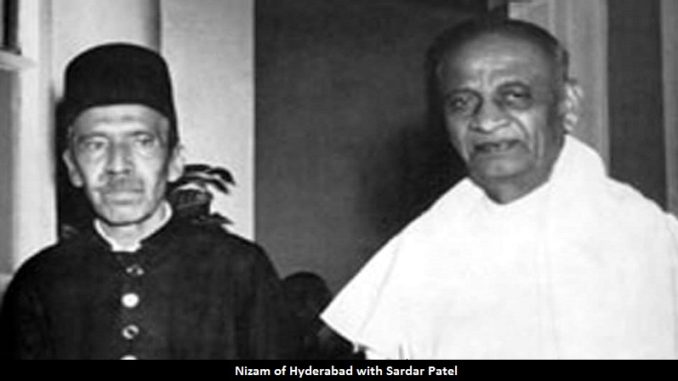
Then comes Hyderabad. It was the largest and richest of all the princely states. The ruler of the state-Nizam– was one of the richest person of the world. He had been in good books with the Viceroy and British Government. After independence, he openly declared his support for Pakistan. He also tried his level best to convince Indian Union to declare Hyderabad as sovereign state but his attempts suffered abject failure. The Nizam of Hyderabad employed each and every means to remain independent. The terror unleashed by Nizam’s backed militia called the Razakars was a time of suffering for Hindus. Bloodthirsty Razakars carried out the systematic pogrom. They perpetuated killings, lootings and rape against the Hindu populace. Patal acted again.  Carnage stopped only after the Indian Army launched Operation Polo and Nizam was forced to surrender at 5 pm on 17th September. Nizam merged his Kingdom with Indian Union 13 months after India won Independence.

It was the Sardar Patel who was harsh against Nizam otherwise Nehru tried to go soft on the Hyderabad action, apparently to appease Muslims. According to the book titled ‘Inside Story of Sardar Patel: The Diary of Maniben Patel (Vision books)’, Patel bluntly told Rajaji, “that he would not want the future generations to blame and curse him for allowing an ulcer in the heart of India. On one side is western Pakistan and on the other side eastern Pakistan (with their idea of (a) pan-Islamic bloc…(they want to) come to Delhi and establish the Mughal empire again. Once we enter Hyderabad, it is no longer an international affair. It is the state ministry’s function. How long are you and Panditji going to bypass the ministry of the states and carry on?” (September 13, 1948).”

“We want the entire territory… and battle for the whole of Kashmir.”- Sardar Vallabhbhai Patel, July 23, 1949. He said these words when some Nehru loyalists were discussing the possibility of the partition of Kashmir, which involved India keeping Jammu and giving rest of the state to Pakistan.

As far as Kashmir is concerned, it was a Muslim majority state with Hindu King- Maharaja Hari Singh. The ruler of the state was not willing to join either of the two countries. Instead, he was interested to remain independent. Maharaja Hari Singh’s state has high Geo-strategic importance. It shared boundaries with Afghanistan, China and also with some central asian countries. The state was also rich in minerals and natural resources, another reason for Pakistan’s interest in Kashmir.

Patel was well aware of Pakistan’s intention as far as Kashmir was concerned. He took series of steps to ensure that the state of Kashmir remained with India. Sardar Patel diverted planes to Delhi-Srinagar route, and telephone and telegraph lines were laid between Pathankot, Amritsar and Jammu as well to gain strategic leverage. He initiated many steps to ensure that the Indian Army gets strategic advantage.

In its pursuit to snatch Kashmir, Pakistan planned an invasion. It launched a tribal invasion against Kashmir. On October 22, 1947, over 5,000 Pakistani lashkars (armed tribesmen) Army, supported by the Pakistan Army invaded Kashmir. They crossed all the known limits of humanity. They ransacked, raped, killed and ruined lives of the Kashmiri populace. Seeing Kashmir slipping away from hands, two days later,  Maharaja Hari Singh offered to join India in return of immediate military assistance to save his state from marauders. On 26 October, Menon flew to Jammu and got the Instrument of Accession signed by Maharaja Hari Singh and thus Jammu and Kashmir became part of Indian union. As soon as the Maharaja signed the Instrument of Accession, India’s Defense Committee (comprising Nehru, Patel and defense minister, Baldev Singh) ordered Indian troops to protect the valley from Pakistan sponsored marauders by forcing them out.

Patel realized that this will go on for long time, so he ordered the construction of motorable road between Jammu and Pathankot to provide assistance to the Indian Army.

However, even after accession to India, the Kashmir problem remain unresolved. Many people give Nehru the credit for taking the Kashmir issue to the UN. According to the same diary quoted above, “Sardar Patel was very unhappy that Nehru had taken the Kashmir issue to the UN which tied India’s hands. His idea was that India should extricate itself from the UN patiently and then solve the Kashmir problem forever. He was also unhappy when reports came that the fertile land left behind in Jammu by Muslim zamindars who had migrated to Pakistan was not being given to Hindu refugees. Instead, the Sheikh was insisting on settling only Muslim refugees on such land (May 1, 1949)… (there were reports) that the majority of government employees were pro-Pakistan.”  The diary further says, “Bakshi Ghulam Mohammad, on the other hand, was insisting that the Sardar should settle the Kashmir issue as he had done Hyderabad. But Nehru would not allow it. Iyengar reported that the Sheikh wanted to have an independent Kashmir. Upon hearing this, the Sardar said he would ask the Maharaja to return to Jammu as he did not place any trust in Sheikh Abdullah.”

Had it not been for Saradar Patel and Menon, these states with considerable resources and strategic locations would have gone to Pakistan, giving the country the edge. Had that happened, the current position of India and Pakistan would have been reversed with Pakistan being the larger power in South Asia. It is because of the diplomatic success of Sardar Patel’s untiring efforts that today India has an edge over Pakistan and is a much more better country than the terrorist nation called Pakistan. Today India is united and giving competition to developed countries of the world and one of the fastest growing country of the world. It is all because of the efforts made by Sardar Patel to unite India at a time when our nation was vulnerable and divided into small princely states. Tough times require tough actions and Patel was that tough man who could take any tough action required to keep the nation united.

Tags: IndiaPakistanSardar PatelStatue of Unity
Share1742TweetSend
Previous Post

‘Married against my will, I was living a stifled life’ Tej Pratap Yadav bares it all

Next Post

BJP releases list of candidates, denies tickets to under-performers

Related Posts

Amaira Meena
Trending

Amaira Meena Case: CCTV Footage Renews Debate on School Bullying and Child Safety

11 July 2026

The release of CCTV footage related to the death of nine-year-old Amaira Meena at Jaipur's Neerja Modi School has...

Narottam Mishra
Politics

Chaos in Datia as supporters of Narottam Mishra Clash with Police Over BJP Ticket Denial

11 July 2026

A major political controversy unfolded in Madhya Pradesh’s Datia district after the Bharatiya Janata Party (BJP) denied a bypoll...

From Shipbuilder to Maritime Capability Partner: Navy Outlines Bigger Vision for Defence PSU HSL With Dy Chief of Navy’s visit
Defence

From Shipbuilder to Maritime Capability Partner: Navy Outlines Bigger Vision for Defence PSU HSL With Dy Chief of Navy’s visit

8 July 2026

The Indian Navy has signalled a much larger role for Hindustan Shipyard Limited (HSL), the Defence Ministry's Miniratna public...

Load More

Leave a Reply Cancel reply

Your email address will not be published. Required fields are marked *

I agree to the Terms of use and Privacy Policy.
This site is protected by reCAPTCHA and the Google Privacy Policy and Terms of Service apply.

Currently Playing

What's Really Behind Xinjiang's Global Supply Chains?

What's Really Behind Xinjiang's Global Supply Chains?

00:03:26

IRAN HITS UAE OIL TANKERS

00:03:28

THE CAMPS AFTER URUMQI

00:03:51

BANGKOK PUB FIRE HORROR

00:04:07

Vietnam Speedboat Tragedy: How 15 Indian Tourists Lost Their Lives

00:03:35
Facebook Twitter Instagram Youtube
tfipostTfipost.com
Right Wing | News Analysis | Indian Opinion
  • About us
  • Contact Us
  • Careers
  • Brand Partnerships
  • Terms of use
  • Privacy Policy
  • Sitemap

©2026 TFI Media Private Limited

No Result
View All Result
  • Premium
  • Politics
    • Analysis
    • Opinions
    • Trending
  • Economy
    • Business
    • Finance
  • Defense
    • Defence
    • Strategy
    • Weaponry
  • Geopolitics
    • Africa
    • Americas
    • Asia Pacific
    • Europe
    • South Asia
    • West Asia
  • Knowledge
    • Culture
    • History
    • Indology
  • Law
  • Lounge
    • Books
    • Cinema
    • Food
    • Health
    • Sports
    • technology
    • Travel
    • Satire
TFIPOST हिन्दी
TFIPOST Global

©2026 TFI Media Private Limited