










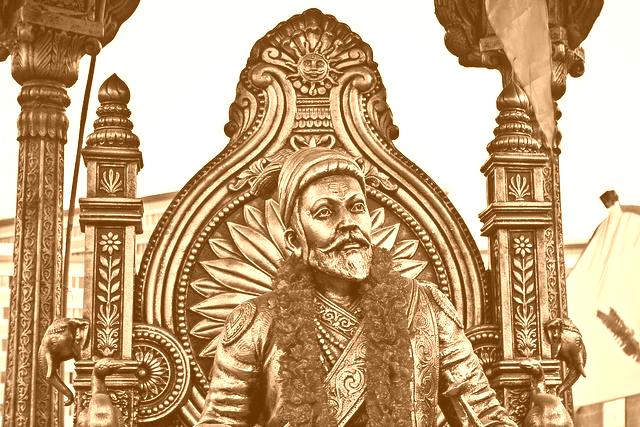
Chhatrapati Shivaji’s greatest test came a decade after his death. It came the moment his illustrious son – Chhatrapati Sambhaji was killed. All problems which had sent powerful Indian kings and their kingdoms to their deaths were now facing the Marathas. They prevailed; Chhatrapati Shivaji prevailed. How and why is important not just from the point of view of history, but in current scenario also.
Speaking of history, the birth of Shivaji was preceded by three important events. These happened in 1298, 1556 and 1565.
In 1298 AD, the Deogiri Yadavs of Maharashtra received a crippling blow at the hands of Allaudin Khilji. They never recovered and by 1316 the dynasty was finished. The manner in which they were defeated in 1298 is appalling to say the least.
Allaudin, out to look for a huge cache of treasure which he knew a rich place like Deogiri possessed, decided to attack it. He found out that a major portion of Deogiri’s army was away in the south, fighting on a campaign led by the prince, and promptly attacked.
The incumbent, Ramdevrao Yadav, found out that an invading army was about to reach Deogiri (near today’s Aurangabad), when it was a mere twelve miles away from his capital! Well, he retreated into the fort after a small fight, and decided to wait out the siege till his son returned from the south. Now came the second horror — his granaries which were supposed to be full of grain were found to be actually full of salt! On top of this, there was a rumour spread by Allaudin Khilji that an army of thirty thousand was on its way from Delhi! The fort itself had only one entrance, which was promptly blockaded. Such was the effect of the rumour, that not even the arrival of the prince could save the kingdom.
To cut a long and sad story short, the reasons for the loss were these –
1.) Total failure in intelligent thinking (good planning versus bad planning). They prepared to defend when invaders were twelve miles away!
2.) A disinformation campaign got the better of their spirits.
3.) Absence to recognize that problems of the north could visit the south — without an invitation.
The second important event happened in 1556 – The Second Battle of Panipat. Hemchandra reached the place after a string of twenty odd victories and looked poised to defeat Akbar and take charge of Delhi. Even the caretaker – Tardi Beg had been turned out. Well, we know what happened next. Hemu, who was sitting atop an elephant and looking at the battlefield like a watchtower, was shot through the eye. The battle finished soon afterwards.
But the reasons in short were as follows:
1.) He did not play to his strength – artillery – which was in the Punjab.
2.) ‘Sole commander’; hence, the entire success or defeat hinged on him. There was no second in command. This was a fatal mistake.
3.) No specified ‘ideal’. All Rajas had joined him under the policy of ‘Jiski Lathi uski Bhains”. As soon as this ‘lathi’ went to Akbar (because Hemu was killed), they joined him.
The third important event was at Talikota in 1565. This town is in today’s Karnataka. Like Hemchandra, Vijayanagar was also very strong at that time. Ram raya was the incumbent. The four Deccan sultanates, realising that this kingdom could become a huge headache, got together and declared Jihad. A familiar story followed, and that was the end of Vijayanagar.
The reasons for their loss:
1.) Again, no thought given to a scenario where Ram Raya died.
2.) Plump posts in administration given to family members, and dynasty politics in full swing everywhere.
3.) No plan of retreating and regrouping at another place; although their domains extended into the deep south.
4.) Bijapur declared a jihad and its two Muslim commanders, guarding the rear, suddenly turned into attackers!
So basically, this was the kind of history which preceded Shivaji. Of these, the last two were more or less living memory when Shivaji was born. It is safe to speculate that at least he heard tales and legends about it. The fall of Deogiri, however, happened a good three hundred years earlier. But, his mother Jijabai, had directly descended from that clan. So there’s a high possibility that the fall of Deogiri was deeply inscribed on him.
Anyway, determining whether Shivaji knew of these events or not, is beside the point. What I want to emphasize about here is that Shivaji faced or knew his people would face similar problems. His genius lay in formulating military policies that would make the Marathas win.
In fact, the death of his successor Chhatrapati Sambhaji, and the fall of Raigad, the capital, brought into focus almost all the problems listed above. But the Marathas prevailed over a much larger Mughal army for over seventeen years after that! It was Shivaji’s vision and planning in the 1660s and 1670s that enabled first Chhatrapati Sambhaji, and then a much weaker Chhatrapati Rajaram to fight the Mughals for a whole generation!
So, what were these radical changes?
1.) Abolishment of the Deshmukhi system and hereditary rights.
2.) The ideal of Swarajya.
3.) Salaried armies with a chain of command.
4.) Science of forts.
5.) Establishment of outposts at Gingee and Vellore.
6.) Establishment of Navy.
7.) A highly professional and committed intelligence department.
Let’s have a look at each of them and their effect on Shivaji’s policies
Abolishment of the Deshmukhi system –
Till the advent of Shivaji, much of the land was cut into little fiefdoms belonging to various families such as Shirkes, Ghorpades, Jedhe, More etcetera. These feudal lords would rule from their forts atop mountains and this had been going on for generations. Eerily, like the wild tribes on the Afghan frontier, these people also had enmity stretching back centuries. Also like the frontier tribes, they were difficult to unite and control. Some of them owed nominal allegiance to various Deccani sultans. Spread over the baramaval (12 maval area- roughly today’s Pune – Satara area) region, they would be the backbone of Swarajya!
Shivaji and his tutor Dadoji Konddeo achieved this by employing a policy of Saam – Daam – Dand – Bhed. Above all, they infused the idea of Swarajya among the people- even the ordinary people; and slowly but surely, the Deshmukhs coalesced under Shivaji’s banner.
More importantly, he got rid of the hereditary rights held by these Deshmukhs or Watandars. In English, the word is called Feudalism. They were masters of their own fiefs and defended their fief onto death. But a Watandar’s vision never went beyond his fief. Shivaji abolished this, and forbade fortifying any hill or village without his permission. The proud Deshmukhs were drawn into the army being built by Shivaji as high ranking officers and given regular pay. Baji Prabhu Deshpande, Deshmukh of the Bandals, is one example.
Ideal of Swarajya –
Shivaji, in a departure from the past, put an ideal — “SWARAJYA” above everything else. He wanted to put an end to the system of a kingdom surviving solely on basis of the individual prowess of the king. He never claimed “Shivaji’s swarajya” — “he swarajyawhave hi shreenchiiccha” meaning ‘creating swarajya is God’s will’. He mentions the words “Hindavi Swarajya” in a letter to Dadaji Naras Prabhu. Hence, the whole aim of the people, the soldiers and the society was the preservation of “Swarajya”, not merely preserving Shivaji.
One more thing, he noticed the inherent flaws in the mansabdari system and did away with it. This is the mark of true genius – recognizing flaws before they show themselves. Reacting to something is nothing great.
But Shivaji recognized that the mansabdari system, while it had built an empire, was flawed. It hinged on the promise of a strong centre. Moreover, it survived by playing off the various mansabdars against each other. It was complete dog eat dog from the mansabdar of 100 swar to mansabdar of 5000 swar. There was no higher ideal to fight for. Little wonder then, that it fell apart at the first instance of trouble.
The real test came in 1689, when Sambhaji was killed. There was no strong leader to lead them now, with Rajaram’s escape to Gingee being thought of as the best option. The leadership in the hills – already fighting the Mughals for a decade under Sambhaji – now passed into the hands of lesser known mortals such as Ramchandrapant Amatya, Santaji Ghorpade and Dhanaji Jadhav. Without a king on the battlefield (he was in Gingee in today’s Tamil Nadu, withstanding a siege by Zulfiqar Khan) and finances a fraction that of the Mughals, the Marathas prevailed. The rayat or people took up arms to guard Swarajya, a far cry from the days when farmers would till their land while armies fought in the distance. Shivaji’s policies had ensured that people fought and died for a higher ideal. In today’s day and age of national anthems and committed armies, this seems usual, but in Shivaji’s time it was not the case.
Salaried armies with a chain of command –
Perhaps the best and most far reaching reform was to create standing armies. These were paid regular salaries. A rank wise order was created, with each rank being paid according to its stature. The ranks were, to give a rough idea of the cavalry as an example:
In Shivaji’s cavalry, the topmost rank was of Sarnobat. The first one to hold the position was Tukoji, followed by Mankoji Dahatonde, Kudtoji Gujar and others following them. Most importantly, it was non-hereditary. Sarnobat reported directly to Chhatrapati Shivaji.
• The paanchhazaris reported to the Sarnobat.
• Five officers each commanding a thousand men (Hazari) were under one Paanchhazari.
• Ten Jumledars were under a Hazari.
• Five Havaldars were under one Jumledar.
• Each Havaldar had twenty five horsemen under him.
The most interesting thing here is the pay scale, which is almost exactly like today’s salaried army. In the cavalry, the pay was something like this:
Havaldar – 125 hon / year
Jumledar – 500 hon / year
Hazari – 1000 hon / year
Panch Hazari – 2000 hon / year
A hon was equal to approximately five rupees.
But how much was this pay worth? A hundred years later, a dakshina of nine rupees given at Parvati hill to attending Brahmins was sufficient for a person’s worldly needs for a month! Thus we can see that Shivaji had ensured the best pay for his soldiers, crucial in creating a strong army. Also, as a rule, civilian officers of equivalent rank were paid less.
Science of forts –
Shivaji recognized that power in Maharashtra meant control of the forts. Ali Adil Shah also recognized this, which is why, while he had given the jagir of Pune to Shahaji, he had kept the forts to himself! Shivaji slowly but surely got the forts under his command – some by sleight, some by waging war. The capture of forts can take up a whole book, but I will write the salient features which made them impregnable –
1.) Unlike the Rajput forts of the north, with their exposed entrances, Shivaji devised the “gaumukh” arrangement. This way, it was impossible to know where the fort entrance was!
2.) The forts were built/ renovated to guard all important passes and roads.
3.) No one person was given absolute charge of a fort. Thus, this eliminated the risk of defections and other nonsense. Each fort had a Havaldar and civilian positions of Sabnis and Karkhanis. A Tatsarnobat was also present. The work, especially related to accounts was such that none was in absolute charge.
4.) Unique techniques such as double walls (eg. Rajgad), use of dense forests (Vasota) were used to make the forts impregnable. Shivaji understood his forts inside out and devised defenses accordingly. The use of Pratapgad against Afzal Khan is an excellent example.
5.) As early as 1671, Shivaji had set aside reserve funds to be used when the inevitable clash with the Mughals happened. This was a 1,25,000 hon reserve for the men on forts and a further 1,75,000 hon for repairs and renovation which would have to be undertaken in war time with little or no option to raise money from elsewhere. Contrast this visionary thinking with the grain and salt story of 1298.
6.) Shivaji ensured forts had multiple entry and exit points. Thus a situation like Deogiri, where Khilji’s blockading of a single door sealed the king’s fate was avoided. Chhatrapati Rajaram was thus able to escape through the Wagh Darwaja on Raigad while the front was being blocked by the Mughals.
7.) Forts in Pairs: While Shivaji ensured that escalading a fort would be difficult, he also gave a fort which could support / provide refuge as the case may be. Thus, we have Rajgad –Torna; Purandar – Vajragad etcetera.
8.) Like the infantry and cavalry, the forts also had proper garrisons, and well-stocked stores. Many forts grew their own food, making them totally independent of being supplied from outside for basic provisions. For example, the fort of Raigad had a well-developed bazaar peth, making it both a fort and a centre of commerce!
9.) Water Tanks: Most forts have huge water tanks which could supply hundreds. Many tanks precede Shivaji, but many were dug by him too. Even today, they are the only source of potable water on many, many forts.
10.) Shivaji recognized the importance of the sea and built a chain of coastal forts. More of this when I talk of Maratha navy.
Establishing outposts in south India at Vellore and Gingee –
As can be seen from the four points given above, Shivaji had made his forts and domains in the Sahyadris as strong as possible. But there was still one flaw – it was geographically still a very limited area. There was no place to go to if the fall of the Sahyadris seemed imminent. There was no “strategic depth” so to speak. The frontier and the central strongholds were within shouting ramge of each other. It is in this light that the south India campaign of 1676 / 1677 should be seen. The seeds of the second phase of the Maratha War of Independence (1690 to 1700) were sowed in this campaign. Gingee, in today’s Tamil Nadu provided shelter to Chhatrapati Rajaram (who, in his own words was ruling in the name of his nephew Shahu). Rajaram kept a strong general like Zulfiqar Khan bogged down for eight years, during which time Santaji and Dhanaji laid bare the Mughal victories in the Deccan. Rajaram could return to the Sahyadris in 1698 and pass on the mantle to his wife Tarabai who led the final assault on the Mughals (1700 to 1707). While the Marathas fought valiantly for Swarajya in the absence of a king personally leading them, the survival of Rajaram and Tarabai also proved to be crucial for the Marathas.
Establishment of the Navy –
For a country associated with rich maritime traditions, the lack of a strong navy under many regional and national powers is perplexing. Except perhaps the Cholas, and to a lesser extent the kings on the Malabar coast, there is no medieval Indian power to challenge the seas. The Ahom dynasty of Assam had a first class naval army, but that was an entirely riverine navy – built and operating on the Brahmaputra. The various Muslim kings of India, with perhaps the exceptions of lone wolf rangers like the Siddi of Janjira, also are found to be lacking in this regard. One explanation being that these people from land locked and arid regions of Central Asia cared little for the sea. Which is why, the Portuguese, English, Dutch, French and for a smaller amount of time – the Danes, the Armenians etcetera found the going relatively easy. In the light of this history, the establishment of the Maratha navy was another revolutionary act of Chhatrapati Shivaji. He recognized that the coastline of Maharashtra was very well suited for building numerous docks and ports. Outlying islets were converted into strong forts – example Padmadurg, Suvarnadurg, Sindhudurg. It led to the rise of a seasoned admiral like Kanhoji Angre. The Maratha navy enabled a stout defense of the coast.
A highly professional and committed intelligence department –
We have seen how, especially in the fall of Deogiri and to lesser extent at Panipat II and Talikota, the intelligence or rather the lack of it, played a crucial role. For Shivaji to succeed in his guerilla tactics, complete support of the rayat (people) was important, coupled with a strong battery of spies. The first was achieved by rising above caste differences, not harming the people, new laws for land, prohibiting wanton loot etcetera.
Shivaji’s spies are the most important factor behind some of his biggest victories like Pratapgad, Shaiste Khan, and the escape from Agra etcetera. Bahirji Naik is the most well-known spy. Also, diplomats such as Pant Bokil did jobs of spying and spreading misinformation too (case in point Bokil’s convincing of Afzal Khan that Shivaji was ill prepared and mortally scared of meeting a ‘great’ person like Afzal Khan! It made Afzal Khan complacent and he walked straight into Shivaji’s trap).
The knowledge of the exact layout of Shaiste Khan’s camp at Pune was crucial to Shivaji’s successful nocturnal mission, conducted almost in pitch darkness.
I would in fact say that even Sant Ramdas played the role of a spy – case in point his letter to Shivaji when Afzal Khan had set out from Bijapur. The letter written in Marathi is otherwise innocuous, but the first alphabet of each line, combines to form —” A sardar of Bijapur has begun his march!”
A good spy department is one which remains secret; and so it is with Shivaji. There is very less information available about who would do these dangerous jobs and in which way. We can only infer by applying our logic that at so and so event, the intelligence department played a major role.
All said and done, for a guerilla warfare centric person like Chhatrapati Shivaji, the spies and diplomats were as important as the visible fighting forces. Thus, we can see that Shivaji’s policies were what created the Hindavi Swarajya and enabled it to fight for twenty seven long years with the Mughals.
Through his sound policies, Shivaji ensured that problems which had caused the ruin of his ancestors did not destroy his own kingdom. The ability of Hindavi Swarajya to last beyond Chhatrapati Shivaji and more importantly last beyond a conquest of the Sahyadris itself is a tribute to his genius.
The fact that Chhatrapati Shivaji’s ideas would not be fully imbued by the Indian army till almost two hundred years later, under the British, speaks volumes of his true greatness and vision.