













TFIPOST हिन्दी
TFIPOST Global
Tfipost.com
Tfipost.com
No Result
View All Result
  • Premium
  • Politics
    • All
    • Analysis
    • Opinions
    • Trending
    ‘Should Work Together, Pave Way for Peace’: Says PM Modi in Bilateral Talks with Putin

    ‘Should Work Together, Pave Way for Peace’: Says PM Modi in Bilateral Talks with Putin

    Indira Gandhi’s Alliance with the Communists Redefined Indian History Education

    Indira Gandhi’s Alliance with the Communists Redefined Indian History Education

    “Inspiration for millions”: PM Modi Presents Russian Edition of Bhagvad Gita as Gift to Putin

    “Inspiration for millions”: PM Modi Presents Russian Edition of Bhagvad Gita as Gift to Putin

    ‘Combat ready, Cohesive, Credible Force’: Indian Navy Reiterates Commitment to Motherland

    ‘Combat ready, Cohesive, Credible Force’: Indian Navy Reiterates Commitment to Motherland

    • Analysis
    • Opinions
    • Trending
  • Economy
    • All
    • Business
    • Economy1
    • Finance
    From Paper-Mandates to eNACH Registration: How Digital Mandates Are Changing Cash Flow

    From Paper-Mandates to eNACH Registration: How Digital Mandates Are Changing Cash Flow

    What is the financial management cycle?

    What is the financial management cycle?

    Smart Investment Planning: Calculating Mutual Fund SIP Growth Easily

    Smart Investment Planning: Calculating Mutual Fund SIP Growth Easily

    Convert ETH to USD Using Price Statistics for Better Trading Decisions

    Convert ETH to USD Using Price Statistics for Better Trading Decisions

    • Business
    • Finance
  • Defense
    • All
    • Defence
    • Strategy
    • Weaponry
    Veterans Deserve More Than Promises: The System Must Match the Soldier’s Sacrifice

    Veterans Deserve More Than Promises: The System Must Match the Soldier’s Sacrifice

    How Ukraine Uses Psychological and Information Warfare to ‘Win,’ and What India Can Learn From This Strategy

    How Ukraine ‘Wins’ the Psychological and Informatiaon War Despite Destruction — Lessons India Cannot Afford to Ignore

    Pakistan’s ‘ship-launched ASBM’ claim doesn’t withstand technical or industrial scrutiny

    Pakistan’s ‘ship-launched ASBM’ claim doesn’t withstand technical or industrial scrutinys

    Borders Can Change: Why Rajnath Singh’s Sindh Remark is India’s New Message to Pakistan

    Borders Can Change: Why Rajnath Singh’s Sindh Remark is India’s New Message to Pakistan

    • Defence
    • Strategy
    • Weaponry
  • Geopolitics
    • All
    • Africa
    • Americas
    • Asia Pacific
    • Europe
    • South Asia
    • West Asia
    ‘Should Work Together, Pave Way for Peace’: Says PM Modi in Bilateral Talks with Putin

    ‘Should Work Together, Pave Way for Peace’: Says PM Modi in Bilateral Talks with Putin

    Europe’s Slow Descent Into Weakness

    Europe: A Continent Happily Committing a Long-Drawn Suicide

    End of NATO? US Secretary of State Marco Rubio May Skip Foreign Ministers’ Meet in Brussels for First Time in Two Decades

    End of NATO? US Secretary of State Marco Rubio May Skip Foreign Ministers’ Meet in Brussels for First Time in Two Decades

    ‘Best Fighter In the World’ Dmitry Peskov Pitches For Sukhoi-57 Fighter Jet Ahead of Putin’s Visit to India

    ‘Best Fighter In the World’ Dmitry Peskov Pitches For Sukhoi-57 Fighter Jet Ahead of Putin’s Visit to India

    • Africa
    • Americas
    • Asia Pacific
    • Europe
    • South Asia
    • West Asia
  • Knowledge
    • All
    • Culture
    • Education
    • History
    • Indology
    Despite Nehru’s objection, Rajendra Prasad became India’s first President !

    How Nehru Resisted Dr. Rajendra Prasad—from Presidency to Somnath visit  and Beyond

    Talom Rukbo Initiated the Donyi–Polo Movement: Bringing Tribal Youth Back to Their Roots

    Talom Rukbo: The Forgotten Hero Who Shielded Arunachal’s Tribal Communities from Religious Conversion

    How Guru Tegh Bahadur The Ninth Sikh Guru Became a Martyr for Religious Freedom

    How Guru Tegh Bahadur The Ninth Sikh Guru Became a Martyr for Religious Freedom

    21 November 1962: Looking Back at the Indo-China war and How it Redefined the Border Equation

    21 November 1962: Looking Back at the Indo-China war and How it Redefined the Border Equation

    • Culture
    • History
    • Indology
  • Law
  • Lounge
    • All
    • Books
    • Cinema
    • Entertainment
    • Food
    • Games
    • Health
    • Lifestyle
    • Satire
    • Sports
    • technology
    • Travel
    감정을 가진 로봇의 시대가 오고 있다

    감정을 가진 로봇의 시대가 오고 있다

    Is AISaver Face Swap the Best Tool for Face Swap Video Online Free in 2025?

    Is AISaver Face Swap the Best Tool for Face Swap Video Online Free in 2025?

    Why Fat Analysis Matters in the Food and Feed  Industry?

    Why Fat Analysis Matters in the Food and Feed Industry?

    Heart Surgery Hospital in Delhi: What to Expect During Your Procedure

    Heart Surgery Hospital in Delhi: What to Expect During Your Procedure

    • Books
    • Cinema
    • Food
    • Health
    • Sports
    • technology
    • Travel
    • Satire
Tfipost.com
  • Premium
  • Politics
    • All
    • Analysis
    • Opinions
    • Trending
    ‘Should Work Together, Pave Way for Peace’: Says PM Modi in Bilateral Talks with Putin

    ‘Should Work Together, Pave Way for Peace’: Says PM Modi in Bilateral Talks with Putin

    Indira Gandhi’s Alliance with the Communists Redefined Indian History Education

    Indira Gandhi’s Alliance with the Communists Redefined Indian History Education

    “Inspiration for millions”: PM Modi Presents Russian Edition of Bhagvad Gita as Gift to Putin

    “Inspiration for millions”: PM Modi Presents Russian Edition of Bhagvad Gita as Gift to Putin

    ‘Combat ready, Cohesive, Credible Force’: Indian Navy Reiterates Commitment to Motherland

    ‘Combat ready, Cohesive, Credible Force’: Indian Navy Reiterates Commitment to Motherland

    • Analysis
    • Opinions
    • Trending
  • Economy
    • All
    • Business
    • Economy1
    • Finance
    From Paper-Mandates to eNACH Registration: How Digital Mandates Are Changing Cash Flow

    From Paper-Mandates to eNACH Registration: How Digital Mandates Are Changing Cash Flow

    What is the financial management cycle?

    What is the financial management cycle?

    Smart Investment Planning: Calculating Mutual Fund SIP Growth Easily

    Smart Investment Planning: Calculating Mutual Fund SIP Growth Easily

    Convert ETH to USD Using Price Statistics for Better Trading Decisions

    Convert ETH to USD Using Price Statistics for Better Trading Decisions

    • Business
    • Finance
  • Defense
    • All
    • Defence
    • Strategy
    • Weaponry
    Veterans Deserve More Than Promises: The System Must Match the Soldier’s Sacrifice

    Veterans Deserve More Than Promises: The System Must Match the Soldier’s Sacrifice

    How Ukraine Uses Psychological and Information Warfare to ‘Win,’ and What India Can Learn From This Strategy

    How Ukraine ‘Wins’ the Psychological and Informatiaon War Despite Destruction — Lessons India Cannot Afford to Ignore

    Pakistan’s ‘ship-launched ASBM’ claim doesn’t withstand technical or industrial scrutiny

    Pakistan’s ‘ship-launched ASBM’ claim doesn’t withstand technical or industrial scrutinys

    Borders Can Change: Why Rajnath Singh’s Sindh Remark is India’s New Message to Pakistan

    Borders Can Change: Why Rajnath Singh’s Sindh Remark is India’s New Message to Pakistan

    • Defence
    • Strategy
    • Weaponry
  • Geopolitics
    • All
    • Africa
    • Americas
    • Asia Pacific
    • Europe
    • South Asia
    • West Asia
    ‘Should Work Together, Pave Way for Peace’: Says PM Modi in Bilateral Talks with Putin

    ‘Should Work Together, Pave Way for Peace’: Says PM Modi in Bilateral Talks with Putin

    Europe’s Slow Descent Into Weakness

    Europe: A Continent Happily Committing a Long-Drawn Suicide

    End of NATO? US Secretary of State Marco Rubio May Skip Foreign Ministers’ Meet in Brussels for First Time in Two Decades

    End of NATO? US Secretary of State Marco Rubio May Skip Foreign Ministers’ Meet in Brussels for First Time in Two Decades

    ‘Best Fighter In the World’ Dmitry Peskov Pitches For Sukhoi-57 Fighter Jet Ahead of Putin’s Visit to India

    ‘Best Fighter In the World’ Dmitry Peskov Pitches For Sukhoi-57 Fighter Jet Ahead of Putin’s Visit to India

    • Africa
    • Americas
    • Asia Pacific
    • Europe
    • South Asia
    • West Asia
  • Knowledge
    • All
    • Culture
    • Education
    • History
    • Indology
    Despite Nehru’s objection, Rajendra Prasad became India’s first President !

    How Nehru Resisted Dr. Rajendra Prasad—from Presidency to Somnath visit  and Beyond

    Talom Rukbo Initiated the Donyi–Polo Movement: Bringing Tribal Youth Back to Their Roots

    Talom Rukbo: The Forgotten Hero Who Shielded Arunachal’s Tribal Communities from Religious Conversion

    How Guru Tegh Bahadur The Ninth Sikh Guru Became a Martyr for Religious Freedom

    How Guru Tegh Bahadur The Ninth Sikh Guru Became a Martyr for Religious Freedom

    21 November 1962: Looking Back at the Indo-China war and How it Redefined the Border Equation

    21 November 1962: Looking Back at the Indo-China war and How it Redefined the Border Equation

    • Culture
    • History
    • Indology
  • Law
  • Lounge
    • All
    • Books
    • Cinema
    • Entertainment
    • Food
    • Games
    • Health
    • Lifestyle
    • Satire
    • Sports
    • technology
    • Travel
    감정을 가진 로봇의 시대가 오고 있다

    감정을 가진 로봇의 시대가 오고 있다

    Is AISaver Face Swap the Best Tool for Face Swap Video Online Free in 2025?

    Is AISaver Face Swap the Best Tool for Face Swap Video Online Free in 2025?

    Why Fat Analysis Matters in the Food and Feed  Industry?

    Why Fat Analysis Matters in the Food and Feed Industry?

    Heart Surgery Hospital in Delhi: What to Expect During Your Procedure

    Heart Surgery Hospital in Delhi: What to Expect During Your Procedure

    • Books
    • Cinema
    • Food
    • Health
    • Sports
    • technology
    • Travel
    • Satire
No Result
View All Result
Tfipost.com
Tfipost.com
No Result
View All Result
  • Premium
  • Politics
  • Economy
  • Defense
  • Geopolitics
  • Knowledge
  • Law
  • Lounge

Indian Epics Ramayana and Mahabharata survived the test of time, while most of ancient Indian literature couldn’t

Kannan by Kannan
14 January 2016
in Culture
Indian Epics
Share on FacebookShare on X

It is said that Vedas were the oldest scriptures that belong to the ancient Indians. Though the Vedas were attributed to the God, this compilation of knowledge that consists of rituals, sacrifices and music must have been done by some human. In all probability, these might have been evolved continuously, from generation to generation, till one has decided to write them.

Vedas were passed on to the next generation orally, and not through documentation. But, why oral transfer of knowledge? And what prevented them to write and communicate to others – or to preserve for next generations?

RelatedPosts

“Inspiration for millions”: PM Modi Presents Russian Edition of Bhagvad Gita as Gift to Putin

‘Combat ready, Cohesive, Credible Force’: Indian Navy Reiterates Commitment to Motherland

Jamiat Ulama e Hind and Madani’s pitch for Sharia Laws for Muslims swearing by Secular Constitution

Load More

The first known piece that was written was ‘Ramayana’ by Valmiki. The epic was called Aadi Kavyam and Valmiki was hailed as Aadi Kavi. But, given the vocabulary and grammar Valmiki had used in Ramayana, it is certain that the Devnagari script and Chhandas was already in usage for some hundreds of years. Still, no one had thought of writing something before Valmiki. Or probably, they might have penned the Vedas and Upanishads, but did not consider them as solely the creation of one person, as they were passed on by their forefathers. Even if someone might have written poems and stories and novellas (Kavyas), the size and scope of Ramayana might have surprised them and Valmiki was honoured with the title.

Given the story of Valmiki being a hunter in the forest before taking up writing, even after throwing away the mythical portion, it can be safely concluded that there existed good centres of learning that could teach a hunter the language to such an extent, he ends up writing Ramayana.

Then came Mahabharata, written by the sage Vyasa, who had to his credit had segregated and compiled all Vedas into the four ones that we know them as of now.

Then time has passed and the people, who had created the oldest civilization in the Indian sub-continent have perished.

One surprising thing in this entire episode was, while Vedas were marginalized with the passage of time, Indian Epics have grown manifold and evolved with time. The heroes of Indian epics, who were humans in the original texts have morphed into deities to the later generations.

With time, Vedas and Sanskrit were limited to only a small section of Brahmins. But, Ramayana and Mahabharata cut across the caste lines and became synonymous with the concept of India that encompassed all smaller kingdoms, spreading from the North West corners of Kandahar to the south east island of Sri Lanka. The fact that a Kshatriya Rama killed Ravana, a Brahmin and the Mahabharata with many intercaste marriages and marriages of connivance, have clearly establish the fact that though castes exist even in those days, they were not in the same discriminatory manner they are now.

Why then Indian Epics were written in the first place, when the people could comprehend the puritanical versions of the knowledge – the Vedas and the Upanishads? They could have simply documented Vedas and Upanishads, if they want to preserve the knowledge for future generations. Post Ramayana and Mahabharata, there were innumerous stories such as Bhagavata, Devi Bhagavata and other Puranas thus essentially creating a corpus of Indian mythology. Purpose of these later writings was clear – to establish divinity to the characters of Ramayana, Mahabharata and those mentioned in the Vedas and Upanishads.

From the critic’s point of view, Gods of Vedic times were the basic forms of the nature and the Brahman, the creator who was omnipresent. The people who founded so excellent a culture from nothing must have endured hardships over hundreds of years, if not few thousands. It must have been a great team that could debate, analyze, decipher and define the ways of universe and tries to explain some fundamental of science. The team would need a great commitment from each member so that the final product could be so magnificent. By attributing the work to the God, they eliminated the selfish desire of individuals to get the credit for such work, or to their part. But, it takes more than the name of God to prevent the team members from claiming credit and it could be the hardships they must have experienced in those days that enlightens their souls to such an extent, they attain Nirvana.

But, the cycle of nature was the most powerful. If it could wipe out dinosaurs, what are men before the power of the nature? And, nature means not only the calamities, but changing values in society that are intrinsic to it. With prosperity, comes lethargy and selfishness. Love of ones kids do prevent them from fulfilling the responsibilities, taking unbiased decisions. Then, things change. And when everything is fine, attitude becomes a bit careless and open to new ideas. Often new ideas bring good, when the mind was a free one, but results in the opposite, when the mind was reckless.

No doubt, a society that could create such a knowledge corpus must have been a democratic one, despite there be a King. In democracy, the majority wins, even when it is wrong. Probably the loosing minority must have thought to preserve the knowledge for the sake of future generations, who may be needing it as much as their ancestors did. In all their wisdom they must have envisaged the future generations of an irresponsible society would pay for the deeds of their fathers. That might have caused to document the Vedas and Upanishads. Knowing fear and overcoming it is courage and it needs wisdom to deal with the eternal fear. Taking life for granted is not courage but the absence of it, as it was not tested against the real fear of life.

Even this explanation is not sufficient for the birth of Indian epics. After getting exposed to the civilization, Valmiki might have had an independent assessment of the society and its on-going denigration. Sometimes, only external eyes could see what is not visible for those part of the system. And as always people alien to the culture are bonded to the adapted culture, rather than those, who born into such a system and take it for granted. Even now, this could be seen from the way the west embraces Indian philosophies and how people adapted foreign faiths safeguard their current faith. Understanding the true value of the culture and its doctrines, Valmiki might have thought the need of a text like Ramayana to induce interest in the coming generations to pursue the greater “way of living” (religion was not known at that time). Probably, he realised the primitive needs of a human being, who could be essentially an animal. And at the same time, he must have understood the ego that can ruin even those with higher level of knowledge, but could not control their senses and give in to the physical needs.

And, why he chose to write a story instead of writing a monograph? The answer is self-evident. Lots of monographs are already available in the form of Vedas. However, the answer to this question was provided millennia later, when Panchatantra was written. Panchatantra was a story that was created so that foolish princes of a King could understand the intricacies of the way the world functions. Stories have a factor of creating interest in the minds of readers and are easy to understand, even to those who are otherwise not inclined to read.

Given the geographical evidences, in all probability Valmiki might have selected one story from the history and created the epic with lots of grandeur and opulence. The way Valmiki narrated Ramayana – the story of a normal prince, who took the help of primitive beings and fell the mightiest warrior, who also happen to be the most knowledgeable King. The reason Sundara Kandam was recommended to be read is the same – it describes the Swarna Lanka, the city of Ravana that was beautiful and rich, but was inhabited by people, who don’t deserve it. Ravana was only the symbolic ruler of such masses.

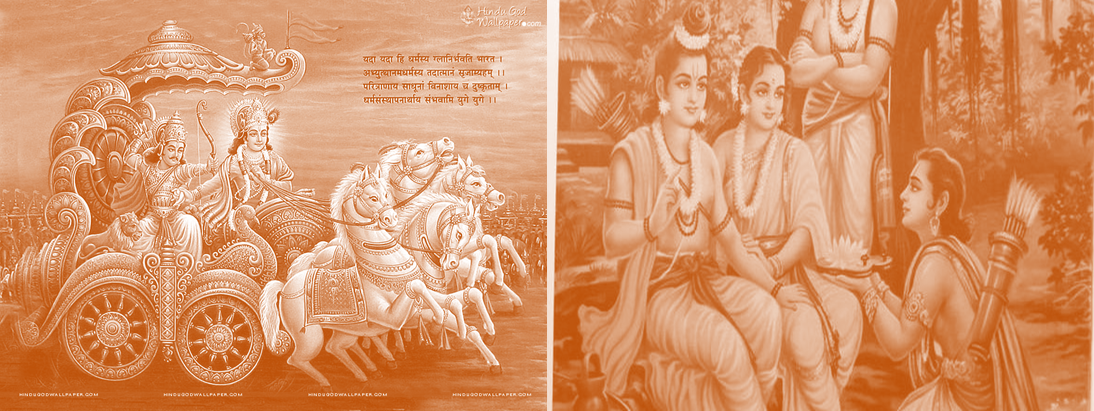
Similarly, after some more years, Vyasa had to segregate and compile Vedas – means at the time of Valmiki, Vedas were still a large mass of ideas and thoughts and are still evolving. Apart from the segregation, Vyasa had also authored Mahabharata, the other greatest epic produced in India. And Mahabharata essentially deals with the administration, politics, envy between brothers. The Kuru clan of Kings have contribution from various persons belonging to various castes, another case that caste had no significance, except it denotes ones duty, job or profession. The fact that the cattle herder Krishna could become king of Dwaraka and delivers Gita, shows Sanskrit was the language of masses and knowledge was not a Brahmin domain. (Rather, people of higher intellectuals might have been called Brahmins.)

The most notable factor in these two great Indian epics was that they deal with almost all predicaments that humans face in their daily life, irrespective of their social status. And, nowhere in the original texts, both Rama and Krishna were regarded as Gods, but good and better human beings, who were ideal figures worth emulating by lesser beings.

Have the authors Valmiki and Vyasa achieved their objectives? Yes, and one can say, more than they expected. They created these epics with such superior excellence, they overshadowed the original scriptures and became representing the ancient knowledge. However, they failed in the main objective – that of keeping the future generations following the older ways of living. This was evident from the way Caste dominated the later generations, and preventing access to education to many sections of the society and transforming an inclusive society into one that had many un-equal segments.

Still, those custodians have failed to restrict commoners from accessing Ramayana and Mahabharata, perhaps considering these are for the people with lesser intellect. But, the penetration of Ramayana and Mahabharata to all corners of the country proved them wrong. These two stories have not only expanded their reach, but with the creativity of the next generation scholars, they changed with times and locale, with various additions to them.

The fact that many folk tales that arise out of these two Indian epics do not find any mention in the original scripts show the flexibility the societies at various periods of time have allowed to the creative minds, rather than asking them to stick to the original versions.

Both Ramayana and Mahabharata have withstood the test of time, even while Vedas have disappeared and Sanskrit was marginalised. The evolution of epics into mythology was almost synonymous with the evolution of Indian nation that had transformed from a mono-linguistic culture to the house of many languages and cultures; and these Indian epics became the treads that stitched various societies and cultures together.
 

Tags: EpicIndiaMahabharataRamayanaUpanishadesVedas
Share17TweetSend
Previous Post

Anti-BJP United Front: The League of extraordinary thugs

Next Post

Kiku Sharda: Victim, Not Perpetrator

Related Posts

Talom Rukbo Initiated the Donyi–Polo Movement: Bringing Tribal Youth Back to Their Roots
Culture

Talom Rukbo: The Forgotten Hero Who Shielded Arunachal’s Tribal Communities from Religious Conversion

1 December 2025

There are some national heroes whose contributions history has consistently failed to acknowledge. Talom Rukbo of Arunachal Pradesh was...

“Historic Ramlila Maidan in Delhi Under Siege: Mosque Encroachment Threatens Public Space”
Culture

“Historic Ramlila Maidan in Delhi Under Siege: Mosque Encroachment Threatens Public Space”

27 October 2025

It is a disturbing sight: one of New Delhi’s most emblematic public grounds, the vast expanse of Ramlila Maidan,...

How Chhath Puja Connects From Karna to King Priyavrata: A Festival Rooted in Sanatan Dharma and Gratitude
Culture

How Chhath Puja Connects From Karna to King Priyavrata: A Festival Rooted in Sanatan Dharma and Gratitude

25 October 2025

Chhath Puja, one of the most ancient and spiritually profound festivals of Sanatan Dharma, will be celebrated this year...

Load More

Leave a Reply Cancel reply

Your email address will not be published. Required fields are marked *

I agree to the Terms of use and Privacy Policy.
This site is protected by reCAPTCHA and the Google Privacy Policy and Terms of Service apply.

Currently Playing

A War Won From Above: The Air Campaign That Changed South Asia Forever

A War Won From Above: The Air Campaign That Changed South Asia Forever

00:07:37

‘Mad Dog’ The EX CIA Who Took Down Pakistan’s A.Q. Khan Nuclear Mafia Reveals Shocking Details

00:06:59

Dhurandar: When a Film’s Reality Shakes the Left’s Comfortable Myths

00:06:56

Tejas Under Fire — The Truth Behind the Crash, the Propaganda, and the Facts

00:07:45

Why Rahul Gandhi’s US Outreach Directs to a Web of Shadow Controversial Islamist Networks?

00:08:04
Facebook Twitter Instagram Youtube
tfipostTfipost.com
Right Wing | News Analysis | Indian Opinion
  • About us
  • Contact Us
  • Careers
  • Brand Partnerships
  • Terms of use
  • Privacy Policy
  • Sitemap

©2025 TFI Media Private Limited

No Result
View All Result
  • Premium
  • Politics
    • Analysis
    • Opinions
    • Trending
  • Economy
    • Business
    • Finance
  • Defense
    • Defence
    • Strategy
    • Weaponry
  • Geopolitics
    • Africa
    • Americas
    • Asia Pacific
    • Europe
    • South Asia
    • West Asia
  • Knowledge
    • Culture
    • History
    • Indology
  • Law
  • Lounge
    • Books
    • Cinema
    • Food
    • Health
    • Sports
    • technology
    • Travel
    • Satire
TFIPOST हिन्दी
TFIPOST Global

©2025 TFI Media Private Limited