














TFIPOST हिन्दी
TFIPOST Global
Tfipost.com
Tfipost.com
No Result
View All Result
  • Premium
  • Politics
    • All
    • Analysis
    • Opinions
    • Trending
    New address, old controversy as “Sheesh Mahal 2”

    From Flagstaff Road To Lodhi Estate: Kejriwal’s New Bungalow Triggers Fresh “Sheesh Mahal 2” Political Controversy

    The Bengal campaign takes a more aggressive turn.

    “Bengal Under Mafia Grip”: Yogi Adityanath Escalates Attack On TMC, Flags ‘Identity Crisis’ In Rally

    From AAP dissenter to BJP rebel, Swati Maliwal sharpens her attack on Kejriwal

    Did Swati Maliwal Just Puncture AAP’s Politics of Virtue?

    Ahmadis in Pakistan: From Faith to Marginalisation Under Law and Society

    Ahmadis in Pakistan: From Faith to Marginalisation Under Law and Society

    • Analysis
    • Opinions
    • Trending
  • Economy
    • All
    • Business
    • Economy1
    • Finance
    Ahmadis in Pakistan: From Faith to Marginalisation Under Law and Society

    Ahmadis in Pakistan: From Faith to Marginalisation Under Law and Society

    Open Demat Account with Zero Annual Maintenance Charges What to Look For

    Open Demat Account with Zero Annual Maintenance Charges What to Look For

    Blood in the Meadows: How the Pahalgam Terror Attack Exposed Calculated Targeting of Civilians in Kashmir

    Blood in the Meadows: How the Pahalgam Terror Attack Exposed Calculated Targeting of Civilians in Kashmir

    Indian economy is stronger than the ranking.

    IMF Ranking Jolt Misread: India’s Economy Strong, Sixth Spot Just a Statistical Glitch

    • Business
    • Finance
  • Defense
    • All
    • Defence
    • Strategy
    • Weaponry
    The scars of Pahalgam endure, even as the nation moves forward

    Pahalgam Anniversary: Modi Signals Firm National Stand as India Reasserts Anti-Terror Resolve

    Precision Strike: Indian Army Approves Procurement of Indigenous MPATGM to Modernise Infantry Wings

    Precision Strike: Indian Army Approves Procurement of Indigenous MPATGM to Modernise Infantry Wings

    Amit Shah on sensitive Gorkha land issue

    Shah Assures Constitutional Path for Gorkha Issue, Intensifies Attack on TMC at Bengal Rally

    Historic Leap for ‘Aatmanirbhar Bharat’ as First India-Made BrahMos Missiles from Lucknow Join Indian Army

    Historic Leap for ‘Aatmanirbhar Bharat’ as First India-Made BrahMos Missiles from Lucknow Join Indian Army

    • Defence
    • Strategy
    • Weaponry
  • Geopolitics
    • All
    • Africa
    • Americas
    • Asia Pacific
    • Europe
    • South Asia
    • West Asia
    Pakistan Tried to Bury an NYT Report. It Only Exposed Asim Munir’s Panic

    Pakistan Tried to Bury an NYT Report. It Only Exposed Asim Munir’s Panic

    The Strategic Double-Game: Pakistan’s Fatal Gambit in the US-Iran War

    The Strategic Double-Game: Pakistan’s Fatal Gambit in the US-Iran War

    When a repost became a foreign policy problem

    Trump’s India ‘Hellhole’ Insult Triggers Backlash as New Delhi Hits Back, US Scrambles for Damage Control

    PLA Navy Day Spectacle vs South China Sea Reality: How Beijing’s Naval Pageantry Masks Maritime Coercion

    PLA Navy Day Spectacle vs South China Sea Reality: How Beijing’s Naval Pageantry Masks Maritime Coercion

    • Africa
    • Americas
    • Asia Pacific
    • Europe
    • South Asia
    • West Asia
  • Knowledge
    • All
    • Culture
    • Education
    • History
    • Indology
    Chants of ‘Jai Badri Vishal’ Echo as Badrinath Portals Open; All Four Dhams Now Accessible to Pilgrims

    Chants of ‘Jai Badri Vishal’ Echo as Badrinath Portals Open; All Four Dhams Now Accessible to Pilgrims

    Kedarnath Dham Portals Open for Devotees After 181 Days Amid Vedic Chants, Traditional Rituals

    Kedarnath Dham Portals Open for Devotees After 181 Days Amid Vedic Chants, Traditional Rituals

    Sardar Patel and Amit Shah

    Sardar Patel’s 1947 Blueprint on Minority Quotas Resurfaces as Reservation Debate Returns to Centre Stage

    The 1973 Constitution and ‘Bhutto’ the Man Who Made It: What Pakistan Owes and What It Destroyed

    The 1973 Constitution and ‘Bhutto’ the Man Who Made It: What Pakistan Owes and What It Destroyed

    • Culture
    • History
    • Indology
  • Law
  • Lounge
    • All
    • Books
    • Cinema
    • Entertainment
    • Food
    • Games
    • Health
    • Lifestyle
    • Satire
    • Sports
    • technology
    • Travel
    Digital Data Collection In India

    India’s Data Reset Begins: Census 2027 to Become First Fully Digital Population Count

    5 Facilities in Bengaluru Specializing in Mental Health Treatment for Those with Cancer

    5 Facilities in Bengaluru Specializing in Mental Health Treatment for Those with Cancer

    UNESCO World Book Day and Copyright Day

    World Book Day 2026: UNESCO’s Multilingual Push Aligns with India’s Deep Literary Continuum

    Fashion Fusion Accessory Pairings That Modernize Your Look

    Fashion Fusion Accessory Pairings That Modernize Your Look

    • Books
    • Cinema
    • Food
    • Health
    • Sports
    • technology
    • Travel
    • Satire
Tfipost.com
  • Premium
  • Politics
    • All
    • Analysis
    • Opinions
    • Trending
    New address, old controversy as “Sheesh Mahal 2”

    From Flagstaff Road To Lodhi Estate: Kejriwal’s New Bungalow Triggers Fresh “Sheesh Mahal 2” Political Controversy

    The Bengal campaign takes a more aggressive turn.

    “Bengal Under Mafia Grip”: Yogi Adityanath Escalates Attack On TMC, Flags ‘Identity Crisis’ In Rally

    From AAP dissenter to BJP rebel, Swati Maliwal sharpens her attack on Kejriwal

    Did Swati Maliwal Just Puncture AAP’s Politics of Virtue?

    Ahmadis in Pakistan: From Faith to Marginalisation Under Law and Society

    Ahmadis in Pakistan: From Faith to Marginalisation Under Law and Society

    • Analysis
    • Opinions
    • Trending
  • Economy
    • All
    • Business
    • Economy1
    • Finance
    Ahmadis in Pakistan: From Faith to Marginalisation Under Law and Society

    Ahmadis in Pakistan: From Faith to Marginalisation Under Law and Society

    Open Demat Account with Zero Annual Maintenance Charges What to Look For

    Open Demat Account with Zero Annual Maintenance Charges What to Look For

    Blood in the Meadows: How the Pahalgam Terror Attack Exposed Calculated Targeting of Civilians in Kashmir

    Blood in the Meadows: How the Pahalgam Terror Attack Exposed Calculated Targeting of Civilians in Kashmir

    Indian economy is stronger than the ranking.

    IMF Ranking Jolt Misread: India’s Economy Strong, Sixth Spot Just a Statistical Glitch

    • Business
    • Finance
  • Defense
    • All
    • Defence
    • Strategy
    • Weaponry
    The scars of Pahalgam endure, even as the nation moves forward

    Pahalgam Anniversary: Modi Signals Firm National Stand as India Reasserts Anti-Terror Resolve

    Precision Strike: Indian Army Approves Procurement of Indigenous MPATGM to Modernise Infantry Wings

    Precision Strike: Indian Army Approves Procurement of Indigenous MPATGM to Modernise Infantry Wings

    Amit Shah on sensitive Gorkha land issue

    Shah Assures Constitutional Path for Gorkha Issue, Intensifies Attack on TMC at Bengal Rally

    Historic Leap for ‘Aatmanirbhar Bharat’ as First India-Made BrahMos Missiles from Lucknow Join Indian Army

    Historic Leap for ‘Aatmanirbhar Bharat’ as First India-Made BrahMos Missiles from Lucknow Join Indian Army

    • Defence
    • Strategy
    • Weaponry
  • Geopolitics
    • All
    • Africa
    • Americas
    • Asia Pacific
    • Europe
    • South Asia
    • West Asia
    Pakistan Tried to Bury an NYT Report. It Only Exposed Asim Munir’s Panic

    Pakistan Tried to Bury an NYT Report. It Only Exposed Asim Munir’s Panic

    The Strategic Double-Game: Pakistan’s Fatal Gambit in the US-Iran War

    The Strategic Double-Game: Pakistan’s Fatal Gambit in the US-Iran War

    When a repost became a foreign policy problem

    Trump’s India ‘Hellhole’ Insult Triggers Backlash as New Delhi Hits Back, US Scrambles for Damage Control

    PLA Navy Day Spectacle vs South China Sea Reality: How Beijing’s Naval Pageantry Masks Maritime Coercion

    PLA Navy Day Spectacle vs South China Sea Reality: How Beijing’s Naval Pageantry Masks Maritime Coercion

    • Africa
    • Americas
    • Asia Pacific
    • Europe
    • South Asia
    • West Asia
  • Knowledge
    • All
    • Culture
    • Education
    • History
    • Indology
    Chants of ‘Jai Badri Vishal’ Echo as Badrinath Portals Open; All Four Dhams Now Accessible to Pilgrims

    Chants of ‘Jai Badri Vishal’ Echo as Badrinath Portals Open; All Four Dhams Now Accessible to Pilgrims

    Kedarnath Dham Portals Open for Devotees After 181 Days Amid Vedic Chants, Traditional Rituals

    Kedarnath Dham Portals Open for Devotees After 181 Days Amid Vedic Chants, Traditional Rituals

    Sardar Patel and Amit Shah

    Sardar Patel’s 1947 Blueprint on Minority Quotas Resurfaces as Reservation Debate Returns to Centre Stage

    The 1973 Constitution and ‘Bhutto’ the Man Who Made It: What Pakistan Owes and What It Destroyed

    The 1973 Constitution and ‘Bhutto’ the Man Who Made It: What Pakistan Owes and What It Destroyed

    • Culture
    • History
    • Indology
  • Law
  • Lounge
    • All
    • Books
    • Cinema
    • Entertainment
    • Food
    • Games
    • Health
    • Lifestyle
    • Satire
    • Sports
    • technology
    • Travel
    Digital Data Collection In India

    India’s Data Reset Begins: Census 2027 to Become First Fully Digital Population Count

    5 Facilities in Bengaluru Specializing in Mental Health Treatment for Those with Cancer

    5 Facilities in Bengaluru Specializing in Mental Health Treatment for Those with Cancer

    UNESCO World Book Day and Copyright Day

    World Book Day 2026: UNESCO’s Multilingual Push Aligns with India’s Deep Literary Continuum

    Fashion Fusion Accessory Pairings That Modernize Your Look

    Fashion Fusion Accessory Pairings That Modernize Your Look

    • Books
    • Cinema
    • Food
    • Health
    • Sports
    • technology
    • Travel
    • Satire
No Result
View All Result
Tfipost.com
Tfipost.com
No Result
View All Result
  • Premium
  • Politics
  • Economy
  • Defense
  • Geopolitics
  • Knowledge
  • Law
  • Lounge

Indian Epics Ramayana and Mahabharata survived the test of time, while most of ancient Indian literature couldn’t

Kannan by Kannan
14 January 2016
in Culture
Indian Epics
Share on FacebookShare on X

It is said that Vedas were the oldest scriptures that belong to the ancient Indians. Though the Vedas were attributed to the God, this compilation of knowledge that consists of rituals, sacrifices and music must have been done by some human. In all probability, these might have been evolved continuously, from generation to generation, till one has decided to write them.

Vedas were passed on to the next generation orally, and not through documentation. But, why oral transfer of knowledge? And what prevented them to write and communicate to others – or to preserve for next generations?

RelatedPosts

Trump’s India ‘Hellhole’ Insult Triggers Backlash as New Delhi Hits Back, US Scrambles for Damage Control

World Book Day 2026: UNESCO’s Multilingual Push Aligns with India’s Deep Literary Continuum

Kedarnath Dham Portals Open for Devotees After 181 Days Amid Vedic Chants, Traditional Rituals

Load More

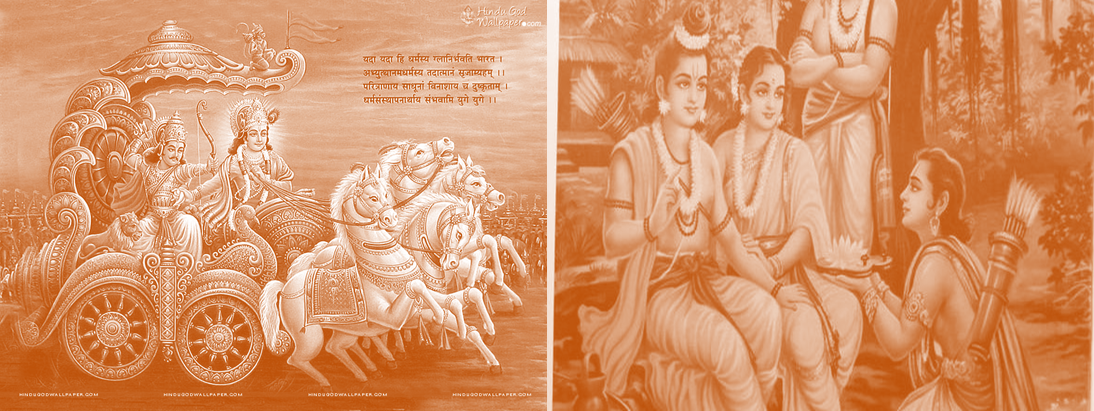
The first known piece that was written was ‘Ramayana’ by Valmiki. The epic was called Aadi Kavyam and Valmiki was hailed as Aadi Kavi. But, given the vocabulary and grammar Valmiki had used in Ramayana, it is certain that the Devnagari script and Chhandas was already in usage for some hundreds of years. Still, no one had thought of writing something before Valmiki. Or probably, they might have penned the Vedas and Upanishads, but did not consider them as solely the creation of one person, as they were passed on by their forefathers. Even if someone might have written poems and stories and novellas (Kavyas), the size and scope of Ramayana might have surprised them and Valmiki was honoured with the title.

Given the story of Valmiki being a hunter in the forest before taking up writing, even after throwing away the mythical portion, it can be safely concluded that there existed good centres of learning that could teach a hunter the language to such an extent, he ends up writing Ramayana.

Then came Mahabharata, written by the sage Vyasa, who had to his credit had segregated and compiled all Vedas into the four ones that we know them as of now.

Then time has passed and the people, who had created the oldest civilization in the Indian sub-continent have perished.

One surprising thing in this entire episode was, while Vedas were marginalized with the passage of time, Indian Epics have grown manifold and evolved with time. The heroes of Indian epics, who were humans in the original texts have morphed into deities to the later generations.

With time, Vedas and Sanskrit were limited to only a small section of Brahmins. But, Ramayana and Mahabharata cut across the caste lines and became synonymous with the concept of India that encompassed all smaller kingdoms, spreading from the North West corners of Kandahar to the south east island of Sri Lanka. The fact that a Kshatriya Rama killed Ravana, a Brahmin and the Mahabharata with many intercaste marriages and marriages of connivance, have clearly establish the fact that though castes exist even in those days, they were not in the same discriminatory manner they are now.

Why then Indian Epics were written in the first place, when the people could comprehend the puritanical versions of the knowledge – the Vedas and the Upanishads? They could have simply documented Vedas and Upanishads, if they want to preserve the knowledge for future generations. Post Ramayana and Mahabharata, there were innumerous stories such as Bhagavata, Devi Bhagavata and other Puranas thus essentially creating a corpus of Indian mythology. Purpose of these later writings was clear – to establish divinity to the characters of Ramayana, Mahabharata and those mentioned in the Vedas and Upanishads.

From the critic’s point of view, Gods of Vedic times were the basic forms of the nature and the Brahman, the creator who was omnipresent. The people who founded so excellent a culture from nothing must have endured hardships over hundreds of years, if not few thousands. It must have been a great team that could debate, analyze, decipher and define the ways of universe and tries to explain some fundamental of science. The team would need a great commitment from each member so that the final product could be so magnificent. By attributing the work to the God, they eliminated the selfish desire of individuals to get the credit for such work, or to their part. But, it takes more than the name of God to prevent the team members from claiming credit and it could be the hardships they must have experienced in those days that enlightens their souls to such an extent, they attain Nirvana.

But, the cycle of nature was the most powerful. If it could wipe out dinosaurs, what are men before the power of the nature? And, nature means not only the calamities, but changing values in society that are intrinsic to it. With prosperity, comes lethargy and selfishness. Love of ones kids do prevent them from fulfilling the responsibilities, taking unbiased decisions. Then, things change. And when everything is fine, attitude becomes a bit careless and open to new ideas. Often new ideas bring good, when the mind was a free one, but results in the opposite, when the mind was reckless.

No doubt, a society that could create such a knowledge corpus must have been a democratic one, despite there be a King. In democracy, the majority wins, even when it is wrong. Probably the loosing minority must have thought to preserve the knowledge for the sake of future generations, who may be needing it as much as their ancestors did. In all their wisdom they must have envisaged the future generations of an irresponsible society would pay for the deeds of their fathers. That might have caused to document the Vedas and Upanishads. Knowing fear and overcoming it is courage and it needs wisdom to deal with the eternal fear. Taking life for granted is not courage but the absence of it, as it was not tested against the real fear of life.

Even this explanation is not sufficient for the birth of Indian epics. After getting exposed to the civilization, Valmiki might have had an independent assessment of the society and its on-going denigration. Sometimes, only external eyes could see what is not visible for those part of the system. And as always people alien to the culture are bonded to the adapted culture, rather than those, who born into such a system and take it for granted. Even now, this could be seen from the way the west embraces Indian philosophies and how people adapted foreign faiths safeguard their current faith. Understanding the true value of the culture and its doctrines, Valmiki might have thought the need of a text like Ramayana to induce interest in the coming generations to pursue the greater “way of living” (religion was not known at that time). Probably, he realised the primitive needs of a human being, who could be essentially an animal. And at the same time, he must have understood the ego that can ruin even those with higher level of knowledge, but could not control their senses and give in to the physical needs.

And, why he chose to write a story instead of writing a monograph? The answer is self-evident. Lots of monographs are already available in the form of Vedas. However, the answer to this question was provided millennia later, when Panchatantra was written. Panchatantra was a story that was created so that foolish princes of a King could understand the intricacies of the way the world functions. Stories have a factor of creating interest in the minds of readers and are easy to understand, even to those who are otherwise not inclined to read.

Given the geographical evidences, in all probability Valmiki might have selected one story from the history and created the epic with lots of grandeur and opulence. The way Valmiki narrated Ramayana – the story of a normal prince, who took the help of primitive beings and fell the mightiest warrior, who also happen to be the most knowledgeable King. The reason Sundara Kandam was recommended to be read is the same – it describes the Swarna Lanka, the city of Ravana that was beautiful and rich, but was inhabited by people, who don’t deserve it. Ravana was only the symbolic ruler of such masses.

Similarly, after some more years, Vyasa had to segregate and compile Vedas – means at the time of Valmiki, Vedas were still a large mass of ideas and thoughts and are still evolving. Apart from the segregation, Vyasa had also authored Mahabharata, the other greatest epic produced in India. And Mahabharata essentially deals with the administration, politics, envy between brothers. The Kuru clan of Kings have contribution from various persons belonging to various castes, another case that caste had no significance, except it denotes ones duty, job or profession. The fact that the cattle herder Krishna could become king of Dwaraka and delivers Gita, shows Sanskrit was the language of masses and knowledge was not a Brahmin domain. (Rather, people of higher intellectuals might have been called Brahmins.)

The most notable factor in these two great Indian epics was that they deal with almost all predicaments that humans face in their daily life, irrespective of their social status. And, nowhere in the original texts, both Rama and Krishna were regarded as Gods, but good and better human beings, who were ideal figures worth emulating by lesser beings.

Have the authors Valmiki and Vyasa achieved their objectives? Yes, and one can say, more than they expected. They created these epics with such superior excellence, they overshadowed the original scriptures and became representing the ancient knowledge. However, they failed in the main objective – that of keeping the future generations following the older ways of living. This was evident from the way Caste dominated the later generations, and preventing access to education to many sections of the society and transforming an inclusive society into one that had many un-equal segments.

Still, those custodians have failed to restrict commoners from accessing Ramayana and Mahabharata, perhaps considering these are for the people with lesser intellect. But, the penetration of Ramayana and Mahabharata to all corners of the country proved them wrong. These two stories have not only expanded their reach, but with the creativity of the next generation scholars, they changed with times and locale, with various additions to them.

The fact that many folk tales that arise out of these two Indian epics do not find any mention in the original scripts show the flexibility the societies at various periods of time have allowed to the creative minds, rather than asking them to stick to the original versions.

Both Ramayana and Mahabharata have withstood the test of time, even while Vedas have disappeared and Sanskrit was marginalised. The evolution of epics into mythology was almost synonymous with the evolution of Indian nation that had transformed from a mono-linguistic culture to the house of many languages and cultures; and these Indian epics became the treads that stitched various societies and cultures together.
 

Tags: EpicIndiaMahabharataRamayanaUpanishadesVedas
Share17TweetSend
Previous Post

Anti-BJP United Front: The League of extraordinary thugs

Next Post

Kiku Sharda: Victim, Not Perpetrator

Related Posts

Chants of ‘Jai Badri Vishal’ Echo as Badrinath Portals Open; All Four Dhams Now Accessible to Pilgrims
Culture

Chants of ‘Jai Badri Vishal’ Echo as Badrinath Portals Open; All Four Dhams Now Accessible to Pilgrims

23 April 2026

The air in the high Himalayas resonated with the sound of Vedic chants and the blowing of conch shells...

Kedarnath Dham Portals Open for Devotees After 181 Days Amid Vedic Chants, Traditional Rituals
Culture

Kedarnath Dham Portals Open for Devotees After 181 Days Amid Vedic Chants, Traditional Rituals

22 April 2026

The grand reopening of the Kedarnath Dham on April 22, 2026, marks a pivotal moment in India’s spiritual calendar,...

From Devotion to Divine Strength: Celebrating Lord Hanuman, Eternal Symbol of Courage, Humility
Culture

From Devotion to Divine Strength: Celebrating Lord Hanuman, Eternal Symbol of Courage, Humility

2 April 2026

  “When the battlefield of Lanka fell into anxious silence and Lakshmana lay gravely wounded, it was Lord Hanuman...

Load More

Leave a Reply Cancel reply

Your email address will not be published. Required fields are marked *

I agree to the Terms of use and Privacy Policy.
This site is protected by reCAPTCHA and the Google Privacy Policy and Terms of Service apply.

Currently Playing

From Runways to Warships: India’s Firefighting Warrior Built for Bases & Battles| IAF | VayuShakti

From Runways to Warships: India’s Firefighting Warrior Built for Bases & Battles| IAF | VayuShakti

00:05:40

Ethanol, EVs and Solar- How India’s Energy Game Is Changing | Modi on LPG & Crude Oil | war| Hormuz

00:05:21

Truth of IRIS Dena: 8 Days That Changed Narrative | War zone Reality, Not an Indian Navy Exercise

00:08:02

300 Million Euros for SCALP: Strategic Necessity or Costly Dependency on France300

00:04:06

Tejas Mk1A: 19th aircraft coupled but Not Delivered: What Is Holding Back the IAF Induction?

00:07:21
Facebook Twitter Instagram Youtube
tfipostTfipost.com
Right Wing | News Analysis | Indian Opinion
  • About us
  • Contact Us
  • Careers
  • Brand Partnerships
  • Terms of use
  • Privacy Policy
  • Sitemap

©2026 TFI Media Private Limited

No Result
View All Result
  • Premium
  • Politics
    • Analysis
    • Opinions
    • Trending
  • Economy
    • Business
    • Finance
  • Defense
    • Defence
    • Strategy
    • Weaponry
  • Geopolitics
    • Africa
    • Americas
    • Asia Pacific
    • Europe
    • South Asia
    • West Asia
  • Knowledge
    • Culture
    • History
    • Indology
  • Law
  • Lounge
    • Books
    • Cinema
    • Food
    • Health
    • Sports
    • technology
    • Travel
    • Satire
TFIPOST हिन्दी
TFIPOST Global

©2026 TFI Media Private Limited