
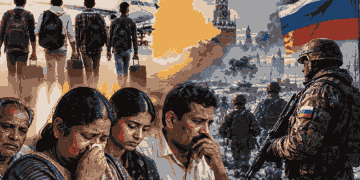

















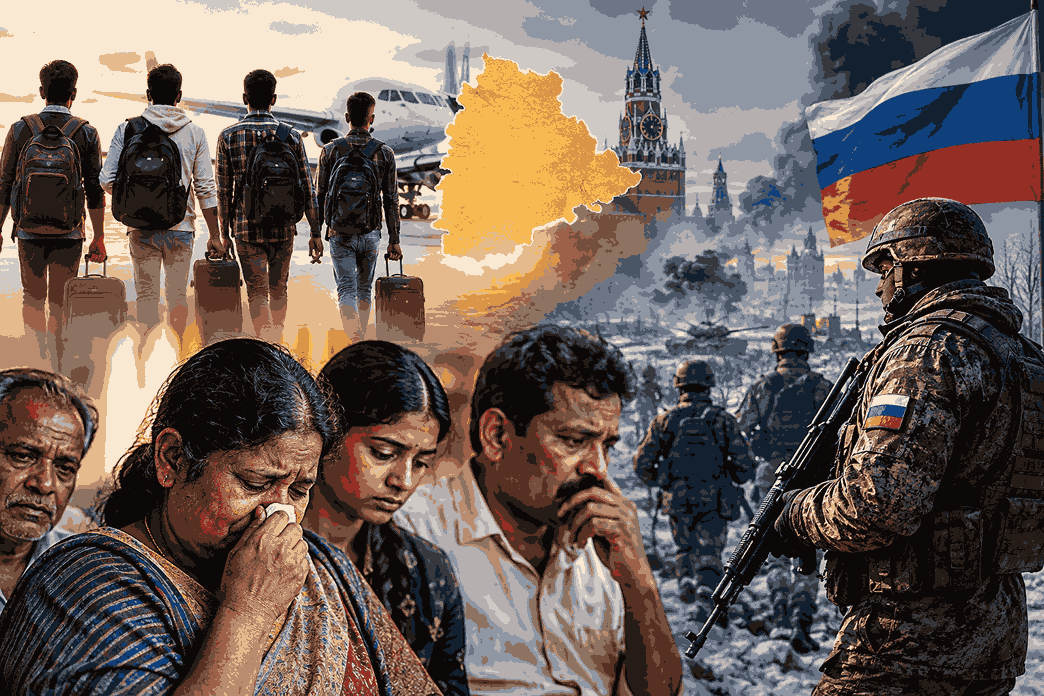
Four men from Telangana who travelled to Russia in search of civilian employment are now allegedly stranded after being drawn into Russian military service, according to their families. The families have approached authorities seeking urgent intervention to establish the men’s whereabouts, secure their release and facilitate their safe return to India.
The four men have been identified as Bhookya Ravinder, 44, Sirshu Ashok, 44, Megavath Prakash, 40, and Mohammed Afzal Khan, 43. They hail from areas in the erstwhile Nizamabad region and Kamareddy district. Their relatives say the men left India after being promised civilian jobs in Russia, but their circumstances changed dramatically after they arrived.
According to the families, the men were initially offered employment such as general helpers, mechanical helpers, gardening workers or jobs connected with the oil industry. One recruitment advertisement reportedly offered a monthly salary of about $477, along with food and other facilities. The families have alleged that the men ultimately found themselves without the promised employment and were subsequently directed towards military-related work.
The case came to the attention of the Telangana government after the families approached the CM Pravasi Prajavani grievance-redressal programme in Hyderabad on September 29. Officials who received the representation reportedly directed the state’s NRI wing to coordinate with the Ministry of External Affairs and the Indian Embassy in Moscow. The families have requested that authorities verify the men’s precise location and take steps for their repatriation.
The families have alleged that an agent, identified as Thelu Krishna from the Kamareddy region and reportedly operating from Russia, was involved in arranging employment. They claim the men were told that they would work in civilian or military-support roles and would not be required to participate in combat. Instead, according to their relatives, the men were taken to military facilities, trained in handling weapons and eventually moved towards areas connected to the Russia-Ukraine conflict. These allegations have not yet been independently established in full.
The families’ accounts have raised particular concern because the men reportedly have only limited access to communication. Mohammed Afzal Khan’s relatives said he had sent distress messages describing difficult conditions and seeking assistance. Other families have similarly reported receiving occasional messages or voice communications, intensifying fears about the men’s safety.
For the families in Telangana, the ordeal has also brought severe financial and emotional pressure. Reports indicate that the men or their families paid substantial sums to intermediaries for overseas employment arrangements. Some relatives have said they borrowed money or relied on savings in the expectation that the promised jobs would provide a stable income.
The allegations also highlight the risks faced by Indian workers seeking employment abroad through unverified intermediaries. Authorities have repeatedly advised prospective overseas workers to use registered recruitment agencies and official channels, particularly when employment offers involve unusual visa arrangements or promises of exceptionally attractive benefits.
In this case, the families are asking Telangana authorities to work with the central government and Indian diplomatic officials in Moscow to determine whether the men were lawfully recruited, how their employment status changed and under what circumstances they came to be associated with Russian military units. They have also sought action against intermediaries if wrongdoing is established.
The situation has attracted attention beyond Telangana because it comes amid wider concerns over Indians being recruited for work in Russia and subsequently becoming involved with military operations. The Ministry of External Affairs has previously dealt with cases involving Indian nationals who were recruited into the Russian armed forces, with diplomatic efforts focused on securing their discharge and return. Recent reporting has also documented other cases involving Indian workers who said they were deceived by employment offers.
For the four families, however, the immediate priority remains bringing their relatives home. They are seeking confirmation of the men’s locations, assurances about their safety and diplomatic intervention to secure their release. The families hope that coordination between the state government, the Ministry of External Affairs and the Indian Embassy in Moscow can produce a resolution before the men face further exposure to the conflict.
The allegations surrounding the four men also underline the importance of carefully verifying overseas job offers before travelling. For workers from Telangana and elsewhere, the episode serves as a reminder that recruitment advertisements and promises made by private agents can carry serious risks when they are not independently verified through authorised employment and immigration channels.
As the families await further information, their appeal remains focused on one immediate demand: that the four men be located, protected and brought safely back to India.