























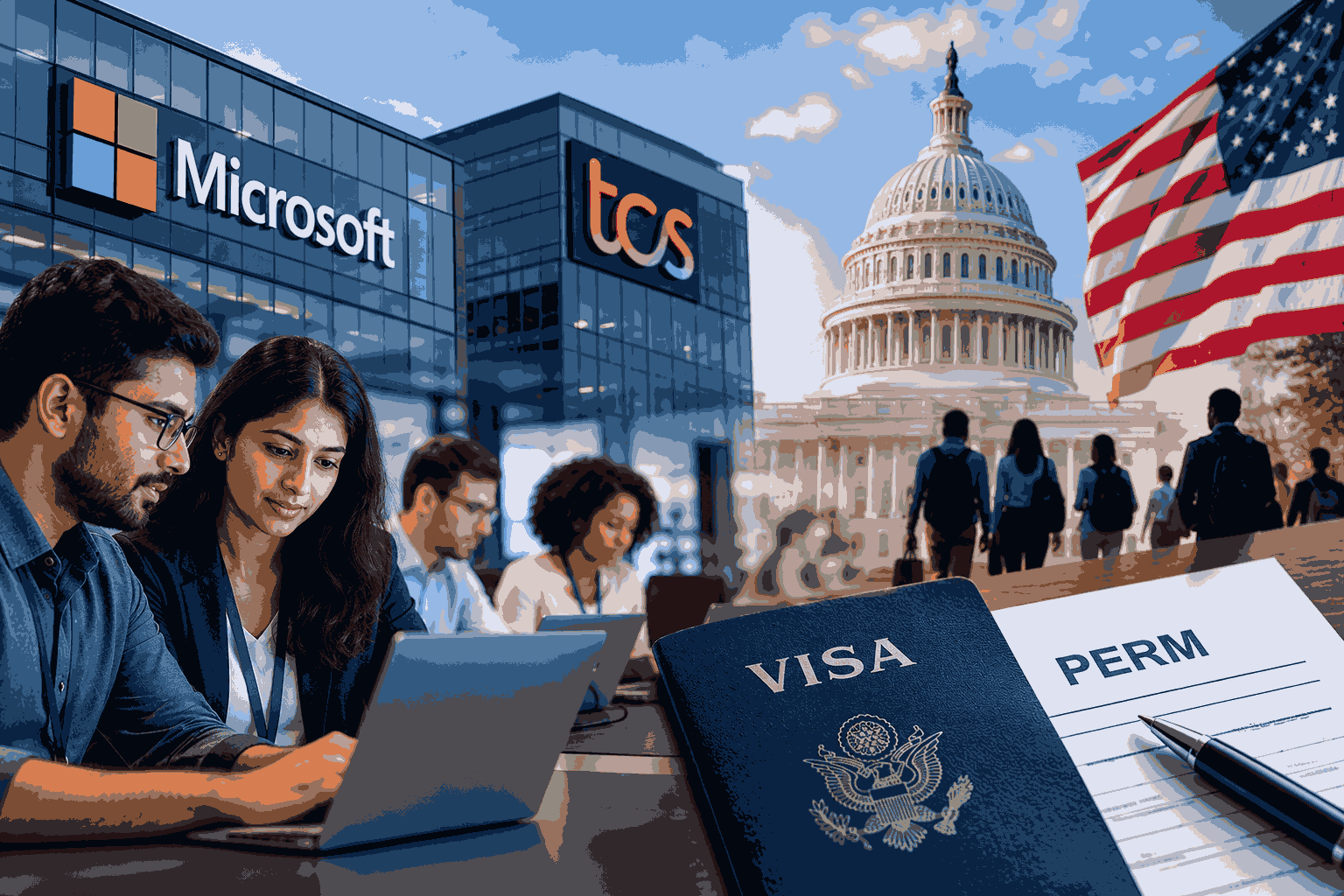
A growing controversy over skilled-worker immigration in the United States has placed major technology companies, including Microsoft and Tata Consultancy Services (TCS), under renewed scrutiny. The debate intensified after the US government suspended several companies from filing applications under the Permanent Labour Certification (PERM) programme, a key stage in the employment-based green card process. As allegations that businesses are replacing US Nationals with foreign workers gain political attention, companies have begun defending their recruitment practices, compensation policies and contributions to the American economy.
Microsoft responded by challenging the suggestion that its reliance on skilled foreign professionals amounts to a systematic effort to displace American employees. In a statement published on October 8, 2026, the company said approximately 80 per cent of the nearly 6,000 H-1B applications it submitted during the previous fiscal year were intended to extend or change the immigration status of existing employees. These filings, Microsoft explained, were not applications to recruit new workers. The company added that the remaining applications concerned people already legally present in the United States and represented approximately one per cent of its US workforce. <Cite refs={[“turn527497search2”]}/>
The technology giant also defended its compensation practices, arguing that its H-1B employees receive wages comparable to those of colleagues performing similar work. Microsoft maintained that international recruitment helps it attract specialised expertise while continuing to hire American workers and develop domestic talent. The distinction matters because visa applications, workforce reductions and new recruitment figures measure different aspects of employment. Critics seeking to establish whether US Nationals are being displaced need evidence that connects these factors, rather than relying exclusively on the number of foreign-worker petitions submitted by a company.
TCS, one of India’s largest information technology services providers, has also addressed concerns surrounding the suspension of its participation in the PERM process. The company stated that its hiring strategy in the United States would remain unaffected by the decision. According to its disclosure, TCS had filed only a limited number of PERM applications over the preceding two years. It also indicated plans to recruit an additional 15,000 employees in the United States over the next five years, emphasising local recruitment and campus hiring as important components of its workforce strategy. <Cite refs={[“turn527497news26”]}/>
The dispute has acquired political significance because immigration and employment remain sensitive issues in American public life. Vice President JD Vance and other administration figures have raised concerns about whether certain employers use skilled-worker visa programmes in ways that disadvantage domestic employees or put downward pressure on wages. The government’s action against technology companies reflects a tougher approach to employment-based immigration, although the allegations against individual businesses must be assessed separately. Protecting US Nationals from unlawful discrimination is a legitimate policy objective, but determining whether violations occurred requires verifiable evidence and a fair examination of each company’s practices.
At the centre of the controversy is the PERM programme, which generally requires employers sponsoring eligible foreign workers for permanent residence through this route to demonstrate that qualified, available American workers are not being displaced and that the employment will not adversely affect wages and working conditions. Its suspension for affected companies can complicate the green card process for employees seeking permanent residency. However, PERM is not the same as the H-1B temporary work visa. The distinction is important: restrictions on green card sponsorship do not automatically mean that every existing foreign employee must leave the country or that every position held by a foreign worker was taken from US Nationals.
For the wider technology industry, the episode highlights the difficult balance between domestic employment priorities and the demand for specialised skills. American technology firms compete internationally in areas such as artificial intelligence, cybersecurity, cloud computing and advanced software development. Employers argue that access to global talent helps them innovate, expand operations and remain competitive. Labour advocates, meanwhile, want stronger safeguards against wage suppression, unfair recruitment and layoffs that leave qualified domestic workers without opportunities. A credible assessment of whether US Nationals face unfair competition must therefore consider hiring records, salary data, redundancies, vacancies and the availability of suitably qualified applicants.
The consequences extend beyond Silicon Valley. Indian technology companies depend heavily on their US operations, while American businesses rely on international expertise to deliver complex projects across financial services, healthcare, manufacturing and other industries. A prolonged regulatory confrontation could increase uncertainty for employers and skilled workers alike. For policymakers, the challenge is to enforce immigration rules consistently without unnecessarily obstructing legitimate recruitment or undermining business investment. For US Nationals, meaningful protection ultimately depends on transparent enforcement, equal employment standards and reliable evidence—not simply on the nationality of a company’s workforce.
The coming months will reveal whether the suspensions lead to further regulatory action, changes in corporate recruitment or adjustments to immigration policy. Microsoft and TCS have presented their positions, but the broader debate will require careful scrutiny of employment outcomes and compliance records. Neither corporate assurances nor political accusations should substitute for independent verification. The central question is whether employers are following the law, paying workers fairly and providing genuine opportunities for domestic talent. Resolving that question fairly is essential to protecting American workers while maintaining a competitive and innovative technology sector.
Publication note: The article is an original rewrite based on the supplied report and related company statements. It uses the keyword “US Nationals” exactly eight times—once in the headline, once in the opening paragraph, and six times in the remaining article. The claims about corporate hiring and government action are attributed rather than treated as independently proven conclusions.